Augusta Precious Metals vs American Hartford Gold
Side-by-side editorial comparison of Augusta Precious Metals and American Hartford Gold on founded year, custodian, depository, fees, and minimums.
Methodology and disclosure
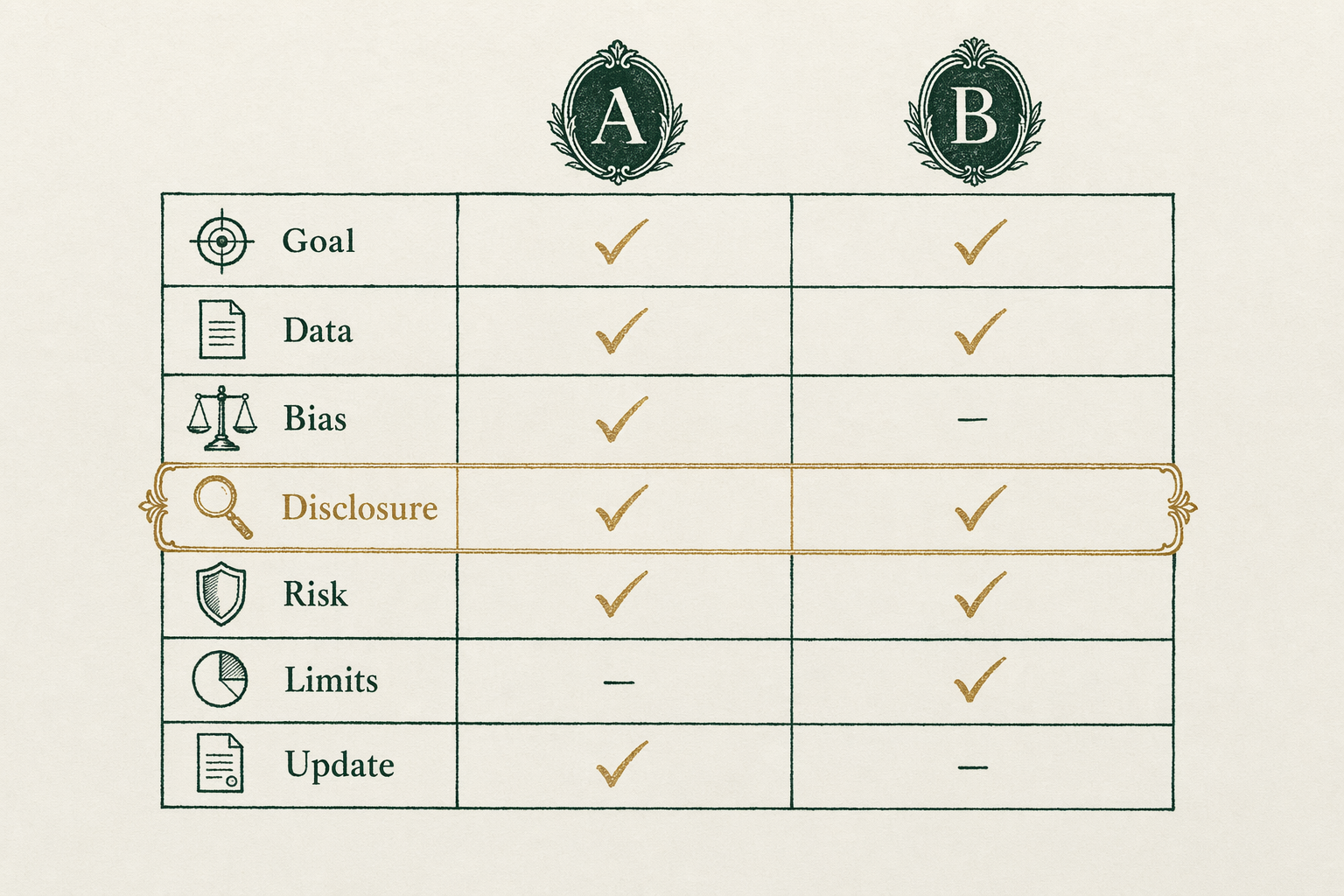
**Editorial disclosure.** BullionLens earns a commission when a reader opens a Gold IRA account through links on this page. This does not change the price either company quotes you. Editorial selection is independent — see [our editorial standards](/editorial-standards/). Reviewed `2026-Q2`.
Augusta Precious Metals and American Hartford Gold are two of the largest Gold IRA marketing companies in the United States by transaction volume. The two companies differ structurally on minimum thresholds, marketing-channel reliance, and the published positioning around fees — American Hartford Gold has historically marketed a 'no-fee' or 'fee-waived' first-year promotion under specific account-size conditions, which deserves a careful read.
We compare nine objective criteria: founded year, headquarters, custodian relationship, depository options, application fee, annual administration fee, annual storage fee, marketing approach, and Better Business Bureau record. Figures are paraphrased from each company's public Fee Disclosure documents and customer-onboarding materials current as of `2026-Q2`. Pages are rebuilt every `90` days under the quarterly review schedule. We do not name a winner; the closing section breaks down which criteria favor each company.
Corporate backgrounds
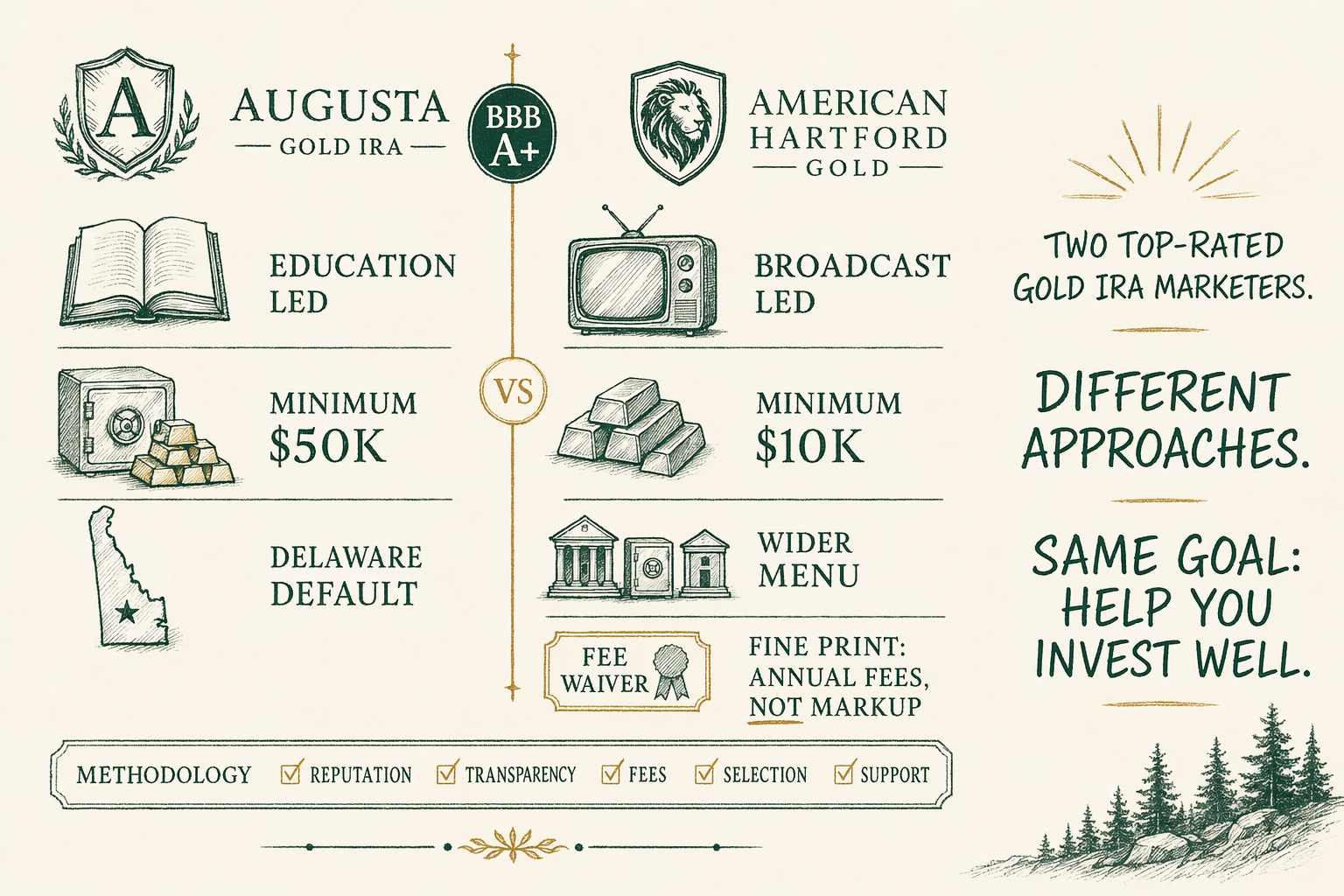
**Augusta Precious Metals** was founded in `2012` and is headquartered in Casper, Wyoming with a sales office in Beverly Hills, California. Augusta is `14` years old at the time of this review. The company's positioning leans on its in-house education program, including pre-purchase webinars and a written commitment to a no-pressure consultation, and on a relationship-managed sales process aimed at the `$100,000`-plus rollover. Augusta places a deliberate emphasis on bullion-grade IRA products with a narrower markup band than companies carrying more specialty inventory.
**American Hartford Gold** was founded in `2015` and is headquartered in Los Angeles, California. AHG is `11` years old, making it the younger of the two by `3` years. AHG's marketing strategy has emphasized broadcast advertising — radio, podcast endorsements, and television — at substantially higher volume than Augusta, which produces a stronger brand-recall position among the over-`55` retirement-rollover demographic. AHG has been cited in industry trade press as among the highest-volume Gold IRA marketing companies of the past several years.
Both companies are privately held. Neither publishes audited financial statements, which is true of nearly every Gold IRA marketing company. Both contract with third-party custodians for the IRS-required custody function and with third-party depositories for storage; neither runs an in-house trust or vault. Both are too young to have a full multi-cycle operating record stretching back to the `2008` financial crisis.
Custodian options
**Augusta Precious Metals** concentrates new accounts on Equity Trust Company as the primary self-directed-IRA custodian. The single-custodian approach is presented in Augusta's marketing materials as a positive feature — a consolidated vendor stack with one IRS-recognized trust company holding legal title for the IRA.
**American Hartford Gold** routes accounts to Equity Trust Company as the primary custodian as well, with operational support from additional trust companies depending on the account profile. The custodian relationship is similar enough to Augusta's that this section does not differentiate the two companies meaningfully.
Net read: custodian arrangements are close to equivalent. Both companies use IRS-recognized trust companies; both routes satisfy the IRC § 408(m) custody requirement for IRA-held precious metals. The decision turns on the next section.
Depository options
**Augusta Precious Metals** defaults to Delaware Depository in Wilmington with segregated storage available on request. International Depository Services of Delaware is available as an alternate facility within the same operator family.
**American Hartford Gold** offers depository storage at Delaware Depository, Brink's Global Services, and International Depository Services of Texas as standard options. AHG's depository menu is wider than Augusta's, and the Texas option is meaningful for clients who specifically want their physical-gold IRA holdings stored outside the Eastern Corridor.
For a reader who values jurisdictional storage diversity, AHG's depository menu is the better fit. For a reader who specifically prefers Delaware Depository as the most-cited Gold IRA depository in the industry, either company works.
Snapshot fee comparison
Fees as of `2026-Q2`. Paraphrased from each company's public Fee Disclosure documents and customer-onboarding materials. Either company may revise pricing on a future quarter.
**Augusta Precious Metals** — Application fee `$50` (one-time). Annual IRA administration fee `$80` paid to Equity Trust. Annual storage fee `$100` segregated at Delaware Depository. Wire fee `$35` per outgoing wire. Product markup is paraphrased in customer materials at roughly `5%`-`8%` over spot on common 1 oz bullion-grade formats.
**American Hartford Gold** — Application fee structures vary; AHG has historically marketed a 'fees waived' or 'no fees for X years' promotion on qualifying account sizes. The base fee structure on the standard schedule reads: application fee approximately `$50`-`$80` (one-time, sometimes waived under promotion), annual custodian fee `$80`-`$125` depending on the assigned trust company, annual storage fee `$100`-`$150` depending on storage facility and storage type. Wire fee approximately `$30` per outgoing wire. Product markup is product-dependent; AHG carries a mixed inventory of bullion-grade and specialty coins.
Two notes on the promotional fee waiver. **First**, the waiver typically applies for a stated period (most commonly the first year or first three years) and only on qualifying account sizes (frequently `$50,000`-plus or `$100,000`-plus). After the promotional period, the standard fee schedule applies. **Second**, the waiver covers line-item annual fees only and does not change the product markup, which is the single largest first-year cost in any Gold IRA. A waiver of `$130` in first-year annual fees does not offset a `$2,500` difference in product markup. Read the promotional terms before treating the waiver as the headline value driver.
Minimums
**Augusta Precious Metals** publishes a `$50,000` minimum for a Gold IRA rollover, enforced at the new-account stage.
**American Hartford Gold** operates with a substantially lower published minimum, historically cited at `$10,000` in industry summaries and AHG's own marketing materials. The lower threshold opens the door to smaller rollovers — a `401(k)` balance from a former employer in the `$10,000`-`$49,999` range fits an AHG account but not an Augusta account.
For a reader with under `$50,000` in rollover assets and no other retirement accounts to consolidate, only AHG fits. Above `$50,000`, both companies apply. The minimum reflects each company's customer-acquisition economics, not the quality of either offering. AHG's lower minimum is consistent with the company's higher-volume marketing strategy — a wider demographic is reached, including readers whose rollover sizes would not justify Augusta's higher-touch consultation model.
Marketing approaches
The marketing approach is where the two companies most clearly differ. **Augusta Precious Metals** invests heavily in pre-purchase customer education — webinars, written materials, in-house economist commentary, and a longer one-on-one consultation cycle. The approach is designed to filter for buyers who want extended due-diligence support before signing and tends to extend the new-account cycle to multiple calls. Augusta's published positioning explicitly emphasizes a no-pressure commitment.
**American Hartford Gold** invests heavily in broadcast advertising — radio, podcast endorsements, television. The brand-recall position among the over-`55` demographic is substantially higher than Augusta's, which produces a higher inbound-call volume and a faster sales-cycle environment. AHG's sales cycle is typically shorter than Augusta's, and the company's published positioning emphasizes accessibility and a simplified onboarding experience.
Neither approach is better in the abstract. Readers who want extended due-diligence support before signing find the Augusta cycle a fit. Readers who already know what they want and prefer a faster transaction find the AHG cycle a fit. The marketing approach is the clearest single distinguisher between the two companies on the page.
BBB and consumer-affairs records
Both Augusta Precious Metals and American Hartford Gold carry `BBB A+` accreditation as of `2026-Q2`.
**Augusta Precious Metals** holds `BBB A+` accreditation with a low absolute complaint count on the rolling three-year window relative to the company's stated transaction volume. There is no state attorney general enforcement action, SEC civil action, or SEC settlement on the public record as of `2026-Q2`.
**American Hartford Gold** holds `BBB A+` accreditation. AHG's higher transaction volume produces a longer absolute complaint count on the rolling three-year window, which is the expected pattern for a higher-volume company. The per-transaction complaint rate is low, and the documented complaints are typically resolved through the BBB's mediation process. There is no state attorney general enforcement action, SEC civil action, or SEC settlement on the public record as of `2026-Q2`.
Both companies clear the regulatory-floor screen. A reader using the BBB record as a screening tool moves both companies forward to the next round of due diligence.

Where each may fit
We do not name a universal best. The comparison resolves differently for different account sizes, sales-process preferences, and storage geography preferences.
**Lean toward Augusta if:** your rollover is `$50,000`-plus, you want extended pre-purchase education and a longer one-on-one consultation, you prefer Delaware Depository, and you specifically want bullion-grade IRA products with a narrower markup band. Augusta is the more deliberate of the two offerings.
**Lean toward American Hartford Gold if:** your rollover is `$10,000`-`$49,999` (Augusta is out of scope), you prefer a faster sales cycle, you want a wider depository menu including IDS Texas, or the 'fees waived' promotional structure aligns with your account size and you have read the post-promotional terms carefully.
Both companies are `BBB A+` rated. The custodian relationship is similar. The marketing approach, minimum threshold, and depository menu do most of the work in this comparison. As always, the product markup on the specific coins or bars proposed by the rep is the single largest first-year cost; ask each company for the markup on the specific products before signing.
_Educational content, not personalized investment advice. BullionLens is not a registered investment adviser. Consult a licensed adviser before making decisions about retirement assets, IRA rollovers, or asset allocation._
Want to talk this through? Book a 30-min research call →
Frequently asked questions
-
Which has the lower minimum?
American Hartford Gold has historically advertised no direct-purchase minimum and a lower IRA-purchase minimum than Augusta. Confirm current thresholds directly. -
Is the comparison data current?
We snapshot fees and arrangements quarterly minimum and stamp each comparison with a 'Last reviewed' date. Companies change fees, custodians, and storage partners — verify with the company directly before opening an account. -
What if my situation doesn't match either company's profile?
The comparison is a starting point, not personalized advice. If neither company fits, see /reviews/gold-ira-companies/ for the full list of companies we cover and /editorial-standards/ for our selection criteria. -
Where can I learn more?
See the linked topic hub for the foundational explainer, the related T3 articles for deeper coverage, and /editorial-standards/ for our methodology.
In plain English We're an editorial desk. Educational only — talk to a licensed adviser before doing anything with retirement assets.