Storage vaults — the editorial cut
Editorial coverage of bullion storage options: IRS-approved depositories (Delaware, Brink's, IDS), allocated vs unallocated, segregated vs commingled.
Why storage choice matters more than people expect
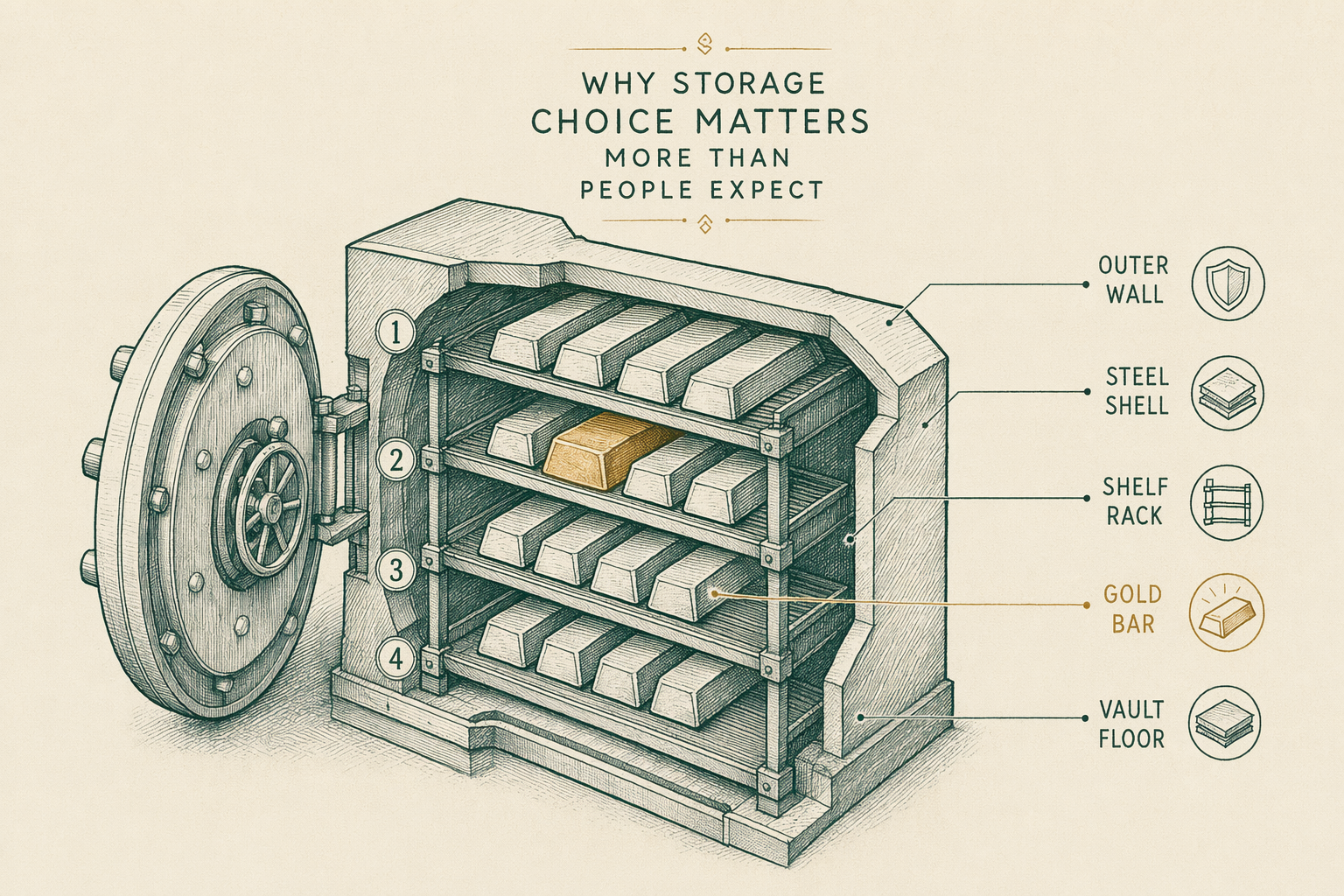
Most first-time Gold IRA holders treat storage as a downstream operational detail: the custodian picks the depository, the depository holds the metal, the storage fee shows up annually. That framing collapses the actual decision. The storage layer determines what happens to the metal if the custodian, depository, or marketing company runs into trouble. It determines whether the bars are specifically registered in your name (allocated) or held against a pool (unallocated). It determines whether the bars sit in their own compartment (segregated) or are stored together with other clients' bars (commingled). It determines the insurance arrangement, the audit cadence, and the buyer's right to physical inspection.
These decisions are usually made by the custodian on the IRA holder's behalf — not because the custodian is hiding the choice but because the IRA holder rarely asks. This editorial hub exists to give the reader the questions worth asking before the storage agreement is signed. We cover six major depositories (Delaware Depository, Brink's Global Services, International Depository Services of Texas, International Depository Services of Delaware, HSBC, and JPMorgan), each with a standalone review listing the IRS-approved status, the insurance underwriter, the audit cadence, and the published storage agreement excerpts.
What we evaluate
Five criteria. The first is IRS-approved status under Section 408(m) and the Treasury Regulation list of qualified custodians and depositories. Depositories on the list satisfy the IRA-eligibility requirement; depositories not on the list do not, regardless of marketing claims. The second criterion is the insurance arrangement: the underwriter (Lloyd's of London syndicates, ENT carriers, or other), the policy limit, the exclusions, and whether the policy covers the full client-asset value or only a portion.
The third criterion is the audit cadence: how often the depository is audited by a third party, what the audit covers (inventory, segregation status, registration accuracy), and whether the audit results are made available to clients. The fourth is the physical-security record: documented physical-security infrastructure (vault class, fire suppression, dual-control access), and any documented breaches or losses. The fifth is the published storage agreement language on segregation, lending, lien, and the operator's right to substitute equivalent metal.
Two criteria we do not score on: marketing claims about 'military-grade' or 'class-3 vault' status without third-party verification, and the appearance of the lobby in promotional photography. Vault security is documented in the storage agreement and the third-party audit, not in marketing materials.
IRS-approved depositories — the institutional tier
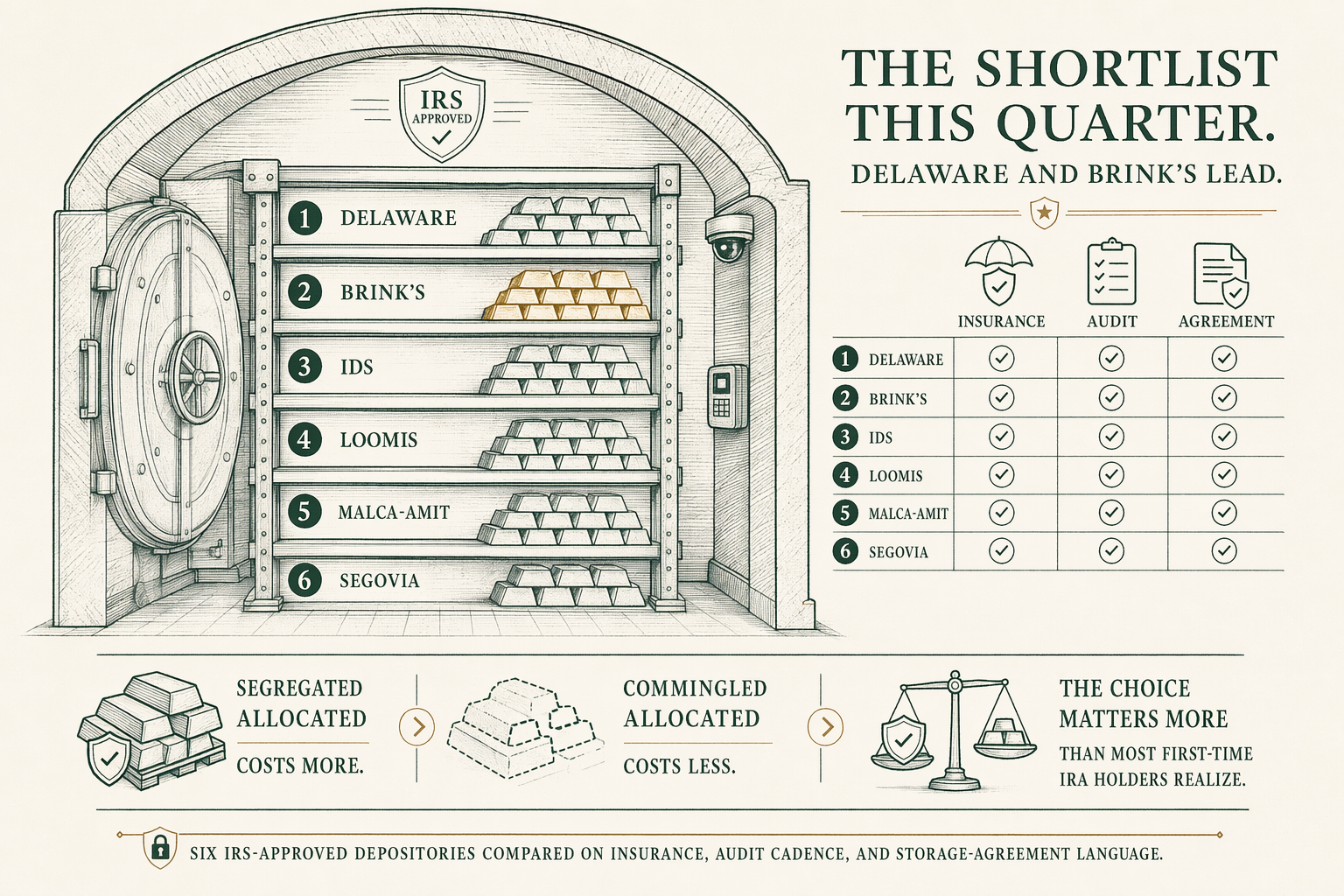
Six depositories dominate the IRS-approved channel. Delaware Depository (Wilmington, Delaware) is the most commonly named depository in the Gold IRA marketing channel, holding metal for a broad cross-section of custodians and IRA marketing companies; the published storage agreement supports both segregated and commingled allocated storage. Brink's Global Services maintains IRS-approved vaults in multiple locations (Los Angeles, New York, Salt Lake City, and others depending on the specific Brink's entity), with institutional-grade insurance and audit arrangements consistent with the broader Brink's secure logistics business.
International Depository Services (IDS) operates two IRA-approved facilities — IDS of Delaware (New Castle) and IDS of Texas (Dallas). The Texas facility receives editorial attention from the Gold IRA marketing channel because Texas state law on precious-metals custody is sometimes marketed as additional protection; we read the actual storage agreement before reading marketing material. HSBC and JPMorgan operate IRS-approved vaults primarily for institutional clients (and increasingly for select Gold IRA channels at larger account sizes); both carry institutional-grade audit and insurance arrangements consistent with their broader bullion-banking operations.
The depository on your specific Gold IRA is set by the custodian, not by the marketing company you spoke to first. Before the account opens, ask the custodian which depositories are available, which is the default, and whether you can choose a non-default option. The custodian is the IRS-recognized trust company; the depository is the IRS-approved vault. Both names belong on the new-account paperwork before you sign.
Private vaults outside the IRA wrapper
For after-tax holdings outside an IRA, the storage options widen materially. Private non-IRA vaults — operated by companies like Brink's, Loomis International, Malca-Amit, and Lloyd's of London-insured private vault operators — offer storage outside the IRA wrapper at price points that vary by service tier. Insurance arrangements, allocated-vs-unallocated terms, and access policies are all negotiable in ways that the IRA channel does not permit.
Bank safe-deposit boxes are a separate category. Banks rent the box; banks do not insure the contents. Most homeowner insurance policies cap unscheduled valuables (jewelry, coins, bullion) at `$200`-`$2,500`, with scheduled coverage (named-item rider) needed for meaningful coverage above that. Some insurers exclude bullion entirely from scheduled valuables; confirm in writing before relying on the box for storage of significant value.
Home storage is on the table for after-tax holdings — many people do it. The economic and legal calculus is different than for an IRA: there are no Section 408(m) constraints, the insurance question shifts to homeowner's-policy schedule riders or a standalone valuables policy, and the security question shifts to physical safes, fire ratings, and (depending on local risk) the choice between a home safe and an off-site arrangement. The IRS issue that disqualifies home storage for IRA holdings does not apply to after-tax bullion ownership.
Allocated vs unallocated storage
Allocated storage means specific bars or coins, identified by serial number and weight, are registered in your name in the vault operator's records. You have legal title to specific physical metal. The bars are not the operator's property and, subject to clean documentation, should not enter the operator's bankruptcy estate if the operator fails. The legal mechanism varies by jurisdiction but the general principle holds across the major vaulting jurisdictions.
Unallocated storage means you hold a claim against a pool of metal owned by the vault operator. The operator owes you the agreed weight of metal in the agreed fineness; you do not own specific bars. Unallocated storage is cheaper than allocated — sometimes materially so, sometimes only modestly. The counterparty risk is the operator's solvency, not the metal itself. In an operator bankruptcy you are a general creditor for the metal balance, recovering whatever the bankruptcy estate eventually pays out.
Inside a Gold IRA wrapper, the IRS-approved depositories operate allocated storage as the default; unallocated is generally not used in the IRA channel. Outside the IRA wrapper, both arrangements are common, and the price differential between them reflects the legal difference. The MF Global bankruptcy of `2011` is the canonical recent case study on why the distinction matters in practice; see `/case-studies/allocated-storage-after-mf-global/`.
Segregated vs commingled storage
Within allocated storage, the secondary distinction is segregated vs commingled. Segregated storage means your specific bars sit physically separate from other clients' bars — typically in their own compartment, drawer, or section of the vault. The bookkeeping shows your serial numbers; the physical layout matches the bookkeeping. Segregated allocated storage is the most expensive tier, typically `$100`-`$300/yr` per IRA account at the IRS-approved depositories, with the exact figure scaling with metal weight.
Commingled allocated storage means your specific bars are tracked by serial number and registered to you in the records, but they are stored physically together with other clients' bars of the same denomination, fineness, and refiner. The bookkeeping still shows your specific bars; the physical layout pools them. Commingled allocated typically runs `$75`-`$150/yr` at the IRS-approved depositories, materially cheaper than segregated.
For most IRA holders the commingled-allocated tier is the default and the appropriate choice. Segregated allocated is worth the premium for buyers who plan to take physical delivery of the specific bars at distribution (the bar serial numbers on the segregated paperwork match the bars in the shipment), for buyers with a strong preference for serial-number-level identification, or for buyers at materially larger metal weights where the segregation premium is a smaller percentage of the account.
Vaults we currently cover
Delaware Depository — Shortlisted. The most commonly named depository in the Gold IRA marketing channel, with a long operating record, institutional-grade insurance, and a published storage agreement that supports both segregated and commingled allocated arrangements. Audit results are made available to clients on request. Standalone review at `/learn/delaware-depository-review/`. Brink's Global Services — Shortlisted. Multi-location IRS-approved coverage, institutional insurance arrangements consistent with the broader Brink's secure-logistics business, and a documented chain-of-custody process. Review at `/learn/brinks-global-services-review/`.
IDS of Texas — Editorially Neutral. Solid mid-scale operator with documented insurance and audit arrangements; the Texas-state-law marketing angle deserves the published storage agreement to back it up rather than the marketing summary. Review at `/learn/ids-of-texas-review/`. IDS of Delaware — Editorially Neutral. Sister facility to IDS of Texas, similar operating profile. Review at `/learn/ids-of-delaware-review/`.
HSBC and JPMorgan — Editorially Neutral on the IRA channel, distinct profiles at the institutional tier. Both operate primarily for institutional clients with select Gold IRA channels at larger account sizes; the desk's coverage focuses on the published storage agreements and the documented audit arrangements rather than the institutional-tier services that are not relevant to most retail IRA holders.
How we score
Same four editorial tags as the other service hubs: Shortlisted, Editorially Neutral, Mid-tier, Deprioritized. Definitions at `/editorial-standards/`. Shortlisted on the depository side means clean IRS-approved status, institutional-grade insurance arrangements (Lloyd's syndicates or comparable), documented audit cadence, and a published storage agreement that supports allocated storage in both segregated and commingled tiers. The two Shortlisted depositories — Delaware and Brink's — meet all four conditions.
Editorially Neutral on the depository side means parity on IRS-approved status and standard storage-agreement language without the additional strengths that elevate a Shortlisted designation (or with one or two criteria — typically audit-disclosure cadence — at parity rather than at the top of the channel). The IDS facilities, HSBC, and JPMorgan all sit at Editorially Neutral, each for slightly different reasons walked in the standalone reviews.
The tags do not collapse into a numerical score because, again, the criteria do not weight the same for every buyer. A buyer planning to take physical delivery at distribution will care about segregation more than a buyer planning to liquidate in cash. The tags give you the editorial judgment; the criteria let you do your own weighting.

Affiliate disclosure for this hub
BullionLens does not currently earn affiliate commission directly from the depositories named on this hub. Depository-level affiliate programs are uncommon in the channel. Where a Gold IRA company on `/reviews/gold-ira-companies/` uses one of these depositories as its default storage partner — which is true for Augusta (Delaware), Birch (Delaware or Brink's), Goldco (Delaware or Brink's), and others — the affiliate relationship flows through the Gold IRA company, not through the depository. The disclosure on those linked Gold IRA company reviews carries the methodology pointer.
Reviewed `2026-Q2`. Depositories will be re-confirmed in `2026-Q3` per the quarterly editorial calendar at `/editorial-standards/`. Educational content, not personalized investment advice. Consult a licensed adviser before making storage or custody decisions on retirement assets.
Want to talk this through? Book a 30-min research call →
Frequently asked questions
-
Which vaults are IRS-approved for a Gold IRA?
Delaware Depository, Brink's Global Services, International Depository Services (IDS) of Texas and Delaware, HSBC, JPMorgan, and a small number of others. The custodian on your Gold IRA controls which depositories are available. -
What is allocated storage?
Allocated storage means specific bars or coins, identified by serial number and weight, are registered in your name in the vault's records. You have legal ownership of the specific metal. -
What is unallocated storage?
Unallocated storage means you hold a claim against a pool of metal owned by the vault operator. Cheaper than allocated. Your counterparty risk is the vault operator's solvency, not the metal itself. -
What is segregated storage?
Within allocated storage, segregated means your bars sit physically separate (own compartment) from other clients'. Commingled allocated storage means your specific bars are tracked but stored together with other clients' bars. Segregated costs more. -
Can I visit the vault and see my bars?
Some depositories offer audited visits by appointment. Delaware Depository, for example, allows scheduled audits. Confirm with the specific depository on your account.
In plain English We're an editorial desk. Educational only — talk to a licensed adviser before doing anything with retirement assets.