Augusta Precious Metals vs Birch Gold Group
Side-by-side editorial comparison of Augusta and Birch on objective criteria: fees, custodian, storage partner, BBB grade, founding year, and minimums.
Methodology and disclosure
**Editorial disclosure.** BullionLens earns a commission when a reader opens a Gold IRA account through links on this page. This does not change the price you pay or the fees either company quotes you. Editorial selection is independent — see [our editorial standards](/editorial-standards/). Reviewed `2026-Q2`.
This comparison covers two of the most-searched Gold IRA companies in the United States: Augusta Precious Metals and Birch Gold Group. Both target the `$50,000`-plus retirement-rollover market. Both partner with established self-directed-IRA custodians and IRS-approved depositories. The question this page tries to answer is the question a reader actually has on a Saturday morning, which is: side by side, on the things I can verify, where do they differ.
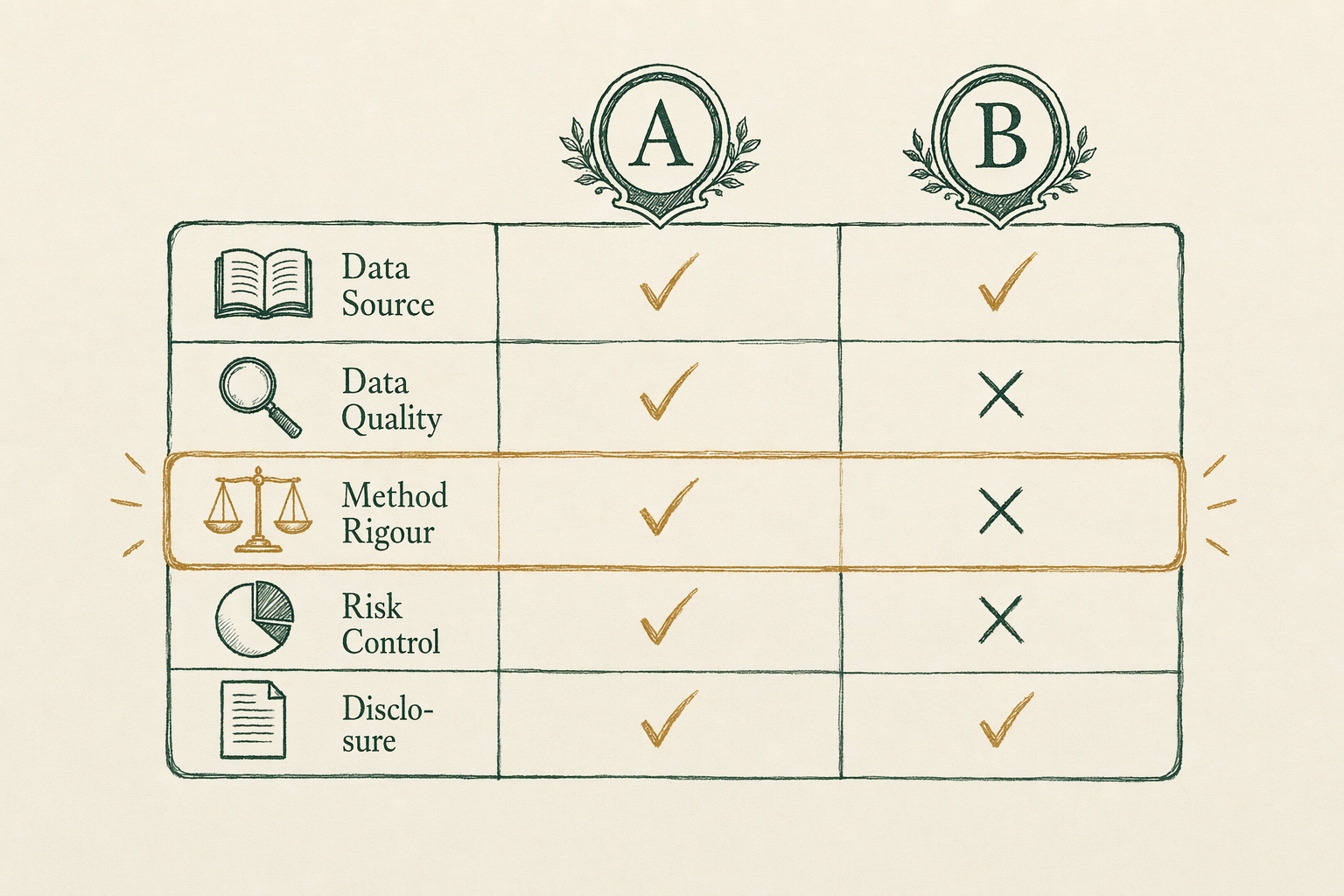
We compared eight objective criteria: founded year, corporate parent, custodian relationship, depository partner, application fee, annual administration fee, annual storage fee, and Better Business Bureau record. We did not compare marketing collateral, salesperson-quoted incentives, or anecdotal Trustpilot threads, because none of those survive a four-year holding period the way the fee schedule does. Fees are dated. Custodians and depositories are named with their primary identifier (Equity Trust Company, Delaware Depository) so readers can confirm independently. The audience is the 45-65-year-old US investor with `$100K`-`$5M` of retirement assets weighing a `5%`-`15%` physical-gold allocation, and the criteria are picked for what that reader will actually live with after the sales call ends.
Two omissions are deliberate. We do not name an editorial winner here — the right answer depends on which criterion matters more to a given account size and storage preference, and we explain that judgment in the closing section. We also do not reproduce either company's published fee schedule verbatim; the figures are paraphrased from each company's public Fee Disclosure documents and customer-onboarding materials current as of `2026-Q2`. Either company may revise pricing on a future quarter, which is why every number on this page carries a snapshot date and why the page is rebuilt every `90` days.
Founded year and corporate background
**Birch Gold Group** was founded in `2003` and is headquartered in Burbank, California. The company operates as a precious-metals dealer with a self-directed-IRA arm that handles the IRS-recognized retirement structure separately. Birch has been writing Gold IRA business for roughly `23` years — long enough that its operating practices were tested through the `2008` financial crisis, the `2011`-`2012` gold-price peak around `$1,900/oz`, and the `2020` pandemic-era flight to physical metals. Length of operation is not a guarantee of quality, but it filters for a company that has navigated more than one bullion-cycle.
**Augusta Precious Metals** was founded in `2012` and is headquartered in Casper, Wyoming with a sales office in Beverly Hills, California. Augusta is roughly `14` years old at the time of this review, which puts it on the younger end of the Gold IRA company population. The company's positioning leans heavily on its in-house customer-education program and a relationship-managed sales process aimed at the `$100,000`-plus rollover. Augusta has not gone through a regulatory action with the SEC or any state attorney general as of the BBB record reviewed `2026-Q2`.
The age gap matters less than people assume. Birch's longer history means more elapsed transactions and a longer Better Business Bureau record. Augusta's shorter history means fewer historical complaints but also a smaller sample of buyback cycles. Both companies are privately held and do not publish audited financial statements, which is true of nearly every Gold IRA marketing company. Neither runs the actual IRA — both contract with third-party custodians for the IRS-required trust function and with third-party depositories for the physical storage. That distinction matters for the next section.
Custodian and depository options
A Gold IRA is a three-party arrangement. The marketing company sells the account and the coins. The **custodian** is the IRS-recognized trust company that holds legal title for the IRA and issues the year-end tax documents. The **depository** is the physical-security operator that stores the metal. Augusta and Birch differ on the first leg and overlap on the second.
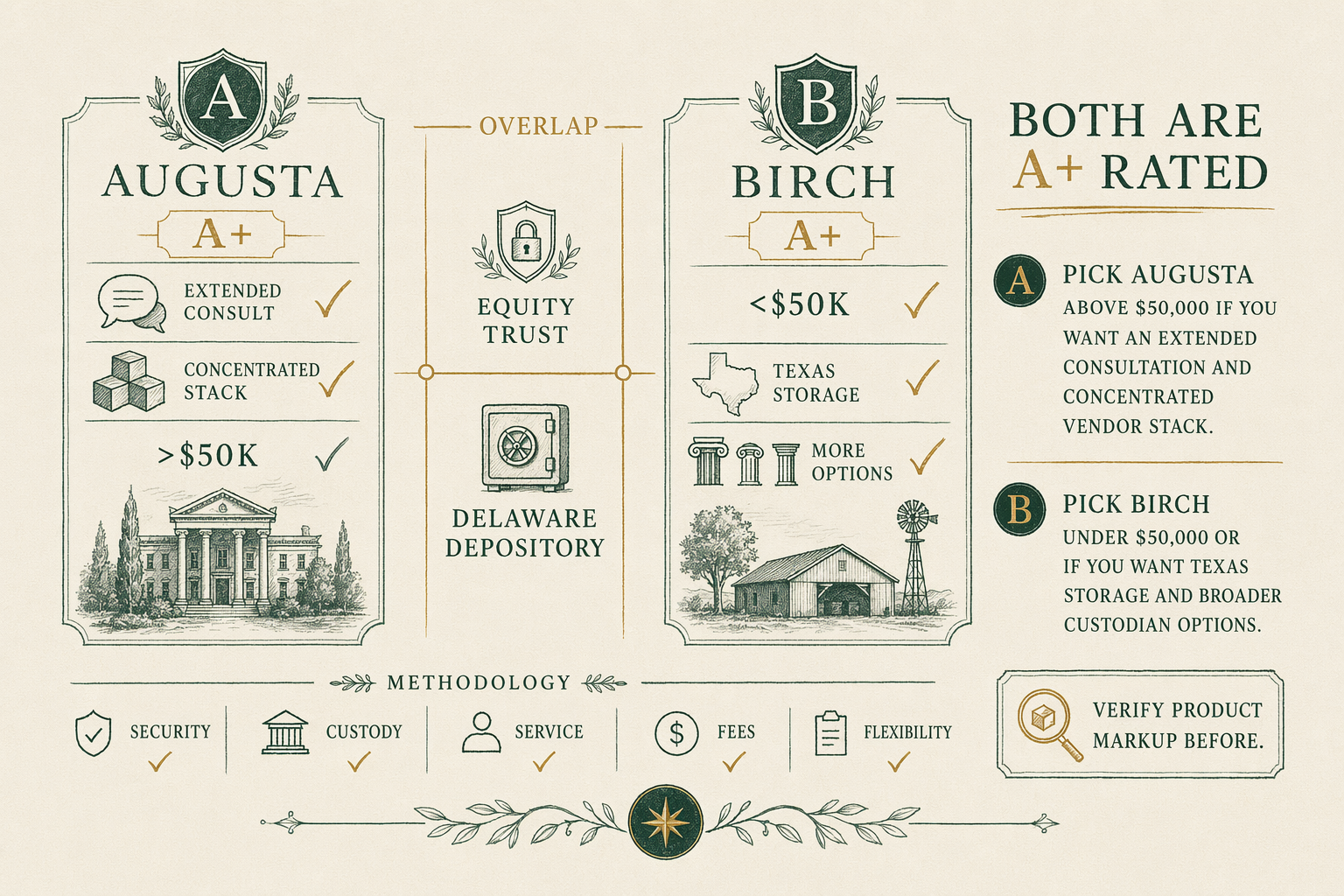
**Augusta** primarily routes accounts to Equity Trust Company, a South Dakota-chartered trust company that is one of the two largest self-directed-IRA custodians in the United States. Equity Trust administers more than `$45 billion` in custodied assets across alternative-asset IRAs (per Equity Trust's published company materials), which makes it a deep operational bench for Augusta clients. Augusta's depository default is Delaware Depository in Wilmington, with segregated storage available on request. International Depository Services of Delaware is an option for clients who prefer a secondary facility under the same operator family.
**Birch** uses a wider custodian set, with Equity Trust and STRATA Trust Company appearing most often in its onboarding documentation. STRATA is a Texas-chartered trust company that specializes in self-directed-IRA custody. Birch's depository options include Delaware Depository, Brink's Global Services, and International Depository Services of Texas. The Texas option is a meaningful distinguisher for clients who prefer storage outside the Eastern Corridor for diversification or jurisdictional reasons.
Net read: Augusta concentrates the custodian relationship; Birch fans it out. A reader who values single-vendor simplicity may prefer the Augusta route. A reader who values geographic or jurisdictional storage diversity may prefer Birch's wider depository menu.
Snapshot fee comparison
Fees as of `2026-Q2`. Paraphrased from each company's public Fee Disclosure documents and customer-onboarding materials. Either company may revise pricing on a future quarter. Confirm directly with each company before signing new-account paperwork.
**Augusta Precious Metals** — Application fee `$50` (one-time). Annual IRA administration fee `$80` (paid to the custodian, billed annually). Annual storage fee `$100` for segregated storage at Delaware Depository, billed annually. Wire transfer fee `$35` per outgoing wire. Markup over spot on the initial coin or bar allocation: Augusta's positioning is bullion-grade products with markups paraphrased in customer materials at roughly `5%`-`8%` over spot on common 1 oz formats — the exact figure is product-dependent and negotiated at the new-account call.
**Birch Gold Group** — Application fee `$50` (one-time). Annual IRA administration fee `$80` paid to the custodian on the Equity Trust schedule, or `$95` on the STRATA schedule. Annual storage fee `$100` for non-segregated commingled storage and `$150` for segregated, depository-dependent. Wire transfer fee `$30` per outgoing wire. Markup over spot is product-dependent; Birch carries a broader product mix that includes both bullion-grade and higher-premium specialty coins, so the markup range published in industry summaries runs wider than Augusta's.
The line-item fees are within `$15`-`$50/yr` of each other and would not move a reasonable comparison decision. The variable that matters more is the **product markup**, which is the largest dollar cost in the first year of any Gold IRA and which neither company publishes in a fixed schedule because it depends on which coins or bars the client buys. A reader rolling over `$50,000` into a `7%`-markup allocation pays `$3,500` in initial product markup; the same `$50,000` into a `12%`-markup allocation pays `$6,000`. The difference is `$2,500`, which dwarfs every other fee on this page combined. Ask each company for the markup on the specific products before signing.
Minimum thresholds
**Augusta Precious Metals** publishes a `$50,000` minimum for Gold IRA accounts in its customer-facing materials. The minimum is enforced at the new-account stage and reflects Augusta's positioning toward the larger-rollover segment of the Gold IRA market. Clients below the minimum are referred elsewhere or coached to consolidate other retirement accounts to reach the threshold.
**Birch Gold Group** operates with a lower published threshold, historically cited at `$10,000` for a Gold IRA account in industry summaries and Birch's own marketing materials. The lower threshold opens the door to smaller rollovers — a `401(k)` balance from a former employer in the `$15,000`-`$30,000` range fits a Birch account but not an Augusta account. Confirm the current minimum with Birch directly; the figure has moved in past years.
The minimum is the single hardest filter on the buyer side. A reader with a `$25,000` 401(k) rollover and no other retirement assets has only one of these two companies in scope. A reader with a `$250,000` rollover can choose freely. The minimum has no relationship to quality — it reflects the marketing-cost economics of the Gold IRA business, where the all-in cost of acquiring a new client runs in the high four figures and the company needs a rollover large enough to justify the customer-acquisition cost. Above `$50,000`, both companies apply.
BBB and consumer-affairs records
Better Business Bureau records are not a quality ranking, but they are a reproducible public dataset. Each company's BBB profile lists accreditation status, letter grade, and the number and disposition of customer complaints over a rolling three-year window.
**Augusta Precious Metals** holds a `BBB A+` rating and is BBB-accredited. The complaint history visible on the BBB profile shows a low absolute number of complaints relative to the company's stated transaction volume, and the documented complaints are typically resolved through the BBB's mediation process. There are no state attorney general enforcement actions against Augusta on the public record as of `2026-Q2`. There is no SEC civil action or settlement on the public record.
**Birch Gold Group** also holds a `BBB A+` rating and is BBB-accredited. Birch's longer operating history produces a longer complaint record by absolute count, which is expected for a company `9` years older than the comparison. The complaints on file are predominantly resolved. There are no state attorney general enforcement actions against Birch on the public record as of `2026-Q2`. There is no SEC civil action or settlement on the public record.
On the regulatory-record axis, the two companies look similar. Neither has the kind of public enforcement record that should disqualify them from a Gold IRA shortlist. A reader treating regulatory history as a screening tool moves both forward to the next round.
Editorial considerations
Two editorial observations beyond the data. **First**, Augusta's customer-education program — pre-purchase webinars, a relationship-managed sales process, a written commitment to a no-pressure consultation — is a deliberate differentiator and lands well with the segment of investors who want extended due-diligence support before signing. The same approach reads as drawn-out to readers who prefer a faster transaction. Both reactions appear in the BBB review record.
**Second**, Birch's broader depository menu (Delaware, Brink's, IDS Texas) is genuinely useful for clients who care about jurisdictional diversification of physical storage. A client who already holds taxable bullion at Delaware Depository may want their IRA gold elsewhere, and Birch supports that without an off-platform workaround. Augusta clients who want Texas storage typically need to negotiate the option rather than select it from a default menu.
Neither observation is dispositive. They are editorial color on top of the data table above. Where the regulatory record and fee floor are similar, these second-order considerations tend to drive the actual choice.

Where each may fit
We do not name a universal best. The comparison resolves differently for different account sizes, custodian preferences, and storage preferences.
**Lean toward Augusta if:** your rollover is above the `$50,000` minimum, you value an extended pre-purchase consultation, single-vendor custodian (Equity Trust) is a positive for you, and Delaware Depository segregated storage fits your jurisdictional preference. The Augusta arrangement is more concentrated and more deliberate.
**Lean toward Birch if:** your rollover is under `$50,000`, you want optionality in custodian (Equity Trust or STRATA) and depository (Delaware, Brink's, or IDS Texas), or you specifically want Texas-based storage for diversification reasons. The Birch arrangement is more flexible and supports a wider range of buyer profiles.
Either way, the most consequential variable on your statement at year-end will be the product markup on the initial allocation, not the line-item annual fees. Ask each company for the markup on the specific coins or bars before you sign. The custodian and depository names are facts. The fee schedule is a snapshot. The markup is where the money actually moves.
_Educational content, not personalized investment advice. BullionLens is not a registered investment adviser. Consult a licensed adviser before making decisions about retirement assets, IRA rollovers, or asset allocation._
Want to talk this through? Book a 30-min research call →
Frequently asked questions
-
Which is older?
Birch Gold Group (founded 2003) is older than Augusta Precious Metals (founded 2012). -
Which has a lower minimum?
Birch has historically operated with a lower minimum than Augusta. Confirm current thresholds directly with each company. -
What's the editorial verdict?
There is no universal verdict. We compare on objective criteria; the right choice depends on your account size, custodian preference, and storage location preference. See /editorial-standards/ for our methodology. -
Is the comparison data current?
We snapshot fees and arrangements quarterly minimum and stamp each comparison with a 'Last reviewed' date. Companies change fees, custodians, and storage partners — verify with the company directly before opening an account.
In plain English We're an editorial desk. Educational only — talk to a licensed adviser before doing anything with retirement assets.