Is APMEX a legitimate bullion dealer?
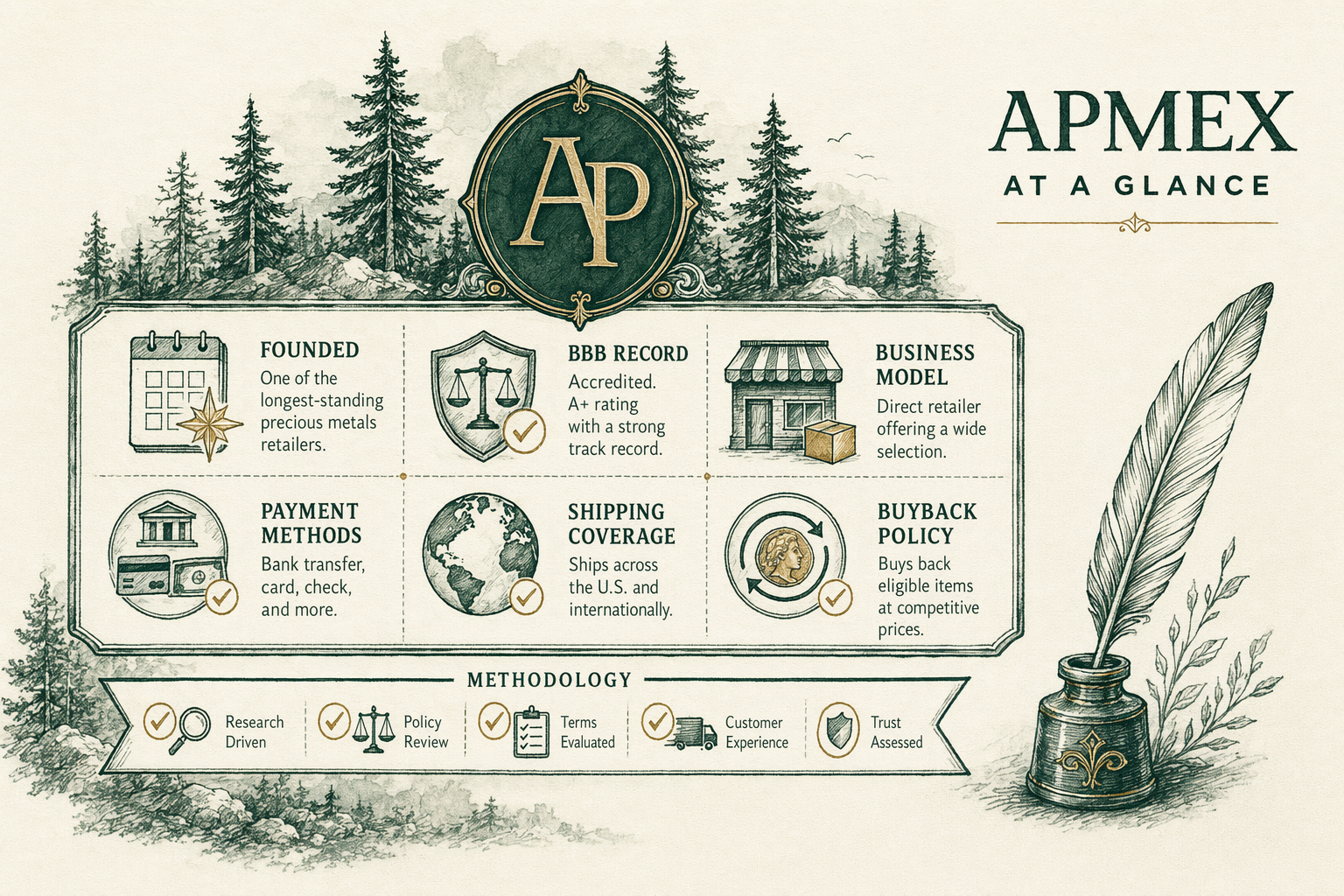
APMEX founded date, BBB record, business model, payment methods, shipping coverage, and buyback policy. Editorial review, not promotional content.
Founding date and business background
American Precious Metals Exchange (APMEX) was founded in `2000` and is headquartered in Oklahoma City, Oklahoma. The company is privately held; Oklahoma Secretary of State business records show continuous good-standing for the registered entity over the company's operating window. With more than two decades of operating history, APMEX is one of the older and larger US online bullion dealers, alongside JM Bullion (founded `2011`) and Money Metals Exchange (founded `2010`).
APMEX's business model is straightforward online retail bullion sales of gold, silver, platinum, and palladium products, plus secondary services including IRA-eligible product fulfillment to partnered Gold IRA custodians, numismatic-coin sales, and a structured buyback program. The company is an Authorized Purchaser for several sovereign mints, including the US Mint's American Eagle program, which gives APMEX direct-from-mint product access. Direct mint relationships generally translate to deeper inventory and faster restocking during supply-stress periods than dealers without those relationships.
BBB record and complaint patterns
Better Business Bureau records for APMEX (BBB Oklahoma file) at the time of this snapshot show an A+ rating with BBB accreditation. Complaint volume over recent years sits in the moderate range relative to APMEX's transaction volume — the company processes a high volume of orders, so absolute complaint counts are larger than at smaller dealers, but the ratio of complaints to total orders is in the typical industry range. The company responds to BBB complaints within published timelines.
Complaint patterns visible in public BBB records (not specific to any particular period) frequently relate to shipping disputes (late arrival, missing items in multi-item orders), occasional disputes over the buyback price quoted versus the buyback price paid after dealer inspection, and timing of refunds on returned items. None of these are red-flag patterns suggesting the company is not delivering goods or is otherwise not a legitimate dealer. APMEX has been routinely buying back coins from customers for over two decades; the dealer relationship is well-established. Always verify current BBB status before transacting — records change.
Spread on common products
APMEX's retail spreads on the most-traded products (`1 oz` American Gold Eagles, `1 oz` Gold Maple Leafs, `1 oz` Gold Buffalos) are in the industry-typical range — usually a few percentage points wider than the deepest-discount dealers (Money Metals, SD Bullion) on identical products, and a few percentage points tighter than smaller regional dealers without comparable volume. The premium gap between APMEX and a deep-discount dealer on a single `1 oz` Eagle is typically `$20-50` in normal market conditions; multiplied across larger orders, this gap is real.
APMEX's pricing model includes volume-tier discounts that narrow the gap on larger orders: orders of `20+ oz` typically see premium reduction, orders of `100+ oz` see further reduction. For buyers running larger orders, the headline single-coin spread is not the right comparison; the volume-tier price is. The dealer's website displays the volume-tier prices at checkout based on quantity. Total-cost comparison across dealers should always use the actual order configuration the buyer intends to place, not the displayed single-coin price.
Payment methods and surcharges
APMEX accepts a wide range of payment methods: bank wire (no surcharge, the cheapest payment method), ACH/eCheck (small flat fee, slower settlement), check by mail (no surcharge, slowest settlement), credit/debit cards (with surcharge, typically `2-4%`), PayPal (with surcharge), cryptocurrency (with surcharge, varying by token), and 'BitPay' (Bitcoin/Bitcoin Cash via BitPay processor). Each method has different settlement timing — wires lock the price immediately, mailed checks lock when received and cleared.
Credit-card surcharges on APMEX reflect the dealer's processing cost and chargeback exposure on a high-value reversible product. A buyer paying by wire avoids the surcharge entirely; a buyer paying by credit card pays the surcharge but gets card-issuer benefits (cash back, points, dispute rights). For most bullion buyers above the `$500-1,000` order range, the bank wire is the lowest-cost payment method. For very small orders, the credit-card convenience may outweigh the small dollar surcharge.
Shipping and insurance
APMEX ships orders via USPS Registered Mail and UPS/FedEx with declared-value insurance, signature required on delivery, and no insurance carrier or contents disclosed on the package exterior. Standard practice across reputable US bullion dealers — the packaging looks generic to deter package-theft. Shipping is generally free over certain order thresholds (varies by promotion); below threshold, APMEX charges a flat shipping fee scaled to insured value.
Insurance coverage is the dealer's coverage during transit. Once the package is signed for at delivery, the insurance ends — losses after delivery are the buyer's responsibility. APMEX's terms include a stated window during which the buyer must report any shipping discrepancies (missing items, damaged packaging, etc.); reporting outside the window forfeits the dealer's transit-insurance recourse. Read the published shipping policy before ordering; standard buyer obligations include being available to sign for the package and not delegating signature authority to anyone who would not return the package undamaged.
Buyback policy
APMEX buys back products it originally sold at or near spot, with the actual buyback price quoted at the time of sell-back rather than a fixed published rate. The mechanics: customer initiates a sell-back through APMEX's online portal, gets a quote good for a stated time window, ships the items via APMEX's prepaid shipping label, APMEX inspects on receipt and confirms (or adjusts) the original quote, then pays via the customer's chosen method.
Buyback timing typically runs `1-2 weeks` from shipment to payment receipt — slower than the immediate-cash settlement available at a local coin shop, but generally at better prices than smaller regional shops can offer for non-major products. For commonly-traded bullion-grade products, the APMEX buyback price is competitive. For numismatic or specialty products, the buyback discount can be wider; sellers of high-premium products may find better prices through specialty numismatic dealers. Verify the buyback quote in writing and read APMEX's terms for any conditions that could allow the quote to be adjusted after receipt.
Real-world example — buying 5 oz from APMEX
Consider a buyer ordering `5 × 1 oz` American Gold Eagles from APMEX at an illustrative LBMA spot of `$2,400/oz`. APMEX retail price (illustrative): `$2,520` per coin at the single-unit price, dropping to `$2,495` per coin at the `5+`-coin volume tier. Total bullion cost: `$2,495 × 5 = $12,475`. Payment by wire transfer: no surcharge. Shipping: free at this order size (above APMEX's stated free-shipping threshold). Total all-in cost: `$12,475`.
On resale `3` years later (assuming flat spot for the illustration), the customer initiates an APMEX buyback. APMEX quotes `$2,395` per coin (slightly under spot for clean bullion), total `$11,975`. The customer ships via APMEX's prepaid label, APMEX inspects and confirms the quote, payment arrives by ACH `8` business days from shipment. Total round-trip cost-of-ownership: `$12,475 − $11,975 = $500`, or about `4%` of the initial purchase price over `3` years. The result is competitive with industry norms; whether it's the lowest available cost depends on whether the buyer could find better single-direction pricing at Money Metals or SD Bullion on the original purchase or a better buy-back at a local coin shop on the exit.
Common misconceptions about APMEX
**'APMEX has the lowest prices.'** Not necessarily. APMEX's retail spreads are in the industry-typical range but a few percentage points wider than the deepest-discount dealers (Money Metals, SD Bullion). For headline pricing alone, the discount dealers win. APMEX's volume-tier discounts and direct-mint Authorized Purchaser relationships are countervailing strengths.
**'The buyback price is locked at order time.'** No. APMEX's buyback price is quoted at the time of sell-back, not at the time of original purchase. Spot moves; your buyback price reflects then-current market.
**'APMEX guarantees delivery.'** Insurance during transit yes, but once the package is signed for at delivery, post-delivery losses are the buyer's responsibility. Sign-and-inspect carefully at the door.
What this means for you
APMEX is a legitimate, established US bullion dealer with `25+` years of operating history, A+ BBB rating at the time of this snapshot, and US Mint Authorized Purchaser status. Retail spreads are industry-typical (not the deepest discounts available, but not the widest either); the volume-tier discount structure rewards larger orders. Shipping is professionally managed with insured-transit coverage. Buyback programs work as advertised, with the standard caveat that quotes are time-of-sale, not time-of-purchase. For most retail bullion buyers, APMEX is a reasonable default among major US online dealers — comparison-shop against JM Bullion and Money Metals on the specific products you intend to buy at the time you intend to buy them. BullionLens earns a commission when a reader places an order through links on this page; see `/editorial-standards/` for our methodology.
Want to talk this through? Book a 30-min research call →
Frequently asked questions
-
When was APMEX founded?
APMEX (American Precious Metals Exchange) was founded in 2000 and is headquartered in Oklahoma City. It has been one of the larger US online bullion dealers for two decades. -
Does APMEX have a BBB rating?
Yes — APMEX has carried a long-standing Better Business Bureau profile. Check bbb.org for the current rating and complaint history before transacting. -
How does APMEX's spread compare?
APMEX's retail spreads on common products (Gold Eagles, Maples) are within the industry-typical range. For competitive comparison see our compare/apmex-vs-jm-bullion review. -
How do I compare this dealer to others?
Pull a same-product quote (one 1 oz American Gold Eagle, wire-transfer payment, shipped to your state) from three dealers at the same minute. Compare total landed cost — premium, surcharge, shipping. Spread differences are real but seldom huge between established dealers.
In plain English We're an editorial desk. Educational only — talk to a licensed adviser before doing anything with retirement assets.