APMEX vs JM Bullion
Side-by-side editorial comparison of APMEX and JM Bullion on spreads, payment methods, shipping coverage, and buyback policies.
Methodology and disclosure
**Editorial disclosure.** BullionLens earns a commission when a reader opens an account or places an order through links on this page. This does not change the price either dealer quotes you. Editorial selection is independent — see [our editorial standards](/editorial-standards/). Reviewed `2026-Q2`.
APMEX and JM Bullion are the two largest US online bullion dealers by trailing transaction volume. Both ship internationally (with restrictions), both publish live bid-ask quotes, and both offer the same broad inventory of US Mint coins, foreign sovereign coins, refiner bars, and rounds. The differences worth surfacing are operational: shipping logistics, payment-method surcharges, buyback spread, and the corporate-parent relationship that has emerged since `2022`.
We compare seven objective criteria: founded year, corporate parent, spread snapshot on `1 oz` American Gold Eagle (a standardized comparison product), payment methods and surcharges, shipping policy, buyback policy, and Better Business Bureau record. Spread figures are snapshot from each dealer's public website on a single day in `2026-Q2`. Spreads move with the spot price and with each dealer's inventory position; the comparison is a snapshot, not a rate sheet. Pages are rebuilt every `90` days under the quarterly review schedule. We do not name a winner; the closing section breaks down which criteria favor each dealer.
Corporate backgrounds and parent relationships
**APMEX** (American Precious Metals Exchange) was founded in `2000` and is headquartered in Oklahoma City. The company is one of the oldest online bullion dealers in the United States and has operated through the full bullion cycle including the `2008` financial crisis, the `2011`-`2012` peak around `$1,900/oz`, the long drawdown into `$1,050/oz` by late `2015`, the recovery, and the pandemic-era flight above `$2,000/oz` in `2020`. APMEX's transaction volume is among the highest in the segment.
**JM Bullion** was founded in `2011` and is headquartered in Dallas, Texas. JM Bullion grew rapidly through the `2013`-`2020` period and became, by `2020`, one of the two largest online bullion dealers in the United States. In `2021`, JM Bullion was acquired by A-Mark Precious Metals (NASDAQ: AMRK), a publicly traded precious-metals wholesaler. The acquisition gives JM Bullion access to A-Mark's wholesale supply chain and to public-company financial transparency that most privately held bullion dealers do not offer.
The corporate-parent relationship is a meaningful difference. JM Bullion's public-company parent files quarterly financial statements with the SEC, which means JM Bullion's parent operations are auditable in a way APMEX's are not. APMEX has remained privately held throughout its operating history. Neither structure is inherently better — public-company parentage offers transparency at the cost of quarterly-earnings pressure on margins; private ownership offers operational flexibility at the cost of less external transparency.

Spread snapshot on 1 oz Gold Eagle
The `1 oz` American Gold Eagle is the most-traded gold coin in the United States and the cleanest single-product comparison across online dealers. The spread (the gap between bid and ask) is the relevant measurement, not the absolute price, because the absolute price moves with spot.
Snapshot as of `2026-Q2` on a representative trading day: **APMEX** quoted `1 oz` American Gold Eagle bullion-grade coins at roughly `2.5%`-`4.0%` over spot on the ask side and roughly `0.5%`-`1.5%` under spot on the bid side, depending on volume tier. The published bid-ask spread on a single coin worked out to approximately `3.0%`-`5.5%` across the snapshot week. **JM Bullion** quoted the same coin at roughly `2.0%`-`3.5%` over spot on the ask side and roughly `0.0%`-`1.0%` under spot on the bid side, for a published spread of approximately `2.5%`-`4.5%` across the snapshot week.
On a single representative day, JM Bullion's spread on `1 oz` Gold Eagle ran approximately `40`-`80 bps` tighter than APMEX's. The gap moves daily with each dealer's inventory and with market conditions. Spread comparison is best done at order time on the day the order will be placed; the snapshot here is illustrative, not a permanent ranking. Volume tiers matter: both dealers tighten the spread for orders above `10 oz`, and both can quote large-lot pricing for orders above `100 oz` that is not visible on the standard website pricing.
Payment method options and surcharges
Payment method drives the all-in cost of a bullion purchase by `2%`-`4%` in most cases, because credit-card processing carries higher cost and chargeback exposure on a high-value reversible product. The bank-wire price is typically the headline 'sale' price; the credit-card price is the surcharged equivalent.
**APMEX** accepts bank wire and ACH at the published headline price. Credit card and PayPal carry a published surcharge of approximately `3.0%`-`4.0%` (rate has moved over time and is published on the order-entry page). Personal check and money order are accepted at the headline price with a hold period for clearing. Cryptocurrency payment via approved processors carries variable surcharge depending on the processor. APMEX additionally offers a `Bullion Card` co-branded financing product on qualifying orders; the financing terms are disclosed at the application stage.
**JM Bullion** accepts bank wire, ACH, and personal check at the published headline price. Credit card and PayPal carry a published surcharge of approximately `4.0%` (rate published at order entry). Cryptocurrency payment is accepted with variable surcharge. JM Bullion's payment-method menu is narrower than APMEX's; the absence of a co-branded financing product is the most-visible single difference.
Net read: on bank-wire pricing, the two dealers are within the spread snapshot above. On credit-card pricing, APMEX's `3.0%`-`4.0%` surcharge is slightly cheaper than JM Bullion's `4.0%` if APMEX is at the bottom of its surcharge band. For a `$10,000` credit-card order, the surcharge difference works out to `$0`-`$100`. The decision turns more on bank-wire pricing for serious orders.
Shipping coverage
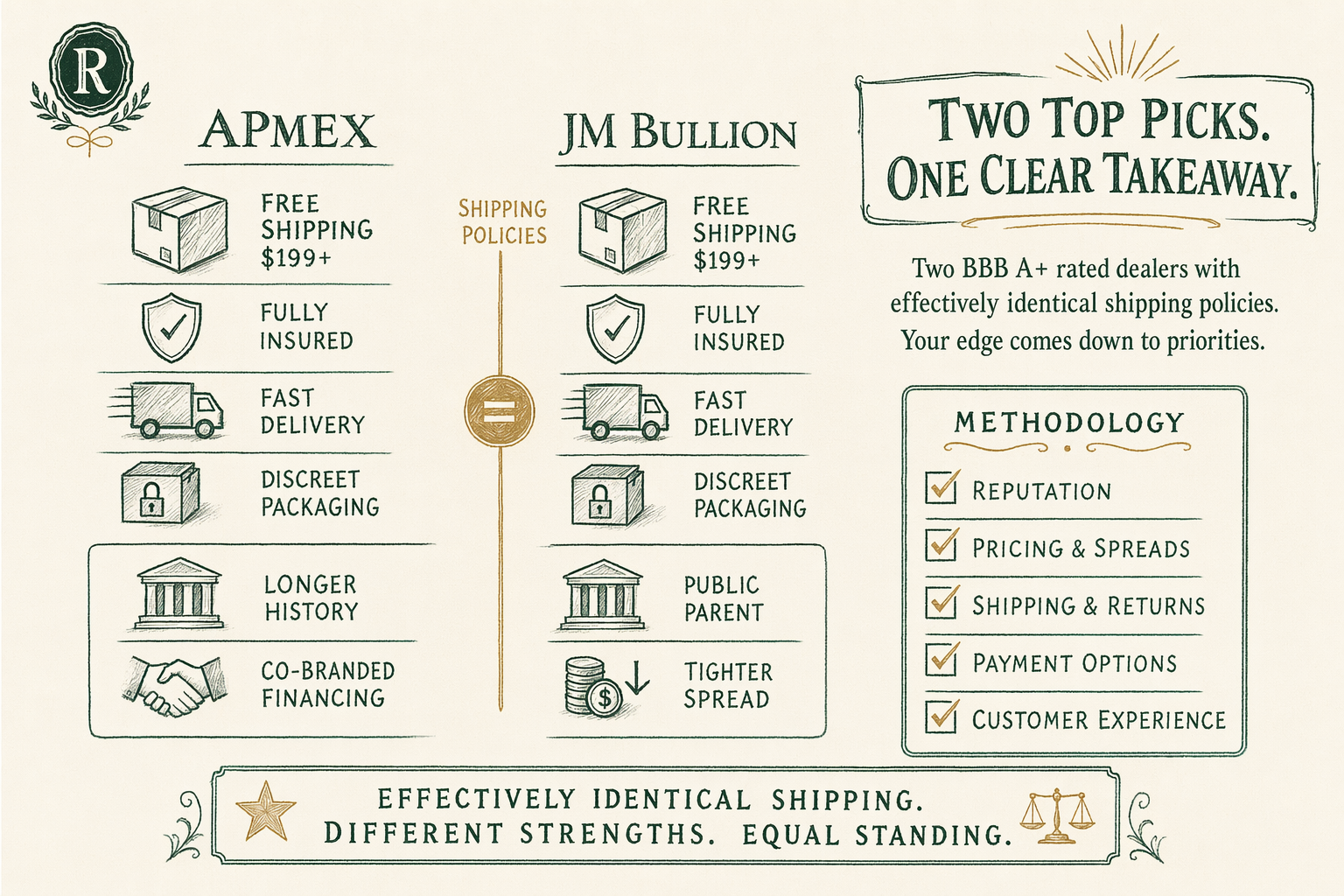
Both APMEX and JM Bullion ship via USPS Registered Mail, UPS Next Day Air, and FedEx with declared-value insurance and signature required at delivery. Neither carrier disclosure appears on the package; the standard practice in the bullion industry is to use plain packaging with no carrier-branding suggesting the contents.
**APMEX** ships to all `50` US states and to select international destinations. Free shipping kicks in at `$199` per order on most product categories on the standard schedule (the free-shipping threshold has moved in past quarters). Below the threshold, shipping is approximately `$10`-`$25` depending on order size and destination. International shipping is available on a category-limited basis with duties paid by the buyer.
**JM Bullion** ships to all `50` US states and to select international destinations. Free shipping kicks in at `$199` per order on most categories on the standard schedule. Below the threshold, shipping is approximately `$8`-`$25`. International shipping availability is similar to APMEX's, with category limits and buyer-paid duties.
Shipping policy is effectively equivalent. The choice between the two dealers does not turn on shipping. Both ship insured to the entire continental US; both use industry-standard plain packaging; both clear orders within `1`-`5` business days depending on payment method (wire clears fastest; check has the longest hold).
Buyback policies
Buyback policy is the most under-discussed lever in online bullion dealing. The dealer sets both sides of the trade — buy at spot plus markup, sell back at spot less spread — and the buyback spread is where the dealer's profit on a customer's eventual exit is locked in.
**APMEX** publishes a buyback program with quoted buyback prices on most inventory at the time of sale. The buyback spread on `1 oz` American Gold Eagle bullion-grade coins typically runs approximately `0.5%`-`2.0%` under spot, depending on market conditions and inventory position. Buyback is offered at the time of sale and on a sell-to-APMEX basis later (with current-quote pricing). APMEX accepts buybacks on coins originally purchased elsewhere as well, not only on its own prior sales.
**JM Bullion** publishes a buyback program with a quoted live buyback price on the dealer's website. The buyback spread on `1 oz` American Gold Eagle runs approximately `0.0%`-`1.5%` under spot on the snapshot reviewed `2026-Q2`. JM Bullion's parent company (A-Mark) wholesale-supply backstops the buyback program, which can produce tighter buyback spreads than smaller dealers because A-Mark immediately recirculates the metal through wholesale channels.
On the buyback spread on the snapshot reviewed, JM Bullion ran approximately `50 bps` tighter than APMEX. The gap moves with market conditions and inventory; the buyback spread for any given coin or bar should be quoted at sell-back time, not assumed from a comparison snapshot. For long-hold investors, buyback spread is a real but secondary cost — the primary cost is the bid-ask spread at purchase, and the secondary cost is the eventual buyback spread on exit.
BBB and consumer-affairs records
Both APMEX and JM Bullion carry `BBB A+` accreditation as of `2026-Q2`.
**APMEX** holds a `BBB A+` rating and is BBB-accredited. The long operating history (`26` years) produces a long complaint record on the BBB profile; the per-transaction complaint rate is low and complaints are typically resolved through the BBB mediation process or directly through APMEX's customer service. There is no state attorney general enforcement action, SEC civil action, or SEC settlement on the public record as of `2026-Q2`.
**JM Bullion** holds a `BBB A+` rating and is BBB-accredited. The shorter operating history produces a shorter absolute complaint record. JM Bullion's parent A-Mark is a public company and files its own quarterly reports with the SEC; A-Mark has no SEC enforcement action on the public record as of `2026-Q2`. There is no state attorney general enforcement action against JM Bullion on the public record.
Both dealers clear the regulatory-floor screen. The BBB record does not differentiate them in a way that should move a careful decision.

Where each may fit
We do not name a universal best. The comparison resolves differently for different order sizes, payment-method preferences, and buyback expectations.
**Lean toward APMEX if:** you want the longer operating history (`26` years through multiple bullion cycles), you value access to the co-branded financing product on qualifying orders, you regularly use credit card and the APMEX surcharge band is at the bottom of its range on the day, or you value a dealer with deep numismatic inventory beyond bullion-grade products.
**Lean toward JM Bullion if:** the spread on a `1 oz` Gold Eagle is your primary decision variable and JM Bullion's snapshot spread is tighter on the day you order, you value the public-company parent (A-Mark) transparency, or you want the wholesale-backstopped buyback program that tends to quote slightly tighter buyback spreads.
Both are `BBB A+` rated. Both ship insured to all `50` US states. Both publish live bid-ask quotes. The choice between the two often comes down to which dealer's snapshot spread is tighter on the day of the order, which is a per-order question rather than a one-time decision. Many serious bullion buyers maintain accounts at both dealers and route each order to whichever has the tighter spread that day.
_Educational content, not personalized investment advice. BullionLens is not a registered investment adviser. Consult a licensed adviser before making decisions about asset allocation or retirement assets._
Want to talk this through? Book a 30-min research call →
Frequently asked questions
-
Who is older?
APMEX (founded 2000) is older than JM Bullion (founded 2011). -
Which has tighter spreads?
Both publish current quotes; spreads on common products are usually within a few percent of each other and shift over time. Check current quotes at order time. -
Is the comparison data current?
We snapshot fees and arrangements quarterly minimum and stamp each comparison with a 'Last reviewed' date. Companies change fees, custodians, and storage partners — verify with the company directly before opening an account. -
What if my situation doesn't match either company's profile?
The comparison is a starting point, not personalized advice. If neither company fits, see /reviews/gold-ira-companies/ for the full list of companies we cover and /editorial-standards/ for our selection criteria.
In plain English We're an editorial desk. Educational only — talk to a licensed adviser before doing anything with retirement assets.