Is Kitco a legitimate dealer?
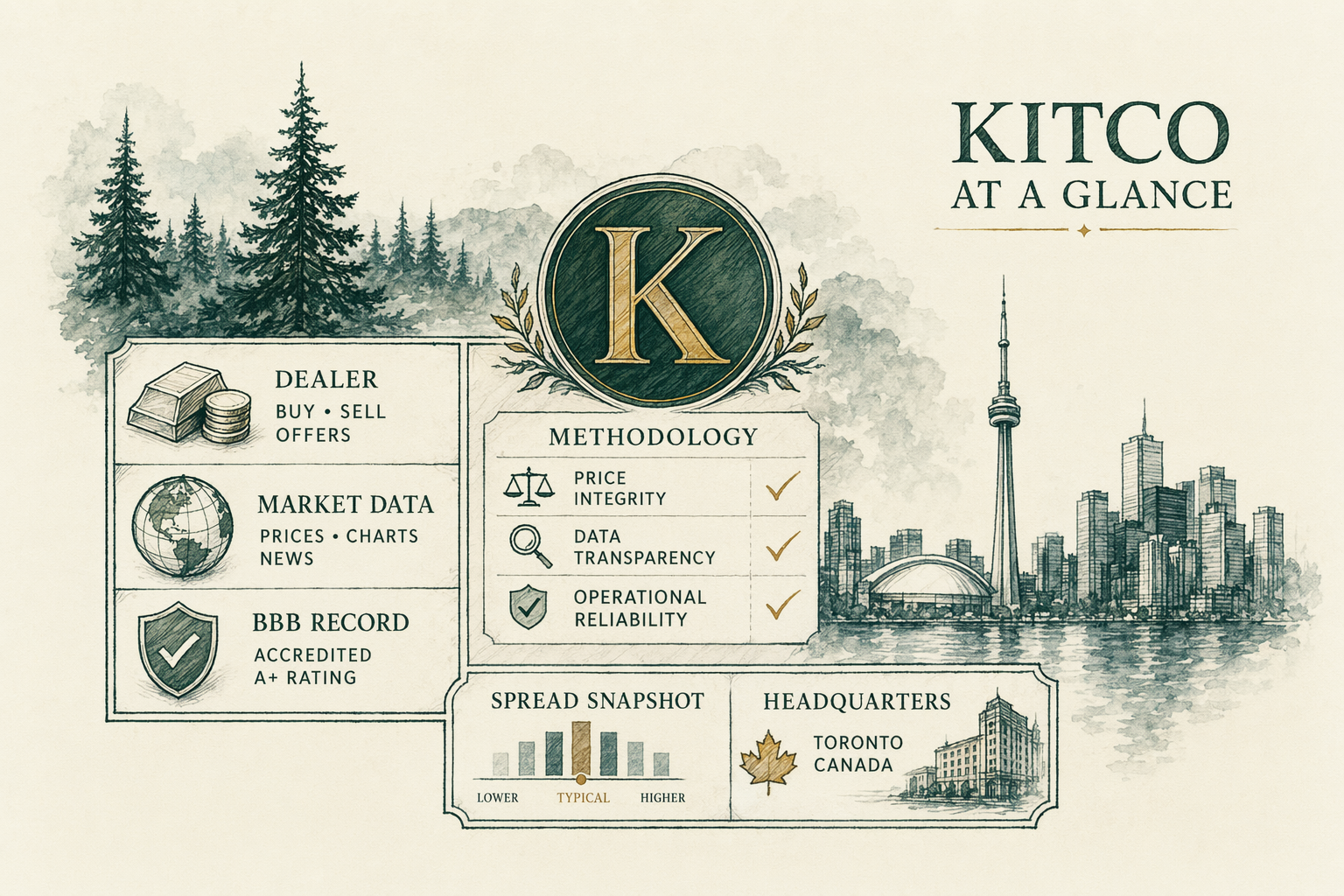
Kitco background, role as both dealer and market data provider, BBB record, spread snapshot, and the Canadian-Toronto headquarters context.
Founding and background
Kitco was founded in 1977 by Bart Kitner and is headquartered in Montreal, Quebec, Canada. The company is one of the longest-tenured precious-metals firms operating internationally, predating the major US online dealers by several decades. Kitco grew the price-streaming and editorial brand alongside the dealer operations; the price-stream visibility is a marketing asset that, in turn, has helped grow the dealer side.
The company maintains operations in Canada, the United States, Hong Kong, and Shanghai. US-facing dealer services route through Kitco's US subsidiary; Canadian-facing services route through the Montreal headquarters. The dual operating structure brings the cross-border considerations covered below. Snapshot as of `2026-Q2`.
Dealer business vs market data business
Kitco's price ticker — the headline number visible on Kitco.com and reproduced on many third-party financial sites — is the company's internal calculation of bid and ask quotes derived from aggregated wholesale market data. It is a useful directional reference for the bullion price; it is not the LBMA daily fix (which is the actual benchmark used by mints and large institutional bullion settlements). For research purposes, the LBMA fix is the more authoritative reference; Kitco's ticker is the more real-time directional read.
The dealer business sells coins and bars at Kitco's published premium over the company's own internal spot calculation. The relationship between the price-data side and the dealer side is structurally similar to how a bank publishes an FX rate and also conducts FX trades — the dealer's quoted spread is real, but the comparison against an independent benchmark (LBMA fix or another major dealer's same-hour quote) is the right way to assess pricing.
Kitco also runs editorial coverage — Kitco News — which publishes market commentary, mining industry reporting, and macroeconomic analysis. The editorial side is useful for context but reads as industry-sympathetic; it is not neutral analysis.
BBB record
Kitco's US subsidiary holds a BBB profile reflecting US-routed dealer transactions. The rating has historically been in the A range. Complaint volume reflects the dealer's transaction count — fewer complaints in absolute terms than APMEX or JM Bullion (both larger US-only dealers), but a complaint rate per transaction in the typical mid-tier range.
Kitco has historical Canadian regulatory considerations — the company restructured under Canadian creditor protection in 2015 following tax-related issues with Canadian authorities. The matter resolved; Kitco continues to operate. The Canadian filing is separate from the US-facing dealer business; a US buyer's regulatory frame remains primarily US-side (BBB, state attorney general, federal agencies).
Spread snapshot
Spreads on common products from Kitco's US-facing operation as of `2026-Q2`, wire-transfer pricing, verified against the LBMA daily fix: `1 oz American Gold Eagle` at approximately `4-5%` over spot; `1 oz Canadian Gold Maple Leaf` (a category where Kitco is more competitive, given the Canadian connection) at `3-4%` over spot; `1 oz` PAMP Suisse bars at `2-3.5%` over spot.
The American Gold Eagle pricing is generally a touch higher than the lowest-quoting US dealers (SD Bullion, BGASC, Provident Metals) and comparable to APMEX and JM Bullion. The Canadian Maple Leaf pricing is competitive — sometimes class-leading — reflecting Kitco's Canadian distribution channels. For a buyer specifically interested in Canadian-mint products, Kitco is worth quoting first.
Cross-border considerations for US buyers
Kitco's US-facing dealer services route through US-based fulfillment, so a typical US online order ships from a US warehouse to a US address with no customs involvement. Verify the shipping origin on the order confirmation — if the order is being filled from a Canadian warehouse, customs and import duties apply, and the landed cost calculation changes meaningfully.
Payment routing is straightforward for US-facing orders. The buyer pays a US-routed account in US dollars; the transaction is structurally identical to ordering from a US dealer.
Tax reporting follows US rules: monetary precious metals are subject to the destination state's sales-tax treatment (some states exempt, some apply), and gains on resale are reported as US capital gains under IRS rules. The Canadian headquarters does not affect the US tax treatment of the bullion in a US-resident's hands. For more on the US tax treatment of gold sales, see our guide on US gold taxation.
Want to talk this through? Book a 30-min research call →
Frequently asked questions
-
When was Kitco founded?
Kitco was founded in 1977 and is headquartered in Montreal, Canada, making it one of the older firms in the global bullion business. -
Is Kitco the same as the Kitco price ticker?
Same company. Kitco operates a widely-referenced precious metals price stream alongside its dealer business. -
Do US buyers face cross-border issues?
Kitco operates US-facing dealer services. Confirm shipping origin, customs handling if applicable, and tax reporting for your jurisdiction. -
How do I compare this dealer to others?
Pull a same-product quote (one 1 oz American Gold Eagle, wire-transfer payment, shipped to your state) from three dealers at the same minute. Compare total landed cost — premium, surcharge, shipping. Spread differences are real but seldom huge between established dealers.
In plain English We're an editorial desk. Educational only — talk to a licensed adviser before doing anything with retirement assets.