Is SD Bullion a legitimate dealer?
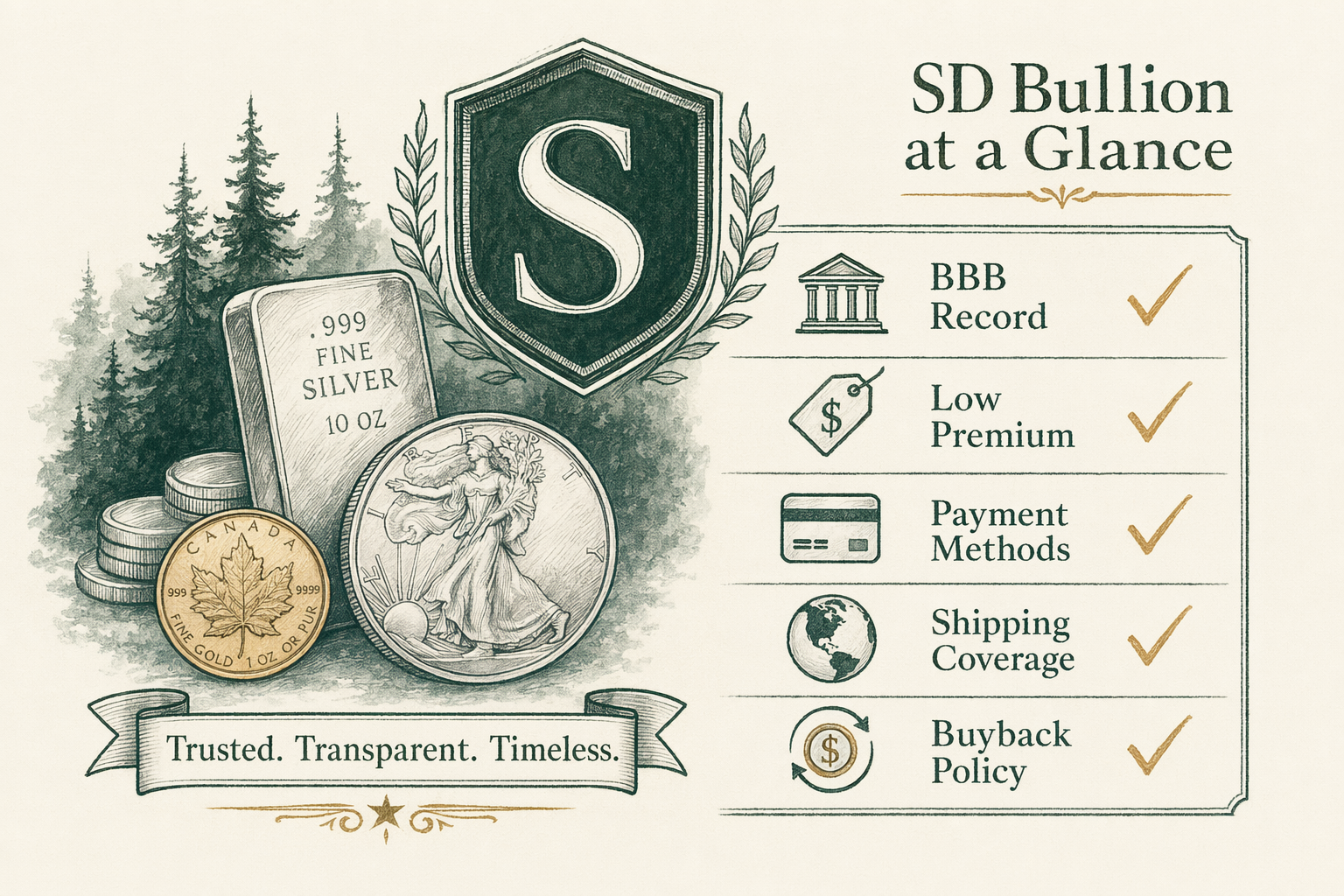
SD Bullion background, BBB record, low-premium positioning, payment methods, shipping coverage, and buyback policy.
Founding and background
SD Bullion was founded in 2012 by Doc Eifrig and is headquartered in Glen Burnie, Maryland. The company is privately held. The corporate name SD Bullion derives from Silver Doctors, the precious-metals editorial brand the principals operated prior to launching the dealer business.
The company occupies a specific niche: high-volume, low-margin online bullion sales with explicit positioning on lowest published spot-plus premiums. The business model relies on order volume and operational efficiency rather than on customer-acquisition spend. Marketing is meaningfully more restrained than at APMEX or JM Bullion. Snapshot as of `2026-Q2`.
BBB record
SD Bullion holds an `A+` rating with the Better Business Bureau and is BBB-accredited. The complaint volume is moderate — fewer in absolute terms than APMEX or JM Bullion (both larger), but a complaint rate per transaction that sits within the typical online-dealer range.
Complaint categories at SD Bullion skew toward shipping delays during peak market periods, communication issues during high-volume order surges, and isolated disputes over order cancellations during sharp spot-price moves (a category-wide issue when wholesale supply tightens). The company has historically responded to BBB complaints; no active state regulatory matter against SD Bullion appears in this snapshot.
Spread snapshot
Spreads on common products at SD Bullion as of `2026-Q2`, wire-transfer pricing, verified by same-hour quote against the LBMA daily fix: `1 oz American Gold Eagle` at roughly `3-4%` over spot; `1 oz American Silver Eagle` at approximately `12-18%` over silver spot; `1 oz` PAMP Suisse bar at `1-2.5%` over spot.
These are competitive prints. APMEX and JM Bullion's same-hour quotes on identical products sit `0.5-1.5%` higher on the gold products, with comparable or slightly tighter spreads on the silver products. The differential is real on wire-paid orders. On credit-card-paid orders, the comparison flips on some products.
Payment surcharges
SD Bullion's published payment-method surcharge structure runs approximately: bank wire and check at the base (lowest) price; credit card at base plus `3-4%`. PayPal availability is limited; specific products may not be eligible for card payment at all.
The structural reason: card-network fees on a bullion purchase are non-trivial on a low-margin product. SD Bullion passes the fee through transparently rather than absorbing it. Competing dealers handle this differently — APMEX, for instance, has at times absorbed card fees on certain promotions, recovering them through higher base premiums.
For a buyer paying by wire or check, SD Bullion's pricing is competitive and the headline-vs-landed-cost gap is narrow. For a buyer who would prefer card payment for chargeback protection, the math flips. The category-wide rule of thumb: bullion at scale should be paid by wire.
Shipping coverage
SD Bullion ships insured to all 50 US states. Standard insurance covers the full order value during transit; the buyer should verify delivery and contents on receipt, photograph any package damage prior to opening, and report discrepancies within the dealer's stated window (typically 48 hours of delivery).
Shipping costs are calculated on the order — small orders carry proportionally higher per-ounce shipping than large orders. The minimum-order threshold and the free-shipping threshold both change occasionally; check current rates before placing the order. For orders large enough to justify it, requesting a registered-mail shipment with explicit signature delivery is good practice — a step the buyer initiates, not the dealer.
Want to talk this through? Book a 30-min research call →
Frequently asked questions
-
When was SD Bullion founded?
SD Bullion was founded in 2012 and is headquartered in Glen Burnie, Maryland. -
Is SD Bullion really lower-premium than competitors?
SD Bullion has positioned itself on low premiums over spot. Headline pricing can be competitive, but factor in payment surcharges and shipping when comparing total cost. -
How do I compare this dealer to others?
Pull a same-product quote (one 1 oz American Gold Eagle, wire-transfer payment, shipped to your state) from three dealers at the same minute. Compare total landed cost — premium, surcharge, shipping. Spread differences are real but seldom huge between established dealers. -
What documentation should I keep?
Save the dealer invoice, order confirmation email, and shipment tracking. The invoice is your tax basis if you ever sell. Dealer records can be lost in business reorganizations — your own copy is the authoritative reference.
In plain English We're an editorial desk. Educational only — talk to a licensed adviser before doing anything with retirement assets.