What happened to allocated storage after MF Global
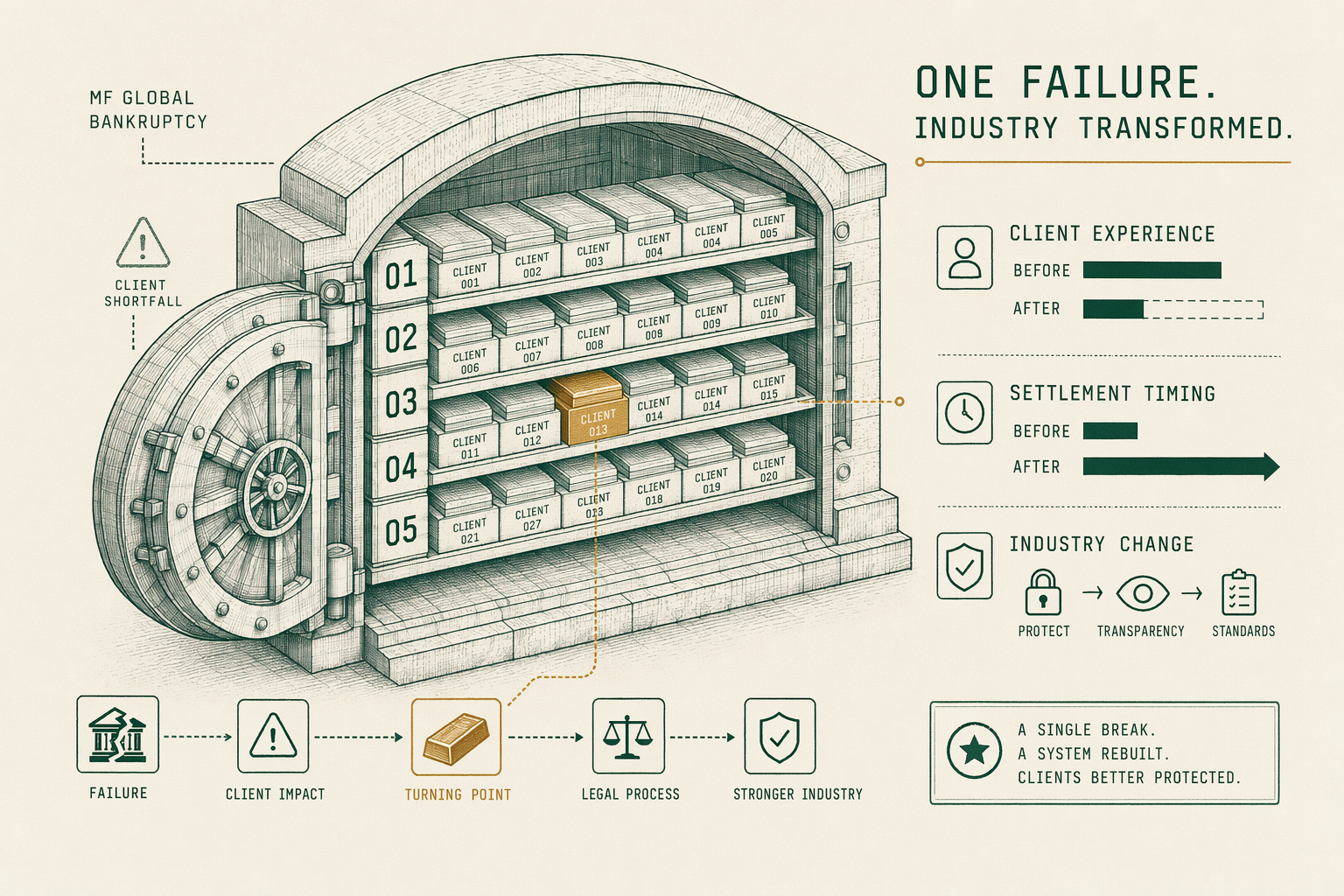
The MF Global bankruptcy and how it reshaped the allocated-storage industry: client claim experience, settlement timing, and post-crisis industry changes.
Background on MF Global
MF Global Holdings Ltd. was a US-headquartered futures broker and primary dealer. As of mid-2011 it was the eighth-largest US broker-dealer by customer assets and a major participant in COMEX futures markets. The firm had been led since March 2010 by Jon Corzine, the former Goldman Sachs co-CEO and former US Senator and Governor of New Jersey, with Corzine's stated strategic objective being to transform MF Global from a futures broker into a full-service investment bank.
The transformation strategy centered on a proprietary trading position in European sovereign debt. Through 2011, MF Global accumulated a leveraged proprietary position of approximately `$6.3 billion` in short-dated European sovereign bonds (Italian, Spanish, Portuguese, Belgian, Irish), funded through repo financing using the bonds themselves as collateral.
The strategy depended on the bonds being held to maturity (capturing the spread between the coupon yield and the cost of repo financing) and on the firm's lenders continuing to roll the repo financing. Through the summer and fall of 2011, the European sovereign debt crisis intensified. Repo counterparties became increasingly reluctant to roll MF Global's financing as collateral values declined and as concerns about MF Global's own credit profile rose.
By late October 2011, MF Global was experiencing severe liquidity stress. The firm's credit rating was downgraded to junk on October 24. Customer-segregated funds were drawn down in the final days as the firm sought to meet collateral calls and operational requirements. The total customer-segregated-funds shortfall as ultimately reconstructed by the SIPA liquidation trustee was approximately `$1.6 billion`.
The October 2011 bankruptcy
MF Global Holdings Ltd. filed Chapter 11 bankruptcy on October 31, 2011 in the US Bankruptcy Court for the Southern District of New York. The operating broker-dealer subsidiary MF Global Inc. entered the parallel SIPA (Securities Investor Protection Act) liquidation process on the same day, with James W. Giddens appointed as SIPA Trustee.
Approximately `38,000` customer accounts were affected. Customer assets at MF Global included cash, securities, futures positions, and physical commodity positions including precious metals stored through MF Global's metals desk and through broker-intermediated relationships with COMEX-approved depositories.
The immediate aftermath was chaotic. Customer positions were frozen. Customers could not withdraw funds or transfer positions. The futures-exchange clearing operations worked through October 31 - November 7 to facilitate orderly close-out of customer positions on COMEX and other exchanges; cash and other-non-position-related assets remained frozen pending SIPA-trustee processing.
The $1.6 billion customer-segregated-funds shortfall became publicly known in early November 2011. The shortfall meant that customer-segregated funds — which by CFTC regulation should have been held strictly separate from the firm's own funds and operationally untouchable for proprietary purposes — had been drawn down by the firm in the final days. The CFTC and the SEC opened parallel investigations. The Department of Justice opened a criminal inquiry that ultimately did not result in indictments of senior personnel.
The Senate Permanent Subcommittee on Investigations and the House Financial Services Committee held hearings throughout 2012 examining the failure. The hearings produced extensive documentary record now available in the Congressional archive.
Customer segregation rules and what failed
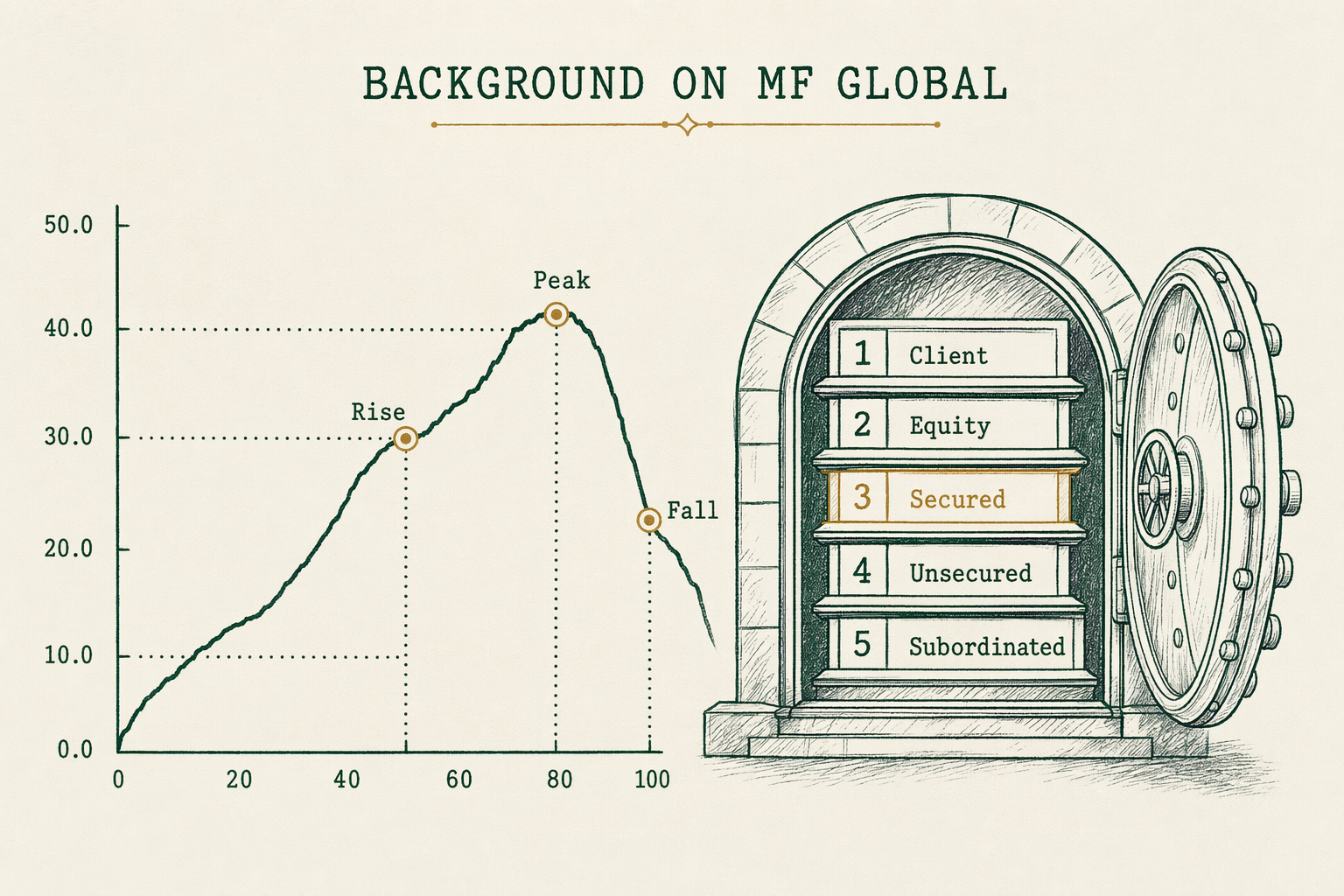
CFTC regulation under Section 4d of the Commodity Exchange Act requires futures brokers to segregate customer funds from the firm's proprietary funds. Customer funds may not be commingled with the firm's funds and may not be used for the firm's proprietary operations.
The MF Global failure mode was not a sudden one-day raid on customer segregated funds. Rather, the firm experienced sustained funding pressure across late October 2011 and progressively drew down available cash positions, including (in violation of CFTC segregation rules) customer-segregated-funds balances. Final-day transactions in particular drew heavily from segregated accounts to meet exchange margin calls and counterparty collateral demands. The exact sequence of transactions was the subject of forensic accounting that took months to reconstruct in the SIPA process.
For precious-metals customers specifically, the segregation framework was more layered than for cash customers. Cash customer segregation operated at the broker-dealer level. Precious-metals customers' physical metal was typically held at COMEX-approved depositories through broker-intermediated arrangements — meaning the metal physically sat at the depository, but the customer's relationship was with the broker, who in turn maintained a depository account.
The broker-intermediated layer was where the operational ambiguity emerged. The depository's books showed the metal allocated to MF Global's depository account. MF Global's books showed sub-allocation to specific customer accounts. The two records were intended to reconcile and at most moments did. Whether the documentation chain established legal allocated title at the customer level — rather than at the broker level — depended on the specific contracts, the specific record-keeping practices, and ultimately on the SIPA trustee's interpretation of the records.
Allocated metal — what was returned, when, and at what fraction
The SIPA liquidation process for MF Global Inc. took approximately five years to substantially complete. The Trustee, James W. Giddens, made an initial customer distribution announcement in February 2012 covering a portion of customer claims; subsequent distributions occurred across 2012-2017 as the asset-recovery process advanced.
For bullion-customer claims specifically, the eventual recovery was substantially complete. Per the Trustee's published reports and the case dockets, customers with valid documented allocated-metal claims ultimately recovered metal (or cash equivalent at market prices) for the substantial majority of their claims, in some cases at par.
The recovery timing varied. Some customers received metal or cash distributions within months of the bankruptcy filing through interim distributions. Others waited multiple years for full settlement, particularly where the documentation chain was more complex or where the specific allocated-storage arrangements required reconstruction.
The interim period imposed real costs on affected customers. Customers needing liquidity during the multi-year SIPA process could not access frozen positions; some sold claims in the secondary market for distressed-claims buyers at discounts ranging from materially-below-par to near-par depending on the specific claim and the timing. Customers needing to maintain hedge positions had to re-establish those positions outside the MF Global relationship, often at higher all-in costs.
Importantly, the eventual substantial-full-recovery result for bullion customers reflected (a) the Trustee's diligent asset-recovery work, (b) industry-coordinated cooperation including transfers of allocated metal from COMEX-approved depositories that had been holding MF Global account positions, (c) parallel litigation that improved the recovery rate, and (d) supplemental industry-sourced funds. The result was not pre-ordained from the bankruptcy filing — it took five years of process work to land there.
Post-MF-Global industry changes
The MF Global case prompted material structural changes in the allocated-storage industry, especially around broker-intermediated arrangements.
First: increased emphasis on third-party audits of allocated holdings. Post-MF-Global, major depositories implemented more rigorous independent-audit cadences specifically focused on reconciling broker-intermediated client positions to depository inventories. The Lloyd's of London underwriting framework requires independent audit, and the audit specifications became more granular for broker-intermediated allocated positions.
Second: more granular client-documentation requirements. The MF Global case demonstrated that documentation gaps in broker-intermediated arrangements could create ambiguity about who held legal allocated title. Post-MF-Global industry practice moved toward clearer documentation chains, with allocated-storage agreements increasingly identifying the depository as the bailee with the customer directly identified as the bailor (rather than the broker being the bailor on the customer's behalf).
Third: increased client demand for direct depository custody rather than broker-intermediated arrangements. Post-MF-Global, retail-and-institutional clients moved meaningfully toward direct depository relationships (where the documentation chain runs directly between the client and the depository, with the broker if any in an advisory or transaction-facilitator role only). The major IRS-approved depositories for Gold IRA holdings (Delaware Depository, Brink's Global Services USA, International Depository Services) all operate predominantly direct-custody models with the Gold IRA custodian and the customer as direct counterparties to the depository.
Fourth: clearer SIPA-vs-non-SIPA awareness in industry communications. The MF Global SIPA process applied because the broker-dealer was registered. Many non-broker bullion-storage arrangements — direct depository arrangements at IRS-approved depositories, private-vault arrangements outside the broker-dealer regulatory perimeter — do not have the SIPA framework. The industry communication post-MF-Global is clearer about which protective frameworks apply where.
Fifth: increased emphasis on the LBMA Bullion Vault Code of Conduct and analogous frameworks. The LBMA published expanded vault-operator best-practice guidance through the 2010s in part as institutional response to the operational ambiguities the MF Global case surfaced.
Lessons for current allocated-storage clients
Three lessons from the MF Global sequence apply to current allocated-storage clients.
Lesson one: prefer direct-depository custody to broker-intermediated arrangements where possible. The MF Global case demonstrated that broker-intermediation creates a documentation-chain risk that direct-depository custody does not. For Gold IRA holdings, the direct-depository model (custodian → depository → customer) is the standard structure at major IRS-approved depositories. For after-tax holdings, ask whether the storage arrangement is direct or broker-intermediated, and prefer direct where the option exists at comparable cost.
Lesson two: read the allocated-storage agreement explicitly. The agreement should identify the depository as the bailee, identify the customer as the bailor, explicitly prohibit lease/lend/pledge of the customer's metal, and provide for monthly or quarterly serial-number-level holdings statements to the customer (not just to any intermediary). If the agreement does not do all four, the arrangement is not allocated in the strict property-law sense regardless of marketing terminology.
Lesson three: verify reconciliation independently. A genuinely-allocated client should receive monthly or quarterly holdings statements with bar-by-bar specifics (refiner, serial number, weight, fineness). Cross-reference the statements against the depository's annual independent audit report (where available). For Gold IRA holdings, ensure the IRA custodian's statements reconcile to the depository's statements, with serial numbers visible at both layers of the chain.
These three steps do not eliminate counterparty risk — no documentation regime can eliminate the operational risk that an institution fails and the recovery process becomes complex. They do meaningfully reduce the risk that 'allocated on paper' fails to mean 'allocated in practice' the way the MF Global broker-intermediated arrangements did in 2011.
Where to learn more
Primary sources: the MF Global Inc. SIPA liquidation case docket (Case No. 11-2790-mg, US Bankruptcy Court for the Southern District of New York); James W. Giddens's Trustee reports issued across 2011-2017; the parallel Chapter 11 case for MF Global Holdings Ltd. (Case No. 11-15059); the Senate Permanent Subcommittee on Investigations' 2012 hearing record; the House Financial Services Committee's 2012 hearing record; the CFTC enforcement record against MF Global personnel; and the contemporaneous Wall Street Journal, Reuters, Financial Times, and Bloomberg coverage from October 2011 forward.
Industry-response documentation: the LBMA's Bullion Vault Code of Conduct (current version available through the LBMA's published-standards section); the post-MF-Global revisions to CFTC customer-segregation rules; the relevant National Futures Association (NFA) compliance bulletins from 2012-2014.
Analytical treatments: the 2013 Federal Reserve Bank of New York Staff Report on MF Global and related broker-dealer failures; the 2014 Office of Financial Research analysis on customer-asset protection; academic treatments in the Journal of Financial Regulation and the broader law-and-finance literature on broker-dealer customer-asset protection.

In plain English
In plain English: in October 2011, the eighth-largest US futures broker collapsed with a $1.6 billion hole in customer-segregated funds. Bullion customers — those holding metals through MF Global's brokerage rather than directly at a depository — entered a five-year process. Most ultimately recovered their full claims, but the recovery wasn't immediate and the interim caused real liquidity pain. The case taught the industry that 'allocated on paper' didn't always mean 'allocated in practice' when a broker sat between the customer and the depository. Post-MF-Global, major depositories tightened audit and documentation practices, and direct-depository custody (the customer directly contracts with the depository) became the dominant structure. For current allocated-storage clients: prefer direct custody, read the storage agreement, verify reconciliation. Those three steps reduce the risk of the same operational ambiguity MF Global revealed.
Frequently asked questions
-
Did MF Global clients lose their allocated metal?
Complicated. Most allocated bullion clients ultimately recovered their full claims after a multi-year SIPA liquidation process, but recovery was not immediate and significantly stressed clients' liquidity in the interim. The case became a structural reminder that allocated-on-paper requires verification of actual segregation in practice. -
What changed in the industry after?
Greater emphasis on third-party audits of allocated holdings, more granular documentation requirements, and increased client demand for direct depository custody rather than broker-intermediated allocated arrangements. -
Is BullionLens an investment adviser based on these case studies?
No. Case studies are historical event analyses, not recommendations. We are an editorial research desk. Consult a licensed adviser before applying any historical pattern to your own situation. -
How are the case studies sourced?
Primary financial-market data (LBMA fixings, COMEX volume, World Gold Council reports), SEC filings of involved entities, court records where applicable, and contemporary news coverage. Every claim of fact carries a citation in the body.
In plain English A historical event, not a forecast. Numbers are sourced from LBMA + WGC + primary regulatory filings.