What is allocated storage?
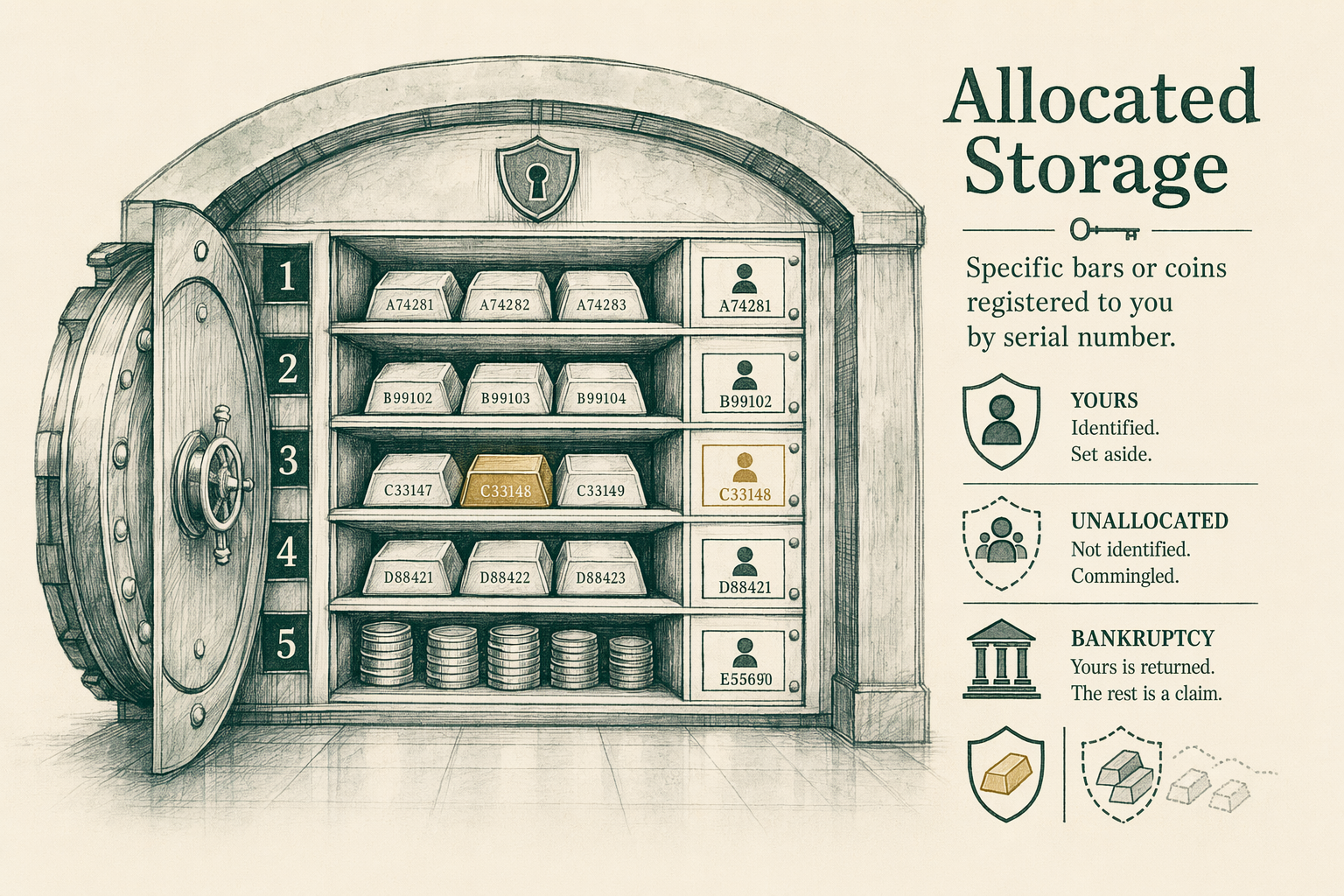
Allocated storage means specific bars or coins registered to you by serial number. The distinction from unallocated, and why it matters in a bankruptcy.
The textbook definition
Allocated storage is a custodial arrangement in which specific physical bars or coins, identified by serial number, weight, and refiner, are registered in the customer's name in the depository's ownership records. The customer holds legal title to those specific items; the depository holds them in bailment — a custodial relationship under which the depository must return the same identified items on demand. This contrasts with unallocated storage, where the customer holds a claim against a pool of metal owned by the depository, with no specific items earmarked.
The distinction is structural, not cosmetic. Allocated metal is the customer's property; the depository is custodian, not owner. Unallocated metal is the depository's property, with the customer as creditor for the agreed weight. In a normal-operations world, both structures function similarly — the customer can draw metal or sell it at any time. In a stress scenario (depository bankruptcy, regulatory failure, court-ordered claims process), the legal framing diverges sharply. Allocated holdings should not enter the depository's bankruptcy estate (subject to clean documentation); unallocated holdings make the customer a general creditor.
How allocated registration works
When you deposit metal into allocated storage (whether shipped from a dealer or transferred from another depository), the receiving facility inventories each item: serial number for bars, quantity-and-type for coins, gross weight, fineness, refiner identifier. The depository's records register these specific items as held under bailment for your account. The bailment relationship is contractually framed in the storage agreement you sign — the document is the load-bearing legal record of what's held for you, by whom, on what terms.
Allocated storage typically takes one of two configurations. Segregated allocated: your specific bars and coins are stored physically separate from other clients', often in a dedicated compartment, vault drawer, or numbered shelf section. Commingled allocated (also called 'allocated, commingled storage' or 'pooled allocated'): your specific bars are tracked individually in records but stored on shelves alongside other clients' bars. Both are legally allocated — the metal is yours by serial number — but segregated provides additional physical separation. Segregated typically costs more annually; commingled is cheaper because the depository's space-utilization is higher.
Documentation you should receive
From the depository directly, the documentation set should include: storage agreement (the legal contract setting custodial terms), original deposit receipt (listing each bar/coin by serial number on initial deposit), and recurring holdings statements (monthly or quarterly, listing current bars/coins by serial number and weight, your account number, and the depository's certification that the holdings are held under allocated bailment). Many major depositories (Delaware Depository, Brink's, IDS) publish monthly statements as standard.
Request and verify these documents. The storage agreement should explicitly: identify the depository as bailee; identify you as bailor with legal title; prohibit the depository from leasing, lending, pledging, or otherwise encumbering your metal; describe the audit and verification regime; and specify procedures for delivery on demand. Statements should show specific serial numbers (not just aggregate ounce totals). If your documentation shows only aggregate weight without serial-number specificity, your arrangement may be unallocated or commingled-allocated rather than segregated allocated — confirm with the depository which configuration applies.
Why it matters in a vault bankruptcy
Vault and dealer bankruptcies historically have shown the practical importance of the allocated-versus-unallocated distinction. In the `2011` MF Global bankruptcy, customers with properly documented allocated metal holdings ultimately recovered their full claims (after a multi-year SIPA liquidation process), while unallocated/segregated-customer-fund situations triggered shortfalls and protracted disputes. The case taught the industry that 'allocated' on paper requires verification of actual segregation in practice — title alone is not enough if records or physical custody have been compromised.
Post-MF-Global, the depository industry tightened documentation standards, increased third-party audit frequency, and reduced the prevalence of broker-intermediated allocated arrangements in favor of direct depository custody. Customers with clean allocated documentation should expect their metal to not enter the depository's bankruptcy estate; the legal pathway is to file a claim asserting the bailment, present documentation, and obtain release. In practice, this can take months or longer even in well-documented cases, and customer liquidity is constrained during the period. Documentation discipline is what makes the allocated structure work as designed.
Comparing allocated to unallocated
Annual cost comparison (illustrative, varies by depository and metal weight): unallocated storage often runs `$50-100/yr` for moderate gold holdings; commingled-allocated runs `$100-150/yr`; segregated-allocated runs `$150-300/yr`. The cost premium for allocated reflects the bookkeeping and physical-custody discipline involved — depositories charge for the documentation and the physical-segregation work, not just the rented vault space.
Counterparty-risk comparison: unallocated holders are general creditors of the depository for the agreed weight; in a stress scenario they share in any shortfall. Allocated holders should be able to claim specific metal not in the bankruptcy estate. For sums where the cost difference matters meaningfully (small holdings where `$200/yr` versus `$50/yr` represents `1%+` annual drag), unallocated may be defensible. For sums where the counterparty-risk asymmetry dominates (any meaningful retirement allocation, IRA holdings — which generally must be allocated anyway), the cost premium is well worth it.
Real-world example — confirming allocated holdings at Delaware Depository
Consider a Gold IRA owner with `30 × 1 oz` American Gold Eagles held at Delaware Depository Service Company under Equity Trust Company as custodian, in segregated allocated storage. The owner wants to verify the holdings are properly allocated. Sequence: request from Equity Trust a copy of Delaware Depository's most recent holdings statement for the owner's account. Statement arrives showing `30 × 1 oz American Gold Eagle` with each coin counted individually, the depository's signed certification of allocated storage, the owner's specific account/sub-account identifier, and the statement date.
The owner cross-references the statement against their original purchase invoice from the Gold IRA marketing company (which should show `30 × 1 oz Gold Eagle` matching). If counts and weights match, the metal is properly allocated and registered. If they don't match, the owner immediately contacts Equity Trust and Delaware Depository in writing for reconciliation. Confirming holdings annually is the recommended discipline — depository statements are issued monthly at most facilities, but spot-checking them periodically catches discrepancies early. The whole verification cycle takes `15 minutes` of attention and is the practical equivalent of the audit discipline institutional bullion investors apply quarterly.
Common misconceptions about allocated storage
**'All Gold IRA storage is allocated.'** Generally yes for IRS-approved depositories serving Gold IRAs, but configurations differ — segregated allocated vs commingled allocated produce different physical-custody arrangements with legally identical title structure. Confirm with the custodian which configuration your specific account uses.
**'Allocated storage is the depository's promise of recovery.'** No. Allocated storage is a contractual bailment with title held by the customer. Recovery depends on documentation discipline and the depository's operational integrity. The structure works as designed only when documentation is clean and audit discipline is enforced.
**'My broker can hold my allocated metal.'** Broker-intermediated allocated arrangements add a layer of counterparty risk (the broker, not just the depository). Direct depository custody removes that layer. Post-MF-Global, the industry has moved toward direct depository custody where possible.
What this means for you
Allocated storage means specific bars or coins are registered in your name in the depository's records — you hold legal title, the depository holds physical custody under bailment. For Gold IRA holdings, allocated storage is the standard structure at IRS-approved depositories; confirm your specific arrangement (segregated vs commingled-allocated) with your custodian. Read the storage agreement and verify monthly holdings statements show specific serial numbers. Documentation discipline is what makes the allocated structure deliver its theoretical advantages in a stress scenario. The cost premium over unallocated is small relative to the counterparty-risk asymmetry. As always, BullionLens does not provide personalized advice; consult a licensed adviser before making custody-structure decisions on significant retirement assets.
Want to talk this through? Book a 30-min research call →
Frequently asked questions
-
Does allocated storage mean I own specific bars?
Yes — specific bars or coins, identified by serial number and weight, are registered in your name in the vault operator's ownership records. You hold legal title to those specific items. -
Is allocated storage more expensive?
Yes. Allocated typically costs 50-150% more than unallocated of the same metal weight, because the vault is providing item-level custody rather than pooled bookkeeping. -
Can the vault lend out my allocated metal?
Under a properly drafted allocated agreement, no. Verify the agreement explicitly prohibits the vault from leasing, lending, or pledging the metal. Read the storage contract before signing. -
How do I confirm my bars are allocated?
Request the depository's allocated holdings statement listing bar serial numbers, weights, refiners, and your account number. Many depositories publish this monthly.
In plain English We're an editorial desk. Educational only — talk to a licensed adviser before doing anything with retirement assets.