Is JM Bullion a legitimate dealer?
JM Bullion background, BBB record, A-Mark Precious Metals parent relationship, shipping coverage, and buyback policy. Editorial review.
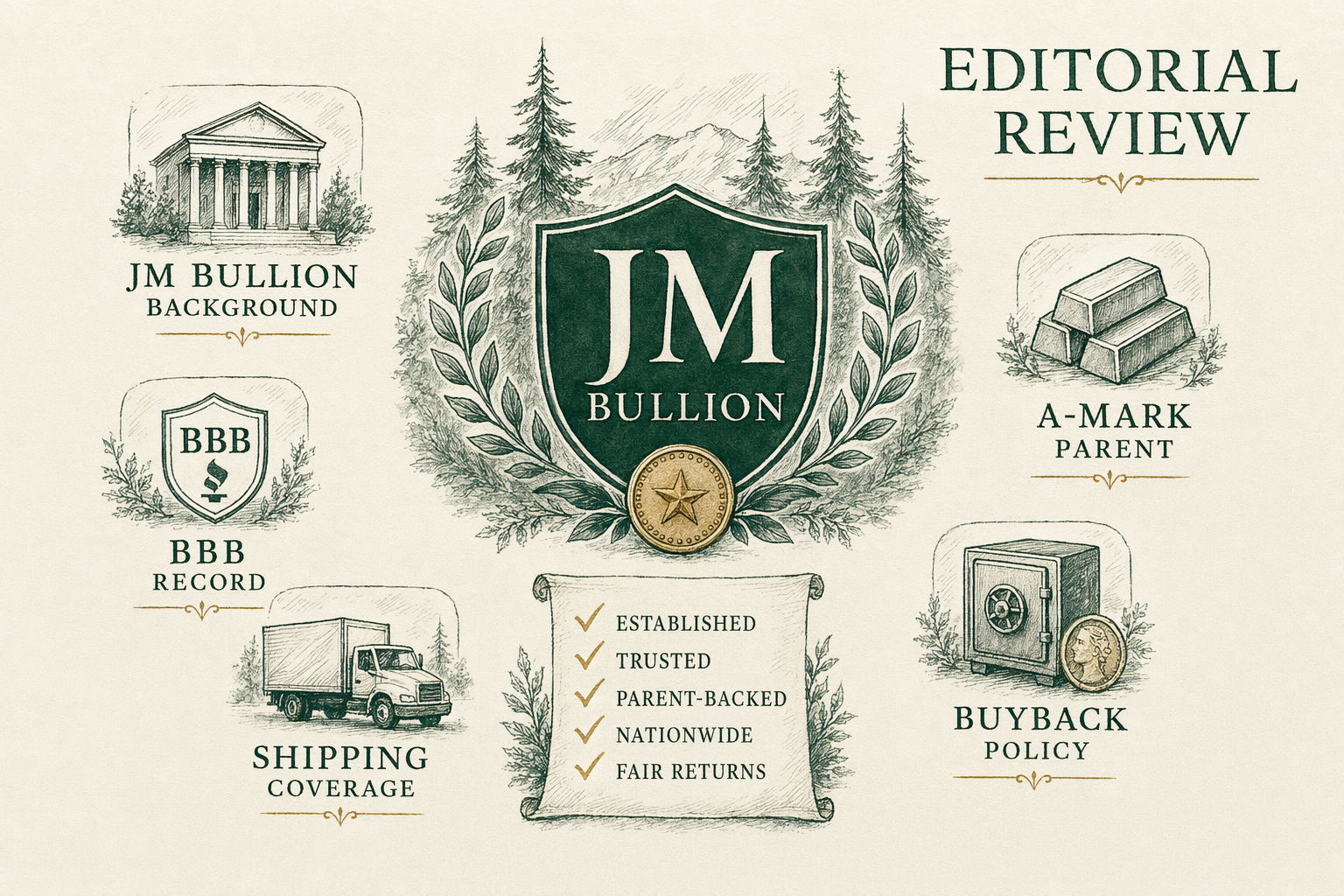
Founding and parent relationship
JM Bullion was founded in `2011` and is headquartered in Dallas, Texas. The company built rapidly on a low-spread, high-volume retail bullion model — it became one of the largest US online bullion dealers by the late `2010s`, alongside APMEX and Money Metals Exchange. In `2022`, JM Bullion was acquired by A-Mark Precious Metals (NASDAQ: `AMRK`), a publicly-traded precious metals wholesaler and dealer founded in `1965` and listed on the Nasdaq Global Select Market. The acquisition put JM Bullion inside a publicly-traded parent with audited financials and SEC reporting obligations.
The A-Mark parent relationship provides additional transparency that purely private dealers do not offer. A-Mark's `10-K` filings, quarterly `10-Q` filings, and proxy statements are publicly accessible via the SEC's EDGAR database. The filings disclose JM Bullion's revenue as a reporting segment, balance sheet position, and operating considerations. For investors who specifically want the institutional-transparency layer of a publicly-traded counterparty, this distinguishes JM Bullion from the private competitor universe.
BBB record
Better Business Bureau records for JM Bullion at the time of this snapshot show an A+ rating with BBB accreditation. Complaint volume sits in the moderate-to-typical range for an online dealer of JM Bullion's transaction scale, with the company responding within published BBB timelines. The complaint pattern visible in public BBB records mirrors what's typical across the industry: shipping disputes (late or damaged delivery), occasional disputes about returned items, and questions about pricing locked at order time versus pricing applied after additional processing.
Beyond BBB, Texas Secretary of State records show continuous good-standing for JM Bullion as a registered entity. Since the `2022` A-Mark acquisition, additional disclosure comes through A-Mark's SEC filings — material developments affecting JM Bullion as an A-Mark business segment must be disclosed to investors. There are no SEC enforcement actions against JM Bullion or A-Mark visible in the searchable record at the time of this snapshot. As always, primary-source verification before transacting: check BBB at bbb.org, the Texas Secretary of State business search, and A-Mark's most recent SEC filings if institutional transparency matters to your decision.

Spread snapshot on common products
JM Bullion's retail spreads on common products (`1 oz` American Gold Eagles, `1 oz` Gold Maples, `1 oz` Gold Buffalos) are in the industry-typical range — comparable to APMEX at the single-coin price level and typically a few percentage points wider than the deepest-discount dealers (Money Metals, SD Bullion) on identical products. JM Bullion's pricing model includes volume-tier discounts that narrow the gap on larger orders; orders of `20+ oz` typically see premium reduction, larger orders see further reduction.
The competitive position between JM Bullion and APMEX on identical products is typically `$5-30` per `1 oz` gold coin one direction or the other at any given moment — the two dealers compete actively, and pricing flexes by hour and by promotional state. The `/compare/apmex-vs-jm-bullion/` page on this site walks through a snapshot-dated comparison on the same product configuration. For most buyers, the right approach is to pull live quotes from both dealers (plus at least one discount dealer like Money Metals) at the same minute for the specific product configuration you intend to buy. The headline 'cheapest dealer' is not stable across products or time.
Payment methods and surcharges
JM Bullion accepts payment methods broadly similar to other major US online bullion dealers: bank wire (no surcharge), ACH/eCheck (small flat fee), check by mail (no surcharge), credit/debit cards (with surcharge, typically `2-4%`), PayPal (with surcharge), and cryptocurrency (with surcharge, varying by token). Bank wire is the cheapest method for orders above the `$500-1,000` range. Credit-card surcharges reflect processing cost and chargeback exposure on a reversible high-value product.
JM Bullion's promotional pricing occasionally differs by payment method — some products may be priced lower with a wire-or-check promotion that does not apply to credit-card payment. This is industry-standard but worth checking at order time. The actual price you pay should be visible at checkout for each payment method before you commit to the order; verify the all-in landed cost (premium + surcharge + shipping) under the payment method you intend to use, rather than assuming the lowest-listed price applies.
Shipping coverage
JM Bullion ships via USPS Registered Mail and UPS/FedEx with declared-value insurance, signature required at delivery, and no contents or insurance carrier disclosed on the package. Standard industry practice — packaging looks generic for security. Shipping is free above certain order thresholds (varies by promotion); below threshold, JM Bullion charges flat shipping scaled to insured value.
JM Bullion's published shipping policy includes a specific window for reporting any discrepancies (missing items, damage) on receipt — typically within `48 hours` of delivery as of the latest published policy, but confirm at order time. Reporting outside the window forfeits the dealer's transit-insurance recourse. Standard buyer obligations include signing for the package in person and not delegating signature to someone who would not preserve the package undamaged for inspection. After signature, post-delivery losses are the buyer's responsibility.
Buyback policy
JM Bullion's buyback program operates similarly to APMEX and other major dealers: customer initiates sell-back through an online portal or phone call, receives a quote good for a stated time window, ships items via the dealer's prepaid shipping label, the dealer inspects on receipt and confirms (or adjusts) the original quote, then pays via the customer's chosen method. Quote timing typically runs `1-2 weeks` from shipment to payment.
Buyback prices on commonly-traded bullion-grade products (`1 oz` Eagles, Maples, Buffalos) are competitive with industry norms — at or near spot for clean coins, with small spreads varying by product. For numismatic or specialty issues, the buyback spread can be wider. As with any dealer buyback, the quoted price is time-of-sale, not time-of-purchase; spot moves between when you bought and when you sell. Verify the buyback quote in writing and read the dealer's terms for conditions that allow adjustment after receipt (typically related to authenticity verification or physical condition).
Real-world example — buying 10 oz from JM Bullion
Consider a buyer ordering `10 × 1 oz` Canadian Gold Maple Leafs from JM Bullion at illustrative LBMA spot of `$2,400/oz`. JM Bullion's retail price (illustrative): `$2,475` per coin at the single-unit tier, dropping to `$2,460` per coin at the `10+`-coin volume tier. Total bullion cost: `$2,460 × 10 = $24,600`. Payment by bank wire: no surcharge. Shipping: free at this order size. Total all-in cost: `$24,600`.
On resale `2` years later (assuming flat spot), the buyer initiates a JM Bullion buyback. JM Bullion quotes `$2,380` per coin for the `10` Maples (slightly under spot, standard for clean bullion-grade product). Total quoted: `$23,800`. Customer ships via prepaid label; JM Bullion inspects on receipt and confirms. Payment by ACH arrives `7-10` business days from shipment. Round-trip cost: `$24,600 − $23,800 = $800`, or `3.3%` of initial purchase. Within industry norms; whether it's the lowest available cost depends on comparison with APMEX, Money Metals, and the buyer's local coin shop on both the original purchase and the eventual sell-back.
Common misconceptions about JM Bullion
**'JM Bullion is always cheaper than APMEX.'** Not always. The two dealers compete actively and pricing flexes by hour. For any given product at any given moment, either can be cheaper. Pull live quotes from both before deciding.
**'A-Mark ownership means JM Bullion is now riskier.'** Public-company parent ownership typically means more transparency (SEC filings, audited financials, SOX-controls infrastructure), not more risk. The acquisition has been net-additive to JM Bullion's institutional-counterparty profile.
**'I can return a coin after I buy it.'** JM Bullion has a return policy, but bullion products are typically returnable only within a short window after delivery and may carry restocking fees. Read the published return policy before assuming standard consumer-product return rights apply.
What this means for you
JM Bullion is a legitimate, established US bullion dealer with `15+` years of operating history, public-company parent (A-Mark Precious Metals, NASDAQ AMRK) bringing SEC-reporting transparency, A+ BBB rating at the time of this snapshot. Retail spreads are industry-typical and competitive with APMEX; volume-tier discounts on larger orders narrow the gap with discount dealers. Shipping is professionally managed with insured transit; buyback program operates within industry norms. For most retail bullion buyers, JM Bullion is a reasonable default alongside APMEX. Comparison-shop on the specific products you intend to buy at the time you intend to buy them. BullionLens earns a commission when a reader places an order through links on this page; see `/editorial-standards/` for our methodology.
Want to talk this through? Book a 30-min research call →
Frequently asked questions
-
Who owns JM Bullion?
JM Bullion was acquired by A-Mark Precious Metals (NASDAQ: AMRK) in 2022. A-Mark is a publicly-traded precious metals wholesaler founded in 1965. -
When was JM Bullion founded?
JM Bullion was founded in 2011 and is headquartered in Dallas, Texas. -
How does JM Bullion compare on spreads?
JM Bullion's retail spreads are within the industry-typical range. See /compare/apmex-vs-jm-bullion/ for a side-by-side. -
How do I compare this dealer to others?
Pull a same-product quote (one 1 oz American Gold Eagle, wire-transfer payment, shipped to your state) from three dealers at the same minute. Compare total landed cost — premium, surcharge, shipping. Spread differences are real but seldom huge between established dealers.
In plain English We're an editorial desk. Educational only — talk to a licensed adviser before doing anything with retirement assets.