GLD vs IAU — gold ETF comparison
Side-by-side comparison of SPDR Gold Shares (GLD) and iShares Gold Trust (IAU): expense ratio, custodian, share price scale, and liquidity.
Methodology and disclosure
**Editorial disclosure.** Gold ETFs are equity-market products held in brokerage accounts; BullionLens does not earn affiliate commission on GLD or IAU purchases (they are bought through brokerage accounts, not through dealer affiliate links). Editorial selection is independent — see [our editorial standards](/editorial-standards/). Reviewed `2026-Q2`.
GLD (SPDR Gold Shares) and IAU (iShares Gold Trust) are the two largest gold-backed exchange-traded funds in the United States by assets under management. Both track the spot price of gold through physical-gold backing held in institutional vaults. Both are listed on US stock exchanges and trade through standard brokerage accounts (Schwab, Fidelity, Vanguard, Robinhood, etc.). The differences worth surfacing are expense ratio, custodian structure, share-price scale, and liquidity.
We compare seven objective criteria: issuer and listing year, assets under management, expense ratio, custodian bank, share-price scale relative to spot gold, average daily trading volume, and tax treatment for US holders. Figures are from SEC filings (Forms `10-K`, `N-CSR`) and from each issuer's published fund-fact materials current as of `2026-Q2`. ETF data updates more frequently than the quarterly cadence; check the fund's website at trade time for the current expense ratio and AUM.
Issuer backgrounds
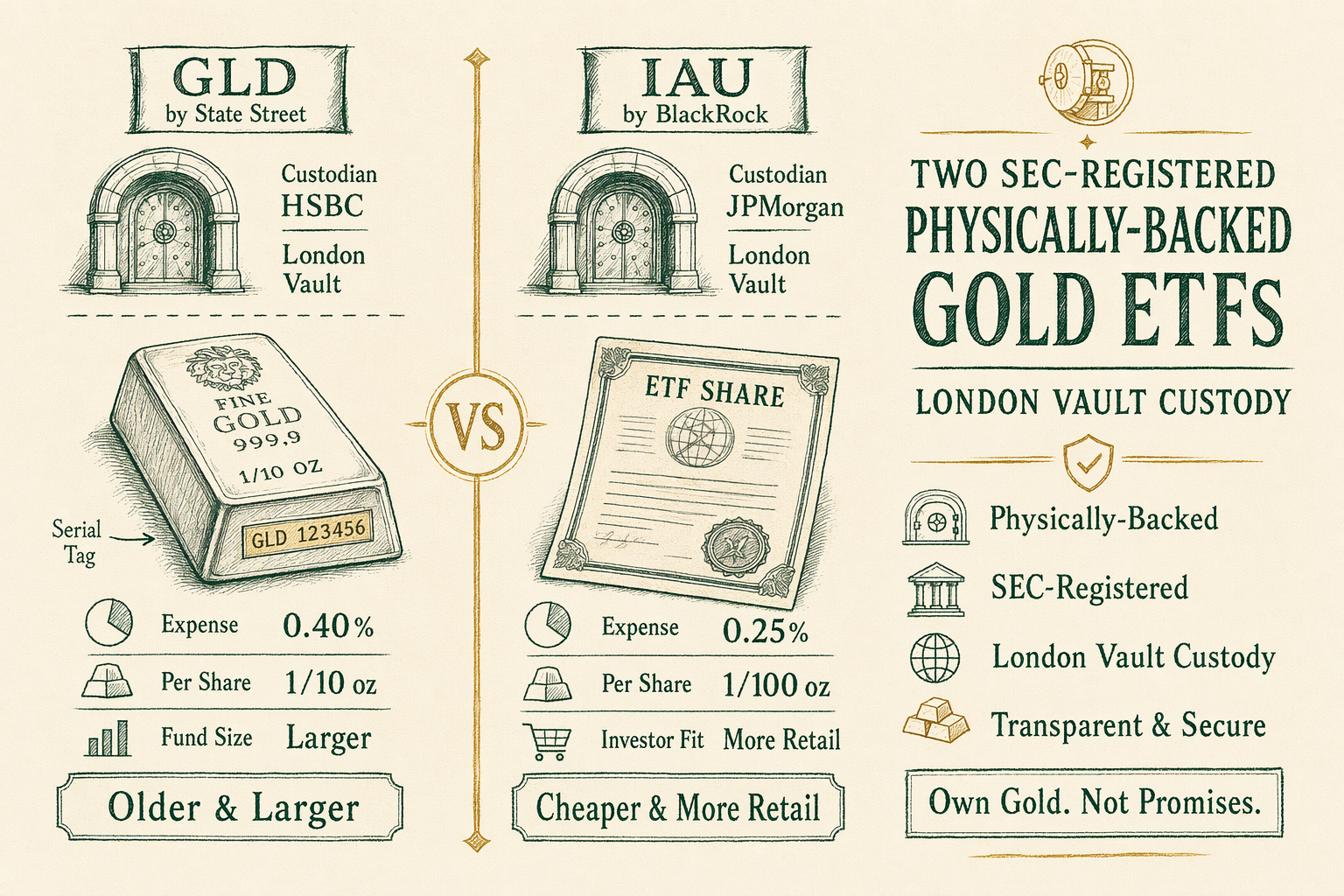
**GLD — SPDR Gold Shares** was launched in November `2004` and is sponsored by State Street Global Advisors. The fund operates as a grantor trust under the World Gold Council Trust Services LLC structure; the underlying gold is held by HSBC Bank USA (custodian). GLD was the first physically-backed gold ETF listed in the United States, and for many years it was the largest gold-backed exchange-traded fund in the world by assets under management. AUM as of `2026-Q2` is paraphrased in trade-press reports at approximately `$60`-`$75 billion`, with the figure moving daily on share-creation and redemption activity.
**IAU — iShares Gold Trust** was launched in January `2005` by Barclays Global Investors; the iShares fund family was acquired by BlackRock in `2009` and IAU now operates under BlackRock sponsorship. IAU's underlying gold is held by JPMorgan Chase Bank N.A. (custodian) at multiple London-based vault facilities. AUM as of `2026-Q2` is paraphrased at approximately `$30`-`$40 billion`, smaller than GLD's by a meaningful margin but the second-largest US-listed gold ETF.
Both funds are SEC-registered grantor trusts. Both file annual Form `10-K` and quarterly Form `10-Q` (or fund-equivalent shareholder reports) with the SEC. Both have audited financial statements available through standard SEC filing search. The public-company-style transparency is one of the most-cited reasons gold ETFs appeal to investors who would not consider physical bullion.

Expense ratios
The expense ratio (the annual percentage of assets the fund charges for management, custody, and operations) is the single largest ongoing cost for long-term gold ETF holders.
**GLD** has an expense ratio of `0.40%` per year as of `2026-Q2`. The expense ratio has remained at `0.40%` since the fund's launch in `2004`; State Street has not reduced it despite competitive pressure from lower-cost alternatives.
**IAU** has an expense ratio of `0.25%` per year as of `2026-Q2`. IAU's expense ratio was reduced from `0.40%` (at launch) to `0.25%` in `2010`, and has remained at `0.25%` since.
The expense-ratio gap is `15 bps/yr` in favor of IAU. On a `$100,000` position held for `10` years, the difference is approximately `$1,500` cumulative (compounded). For a buy-and-hold investor where expense ratio matters most, IAU is the meaningfully cheaper option. State Street has launched a lower-cost gold ETF (GLDM, expense ratio `0.10%`) for cost-sensitive investors who want SPDR-family branding; GLDM is a separate product and not a head-to-head substitute for GLD.
_(Confirm current expense ratios at fund websites; figures move when issuers adjust them.)_
Custodian arrangements
Both funds hold physical gold (allocated, identified by bar serial number and weight) at institutional vault facilities. The custodian-bank arrangements differ.
**GLD** uses **HSBC Bank USA, N.A.** as the primary custodian. The gold is held at HSBC's London vault facilities and at JPMorgan Chase as a sub-custodian on certain holdings. The custody arrangement is disclosed in detail in the fund's annual Form `10-K`, including the bar list (with serial numbers) on a periodic snapshot basis. Periodic third-party audits are conducted by Inspectorate International Ltd. and disclosed to investors.
**IAU** uses **JPMorgan Chase Bank N.A.** as the primary custodian. The gold is held at JPMorgan's London vault facilities. The custody arrangement is disclosed in detail in the fund's annual report, including the bar list (with serial numbers) on a periodic snapshot basis. Periodic third-party audits are conducted by Inspectorate International Ltd. and disclosed to investors.
Net read: the custody arrangements are operationally similar. Both funds hold allocated, audited gold at institutional vaults in London. The custodian-bank difference (HSBC for GLD vs JPMorgan for IAU) is a counterparty-risk diversification question for the rare investor who specifically wants to avoid concentration with one custodian. For most investors, both arrangements are effectively equivalent in terms of counterparty quality.
Liquidity and bid-ask spread
Both ETFs trade with high liquidity by ETF standards. Average daily trading volume figures are paraphrased here from typical recent trading reports.
**GLD** trades approximately `5`-`15 million` shares per day on US exchanges. The deep secondary-market trading produces a very tight intraday bid-ask spread, typically `1`-`2 cents` per share or roughly `0.5`-`1.0 bps` on the share price. Block trades execute at near-mid pricing for institutional investors.
**IAU** trades approximately `7`-`20 million` shares per day on US exchanges. The bid-ask spread is comparably tight on a basis-points basis, though the absolute spread in cents is smaller because the share price is lower.
Net read: liquidity is effectively equivalent. Both funds trade tighter than almost any single physical-gold dealer can quote on a single coin. The intraday trading-cost difference between GLD and IAU is operationally invisible for retail-sized orders.
The trade-off between an ETF and physical bullion is a separate question, covered at [Gold ETF vs physical gold](/learn/gold-etf-vs-physical-gold/). This page compares the two ETFs to each other, not the ETF wrapper to the physical-bullion alternative.
Tax treatment
Both GLD and IAU are taxed as 'collectibles' for US federal income-tax purposes. Long-term capital gains on shares held more than one year are taxed at the IRS collectibles rate, capped at `28%`, rather than at the standard long-term capital-gains rates (`0%`/`15%`/`20%` depending on income tier). Short-term gains are taxed as ordinary income at the holder's marginal rate.
The collectibles classification applies because the underlying asset (physical gold) is itself a collectible under IRC § 408(m). Investors sometimes assume gold ETFs are taxed like ordinary stock ETFs; they are not. The collectibles rate is one of the few areas where direct physical-bullion holding and gold-ETF holding produce identical tax treatment.
Consult a tax adviser for specific situations. This page is general information about US tax treatment for US holders; we are not providing tax advice.
Where each may fit
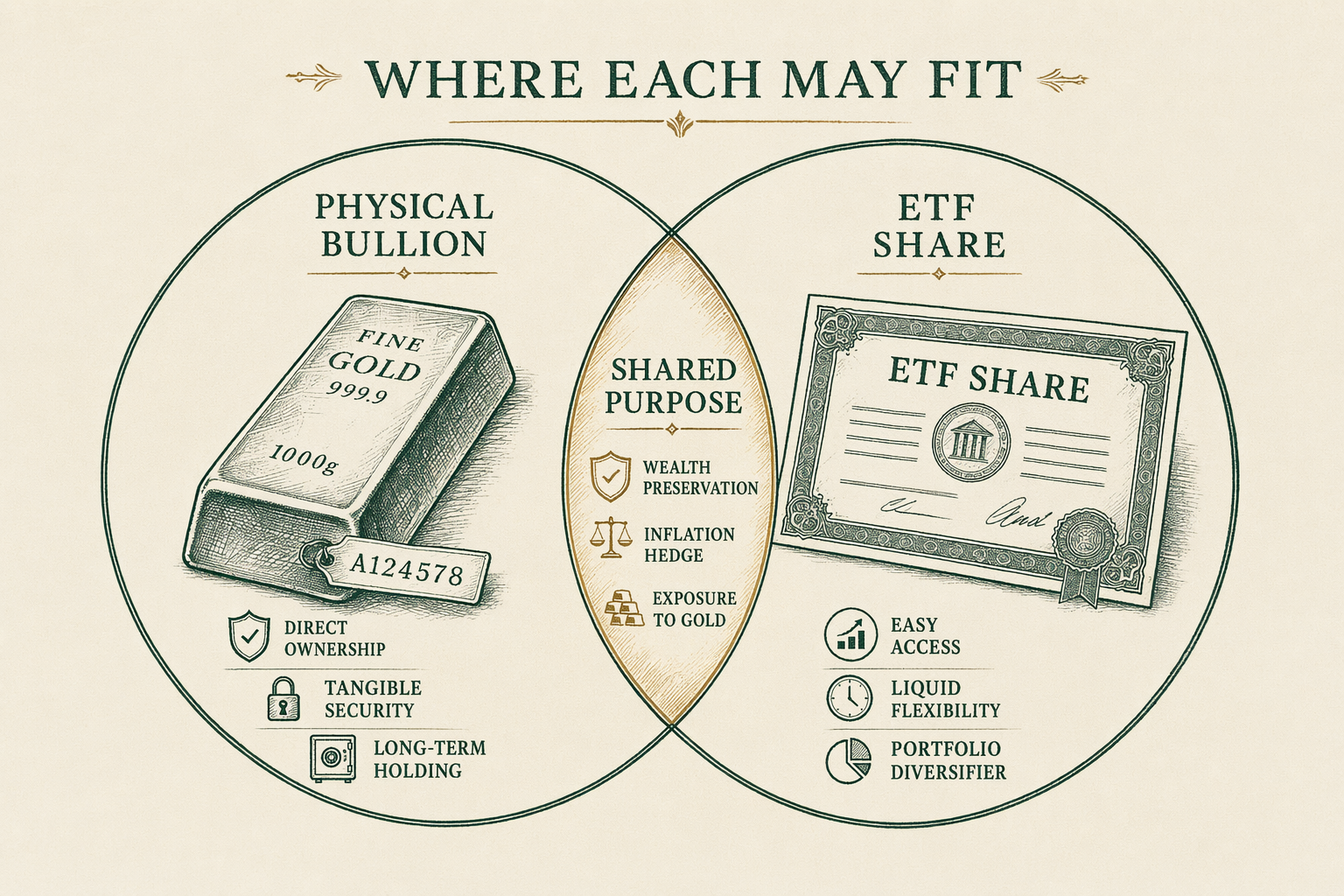
We do not name a universal best. The two funds resolve differently for different investor profiles.
**Lean toward GLD if:** you specifically want the longer operating history (first US-listed physically-backed gold ETF, launched `2004`), you have an existing relationship with State Street or use other SPDR funds and want family consistency, or you prefer the HSBC custody arrangement over JPMorgan for counterparty-risk diversification reasons.
**Lean toward IAU if:** you are a long-term buy-and-hold investor where the `15 bps/yr` expense-ratio savings compounds meaningfully over the holding period, you want the lower share-price scale for retail position-sizing flexibility, or you prefer the JPMorgan custody arrangement over HSBC for counterparty-risk reasons.
Both are SEC-registered grantor trusts with audited custodial holdings, both trade with high liquidity, both are taxed as collectibles. The expense ratio is the single largest differentiator for long-term holders; IAU is the meaningfully cheaper option for buy-and-hold positions.
_Educational content, not personalized investment advice. BullionLens is not a registered investment adviser. Consult a licensed adviser before making decisions about asset allocation or retirement assets._
Want to talk this through? Book a 30-min research call →
Frequently asked questions
-
Which is cheaper to hold?
IAU has historically carried a lower expense ratio than GLD. The gap has narrowed over time but IAU has typically been the lower-cost option for long-term holding. -
Do they hold the same gold?
Both hold allocated gold bars at institutional vaults. Custodian banks differ — HSBC has historically been GLD's primary custodian; JPMorgan has historically been IAU's primary custodian. -
Is the comparison data current?
We snapshot fees and arrangements quarterly minimum and stamp each comparison with a 'Last reviewed' date. Companies change fees, custodians, and storage partners — verify with the company directly before opening an account. -
What if my situation doesn't match either company's profile?
The comparison is a starting point, not personalized advice. If neither company fits, see /reviews/gold-ira-companies/ for the full list of companies we cover and /editorial-standards/ for our selection criteria.
In plain English We're an editorial desk. Educational only — talk to a licensed adviser before doing anything with retirement assets.