Gold ETF vs physical gold
GLD, IAU, SGOL, BAR, OUNZ: how gold ETFs work, where they hold the metal, and the operational differences from owning physical bullion.
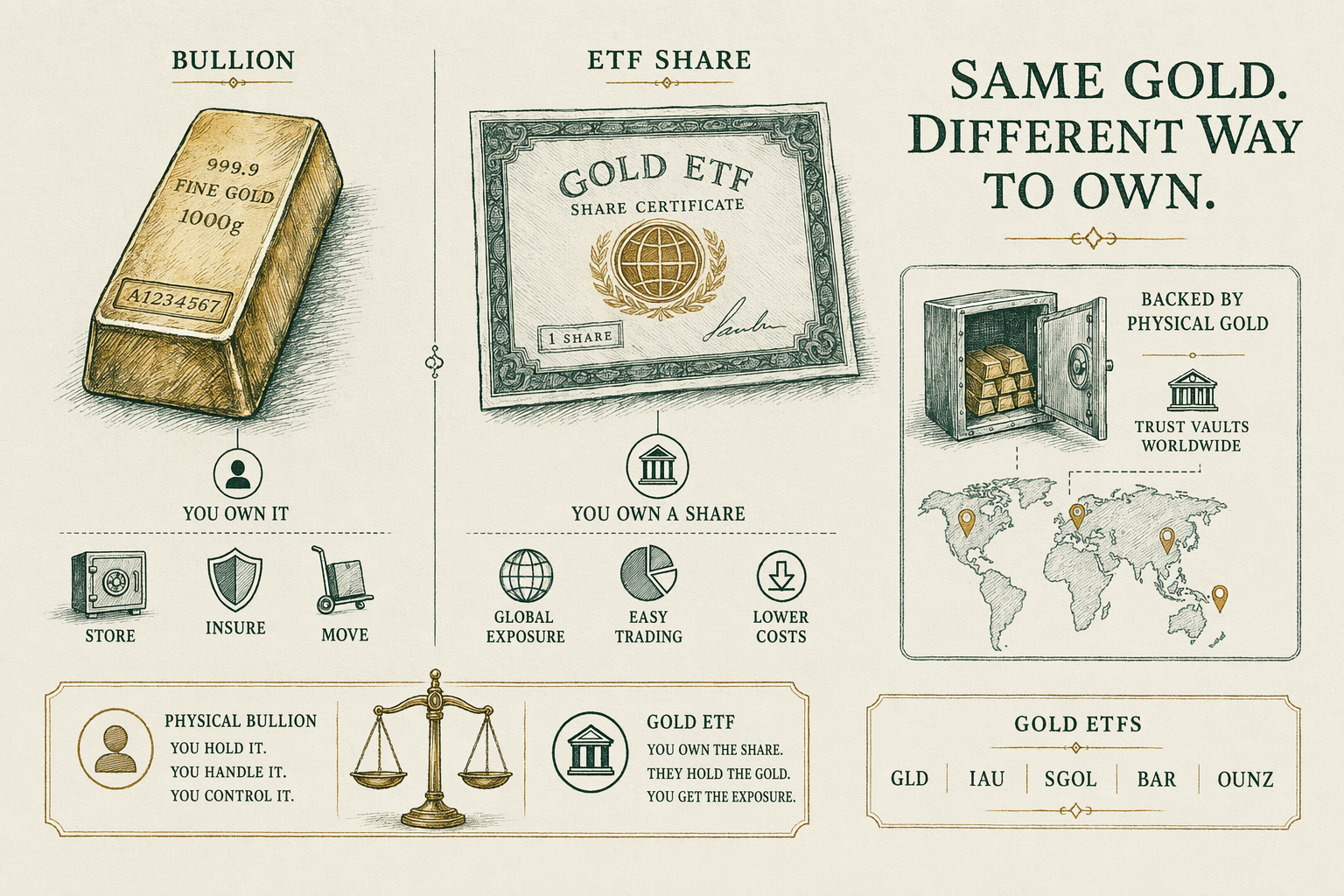
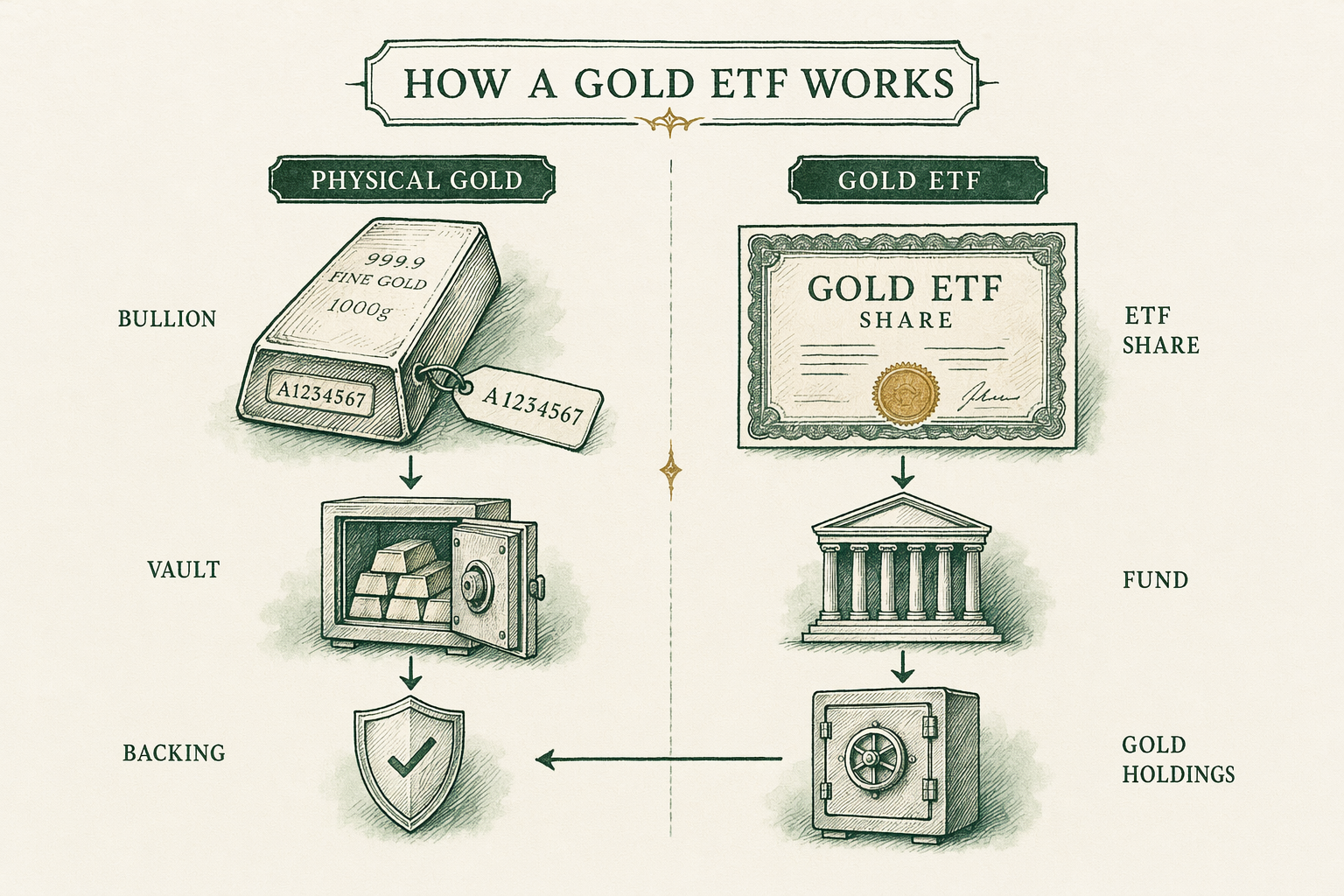
How a gold ETF works structurally
A physically-backed gold ETF is a grantor trust that holds allocated gold bullion as the underlying asset. Investors buy shares of the trust on a stock exchange; each share represents a fractional ownership claim on the gold held in the trust. The trust does not lend, lease, or use derivatives — it holds allocated physical bullion at a named custodian, and the share price tracks the spot price minus accumulated expense ratio drag.
The major US-listed physically-backed gold ETFs are: **SPDR Gold Shares (GLD)** — sponsored by the World Gold Council, managed by State Street Global Advisors, custodian HSBC London; **iShares Gold Trust (IAU)** — managed by BlackRock, custodian JPMorgan Chase; **Aberdeen Physical Gold Shares (SGOL)** — managed by abrdn (formerly Aberdeen Standard), custodian JPMorgan Chase London/Zurich; **GraniteShares Gold Trust (BAR)** — managed by GraniteShares, custodian ICBC Standard Bank London; **VanEck Merk Gold Trust (OUNZ)** — managed by Merk Investments, custodian JPMorgan Chase, with optional physical-delivery to qualifying shareholders.
Each fund publishes a bar list — the specific gold bars held in the vault — and independent audit reports periodically. The bar lists for GLD and IAU each show tens of thousands of individual bullion bars by serial number, weight, and refiner. Snapshot as of `2026-Q2`.
Custody arrangements behind GLD, IAU, SGOL
**GLD** custody is at HSBC London. The metal is held in HSBC's London vault as allocated bullion — specific bars assigned to the SPDR Gold Trust, not commingled with other HSBC clients' holdings. The trust publishes its bar list on a daily basis.
**IAU** custody is at JPMorgan Chase, with bars held primarily in London and New York vaults. The trust's bar list is published periodically; the custodian is contractually required to maintain the bars in allocated form for the trust.
**SGOL** custody is at JPMorgan Chase in London and Zurich vaults. The Zurich vault is the differentiator marketed to investors who value Swiss-jurisdiction storage. The allocated-bullion arrangement is structurally similar to GLD's and IAU's.
All three custodians are LBMA-member bullion banks with regulated trust operations. The custodial arrangement is not the risk that physical-gold advocates sometimes claim — these are some of the most heavily-audited bullion holdings in the world. The structural question is whether the buyer values direct title to the metal in personal possession (physical) versus a regulated ETF share representing a claim on metal at HSBC, JPMorgan, or ICBC vaults.
Expense ratios
Annual expense ratios for the major physically-backed gold ETFs as of `2026-Q2` (approximate, verify against current fund prospectus): GLD at `0.40%/yr`; IAU at `0.25%/yr`; SGOL at `0.17%/yr`; BAR at `0.17%/yr`; OUNZ at `0.25%/yr` (plus delivery fees if exercised).
The expense ratio reduces the fund's tracking of the gold price by the annual rate — `0.40%/yr` for GLD means the ETF's net asset value drifts down `0.40%` per year relative to the gross spot price, accumulating over the hold period. On a 10-year hold, GLD's cumulative tracking drag is approximately `4%`. The lowest-cost competitors (SGOL, BAR) at `0.17%/yr` have approximately `1.7%` cumulative tracking drag over the same period.
Compare against physical-gold custody costs: physical bullion at allocated private-vault storage runs `$0.50-$1.20 per $1,000` per year, or `0.05-0.12%/yr` — meaningfully cheaper than the lowest-expense ETF on an annual basis. Physical at home with insurance is cheaper still. The ETF expense ratio is the cost of the brokerage-account convenience; physical custody can be cheaper on an annual basis if you do the work.
Tax treatment of ETF gains
**The collectibles rule**: The IRS treats physically-backed gold ETFs as collectibles for capital-gains tax purposes despite their security-form structure. Long-term capital gains (shares held >1 year) are taxed at the collectibles rate, capped at `28%` under IRC § 408(m)(3). Short-term gains are taxed at ordinary income rates. This is the same treatment as physical-gold sales — the ETF wrapper does not produce the more favorable `15%/20%` long-term capital gains rate that applies to most other securities.
**In an IRA or 401(k)**: Gold ETF holdings inside a tax-advantaged account are taxed under the wrapper's rules — Traditional IRA ordinary-income at distribution, Roth IRA tax-free on qualified distributions. The collectibles rule does not apply inside the tax-advantaged wrapper because no current taxation is occurring.
**Reporting**: Brokerages issue Form 1099-B for ETF share sales the same way they do for any other security. The collectibles treatment is applied at the holder's tax-return level on Schedule D, not by the brokerage.
Operational differences from physical
**Liquidity**: ETFs trade on stock exchanges with intraday liquidity comparable to any large-cap security. Physical bullion sales take days (online dealer) or are same-day at a local coin shop with a wider spread.
**Custody**: ETFs put the bullion in an institutional vault with HSBC/JPMorgan/ICBC. Physical lets you hold the metal yourself or place it at a depository under your title.
**Counterparty exposure**: ETFs introduce counterparty exposure to the custodian, the trustee, and the fund sponsor. Physical bullion in your possession has no counterparty exposure; physical at a depository introduces counterparty exposure to the depository only.
**Cost structure**: ETFs charge annual expense ratios. Physical bullion at home has no ongoing cost (beyond insurance); physical at a depository has storage fees comparable to or less than ETF expense ratios.
**Tax treatment**: Both are taxed as collectibles outside tax-advantaged accounts.
**Operational complexity**: ETFs require a brokerage account. Physical requires either personal storage or a depository relationship. The ETF is operationally simpler; the physical is more demanding but eliminates several layers of counterparty exposure.
**Convertibility**: OUNZ uniquely offers physical-delivery to qualifying shareholders at creation-unit size (`100 oz` increments). The other major ETFs do not offer retail redemption for physical bullion.
Want to talk this through? Book a 30-min research call →
Frequently asked questions
-
Does a gold ETF actually hold gold?
Yes — major spot-gold ETFs (GLD, IAU, SGOL, BAR) hold allocated gold bars at institutional vaults (HSBC, JPMorgan, Brink's). The fund publishes a bar list and audit reports. -
Can I take delivery from an ETF?
Most retail-accessible gold ETFs do not offer retail delivery. OUNZ is a notable exception, allowing creation-unit-sized delivery to qualifying holders. -
Are gold ETFs taxed as collectibles?
Spot-gold ETFs held in taxable accounts are generally taxed as collectibles (28% max long-term rate) by the IRS, despite being securities. Consult a CPA. -
Where does BullionLens get its data on this topic?
Primary sources cited in the article. For market data we lean on the LBMA daily fixings, COMEX volume reports, IRS publications, SEC filings, and the World Gold Council's annual reports. We do not cite secondary aggregators as authority.
In plain English We're an editorial desk. Educational only — talk to a licensed adviser before doing anything with retirement assets.