IRS-approved Gold IRA depositories
Side-by-side editorial comparison of the major IRS-approved Gold IRA depositories: Delaware, Brink's, IDS, and others. Locations, insurance, options.
Methodology and disclosure
**Editorial disclosure.** BullionLens earns a commission when a reader opens a Gold IRA account through links on this page; the depositories on this page are not direct affiliate partners. The Gold IRA companies that route accounts to these depositories typically are. Editorial selection is independent — see [our editorial standards](/editorial-standards/). Reviewed `2026-Q2`.
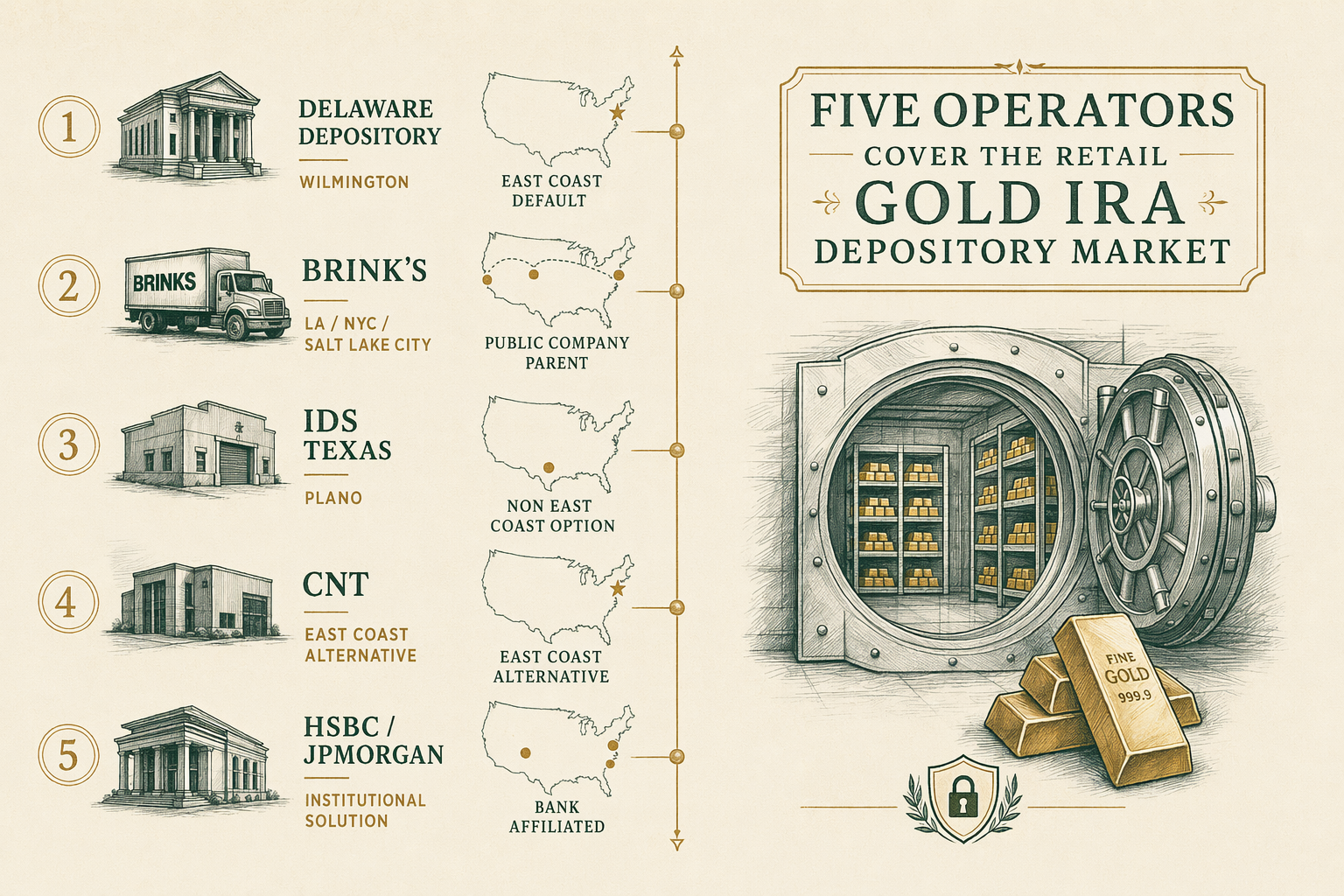
This page is a roundup of the major IRS-approved depositories that hold Gold IRA precious-metals assets in the United States. Unlike the head-to-head comparisons on neighboring pages, this is a side-by-side survey across five primary operators, with the goal of helping a reader who has heard of one depository at their Gold IRA marketing company's new-account call understand the broader landscape. The point is not to rank the depositories; the IRS-approved status is the floor requirement, and the operating quality is broadly comparable across the major operators. The point is to know what the menu looks like.
We cover five operators: Delaware Depository Service Company, Brink's Global Services (US precious-metals facilities), International Depository Services Group, CNT Inc., and the bank-affiliated options HSBC and JPMorgan (which appear primarily in institutional contexts and rarely in retail Gold IRA placements). For each, we note primary US facility locations, operating model, the major Gold IRA marketing companies that route business there, and any specific differentiator. Figures are paraphrased from each operator's public materials current as of `2026-Q2`.
The IRS-approved-depository concept
IRC § 408(m) governs investment in collectibles by Individual Retirement Accounts. Precious metals are a permitted exception to the general 'no collectibles in an IRA' rule, but the exception applies only to specific bullion-grade products that meet IRS fineness requirements **and** only when the metals are held by an IRS-approved trustee or custodian. The depository is the physical-custody operator that actually holds the metal; the trustee/custodian is the IRS-recognized trust company that holds legal title. Both are required.
The IRS does not publish a single static 'approved depository list' the way some marketing materials suggest. Instead, the IRS recognizes any depository that operates under a non-bank trustee arrangement approved under IRC § 408(n), or that holds the metal under a custody arrangement with an IRS-recognized trustee. The practical effect: depositories operate under custody contracts with IRS-recognized trust companies (Equity Trust Company, STRATA Trust Company, Mainstar Trust, and others), and any depository working with one of those custodians is functionally IRS-approved for Gold IRA holdings.
The five operators below all meet this functional definition and have been continuously used by major Gold IRA marketing companies for many years. None has been the subject of an IRS enforcement action regarding IRA-custody compliance on the public record as of `2026-Q2`.

Delaware Depository
**Delaware Depository Service Company** was founded in `1999` and operates from Wilmington, Delaware. The company is the most-cited Gold IRA depository in the US market and is the default storage choice for Augusta Precious Metals, Birch Gold Group's Delaware placements, and most major Gold IRA marketing companies on the East Coast. Insurance is placed through Lloyd's of London. Storage options include both segregated and commingled allocated formats, with segregated typically running `$50`-`$150/yr` more than commingled in retail-customer-facing pricing.
Delaware Depository's single-purpose operating model — the entire company is built around precious-metals custody, not as one product line within a broader logistics company — is the operator's most-cited positioning. The company has held continuous IRS-recognized custody arrangements with major trust companies since shortly after founding.
Brink's Global Services
**Brink's Global Services** is the precious-metals-storage product line of Brink's Incorporated (NYSE: BCO), a publicly traded global secure-logistics company founded in `1859`. Brink's runs precious-metals vaults in Los Angeles, New York, and Salt Lake City (US, IRS-approved for Gold IRA holdings) as well as international facilities in London, Zurich, Singapore, and Hong Kong (international, not IRS-approved for US IRA holdings).
Brink's appears as a depository option at Goldco, American Hartford Gold, and Birch Gold Group, among others. The public-company parent provides quarterly SEC financial reporting transparency that single-purpose private depositories do not match. Insurance is part of the parent company's global insurance program. Storage options include segregated and commingled allocated formats.
International Depository Services (IDS)
**International Depository Services Group** operates facilities in Delaware (alongside the related Delaware Depository) and in McKinney, Texas. IDS Texas is the most-cited non-Delaware US Gold IRA depository and appears as the default storage choice at Noble Gold Investments and as an alternative at Goldco, Birch Gold Group, and American Hartford Gold.
IDS's Texas facility is the relevant operator for clients who specifically want non-Eastern-Corridor storage. Insurance is institutional all-risk coverage on a similar structure to Delaware Depository's Lloyd's placement. Storage options include segregated and commingled allocated formats. The operator has held continuous IRS-recognized custody arrangements with major trust companies since founding.
CNT Inc. and additional facilities
**CNT Inc.** is a Massachusetts-based precious-metals refiner and depository operator and appears as an authorized depository on certain Gold IRA arrangements, primarily on the East Coast. CNT's customer base is mixed retail and institutional. The depository is used less frequently than Delaware Depository, Brink's, or IDS in the Gold IRA marketing channel but is a legitimate alternative for clients whose Gold IRA marketing company offers it.
Additional facilities appear in specific Gold IRA arrangements. Equity Trust Company, STRATA Trust Company, and other IRS-recognized custodians maintain custody contracts with multiple depositories, and a determined customer can sometimes negotiate non-default depository placement with their Gold IRA marketing company. The default list at most major Gold IRA companies is Delaware Depository plus one or two of {Brink's, IDS, CNT}, depending on the marketing company's standard arrangements.
HSBC and JPMorgan options
**HSBC and JPMorgan** operate large precious-metals vaults primarily for institutional customers (commodity-trading houses, hedge funds, sovereign-wealth funds, central banks). Both banks' US precious-metals facilities are technically eligible for Gold IRA custody under IRS rules, but the retail-Gold-IRA marketing companies almost never route accounts to bank-affiliated depositories. The institutional-vault arrangement has high minimums and operational requirements that retail Gold IRA accounts cannot meet.
For practical purposes, HSBC and JPMorgan are out of scope for retail Gold IRA buyers. A reader at a Gold IRA marketing company will not be offered HSBC or JPMorgan storage. The mention here is for completeness: the IRS-approved-depository landscape includes these bank-affiliated facilities, but they operate in a different segment from retail Gold IRA placements.
Choosing by location and storage type
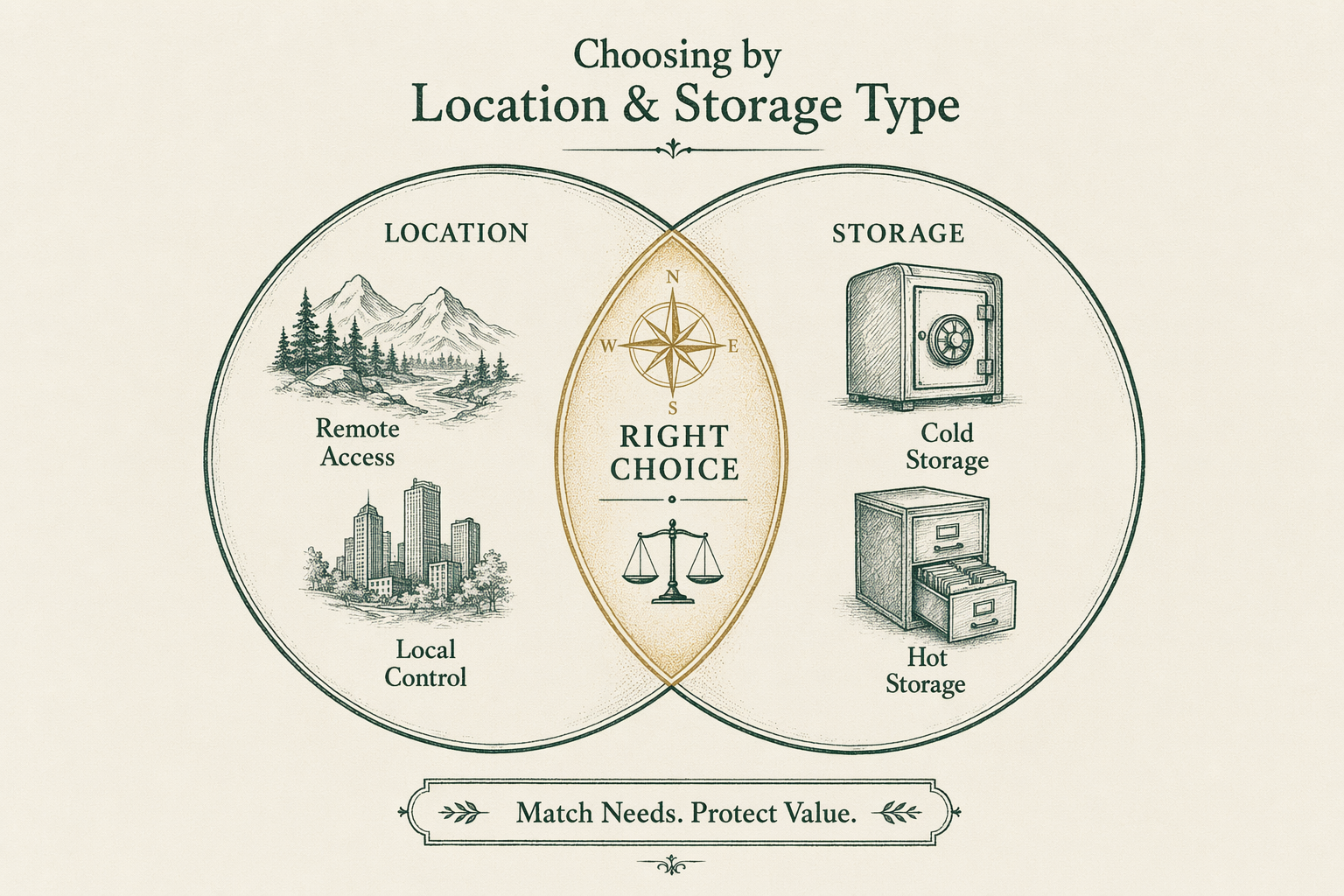
The depository choice in a retail Gold IRA is most often set by the Gold IRA marketing company at account opening, not by the customer directly. The practical choice the customer has is, in order: (1) pick the Gold IRA marketing company; (2) within that company's menu, pick the depository; (3) within the depository, pick segregated vs commingled storage.
For most customers, the relevant menu is Delaware Depository + IDS Texas + Brink's. Delaware is the East Coast default. IDS Texas is the non-East-Coast option for clients who want jurisdictional diversification. Brink's is the West Coast and Mountain West option, with the public-company parent transparency benefit.
Segregated allocated storage costs approximately `$50`-`$150/yr` more than commingled allocated storage in customer-facing pricing across all major depositories. The premium for segregated storage is meaningful for high-value accounts (where the physical separation matters) and less meaningful for moderate-value accounts (where the commingled-allocated arrangement still provides individual title to specific bars and coins). Both options are legally 'allocated' — the customer's specific holdings are identified in the depository's records — so the commingled-vs-segregated decision is about physical-arrangement preference, not about legal title.
_Educational content, not personalized investment advice. BullionLens is not a registered investment adviser. Consult a licensed adviser before making decisions about retirement assets._
Want to talk this through? Book a 30-min research call →
Frequently asked questions
-
Which depositories can my Gold IRA use?
Set by your Gold IRA custodian. Common options include Delaware Depository, Brink's, IDS of Texas and Delaware. Some custodians offer additional facilities. -
Does the depository's location matter?
For practical purposes, mostly for in-person audit visits (if you ever want one) and for any preference about regulatory jurisdiction. Operationally, modern audited depositories function similarly. -
Is the comparison data current?
We snapshot fees and arrangements quarterly minimum and stamp each comparison with a 'Last reviewed' date. Companies change fees, custodians, and storage partners — verify with the company directly before opening an account. -
What if my situation doesn't match either company's profile?
The comparison is a starting point, not personalized advice. If neither company fits, see /reviews/gold-ira-companies/ for the full list of companies we cover and /editorial-standards/ for our selection criteria.
In plain English We're an editorial desk. Educational only — talk to a licensed adviser before doing anything with retirement assets.