Are American Gold Eagles the best gold coin to buy?
American Gold Eagle fineness, sovereign-mint status, premium over spot, IRA eligibility, and how Eagles compare to Maples and Buffalos.
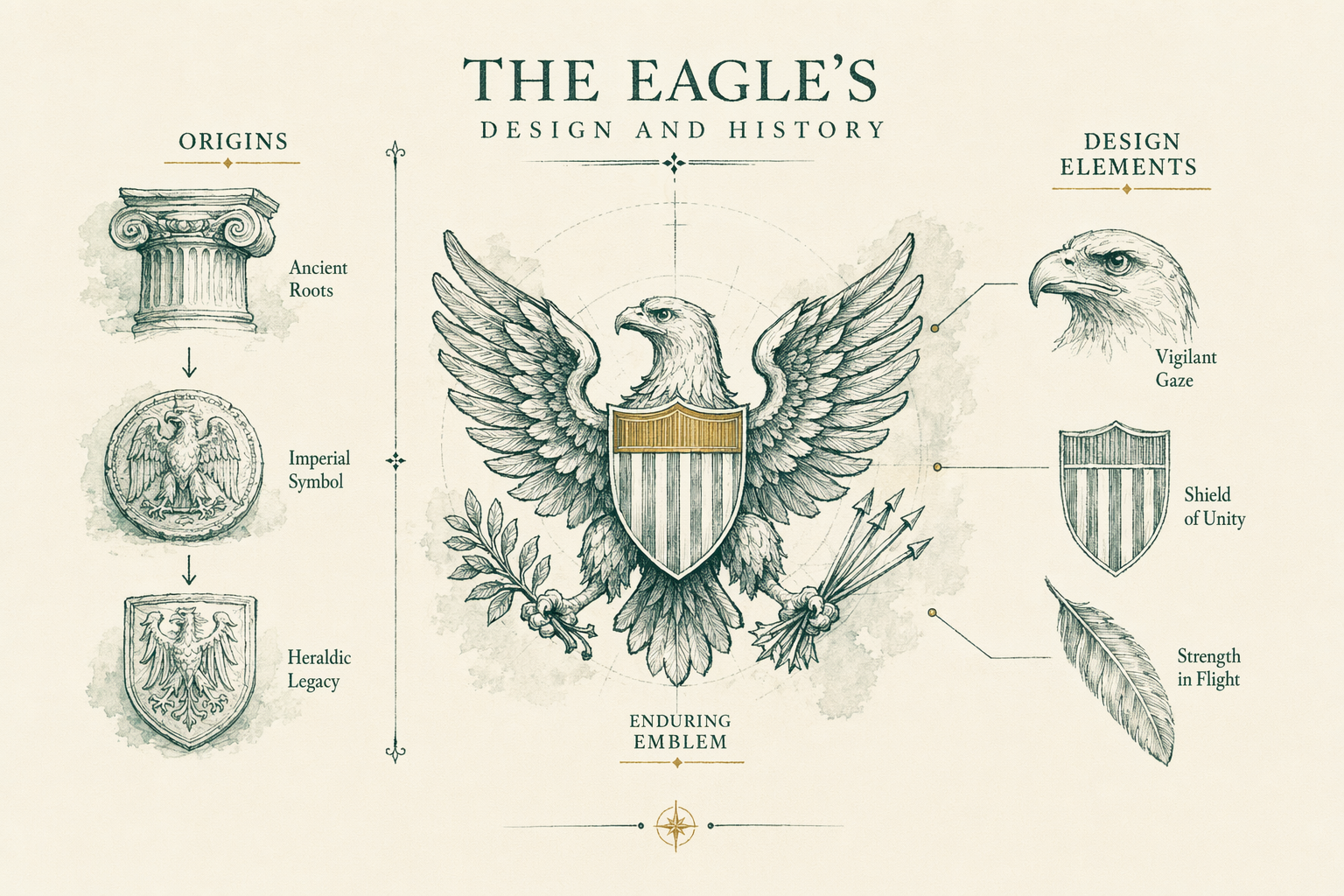
The Eagle's design and history
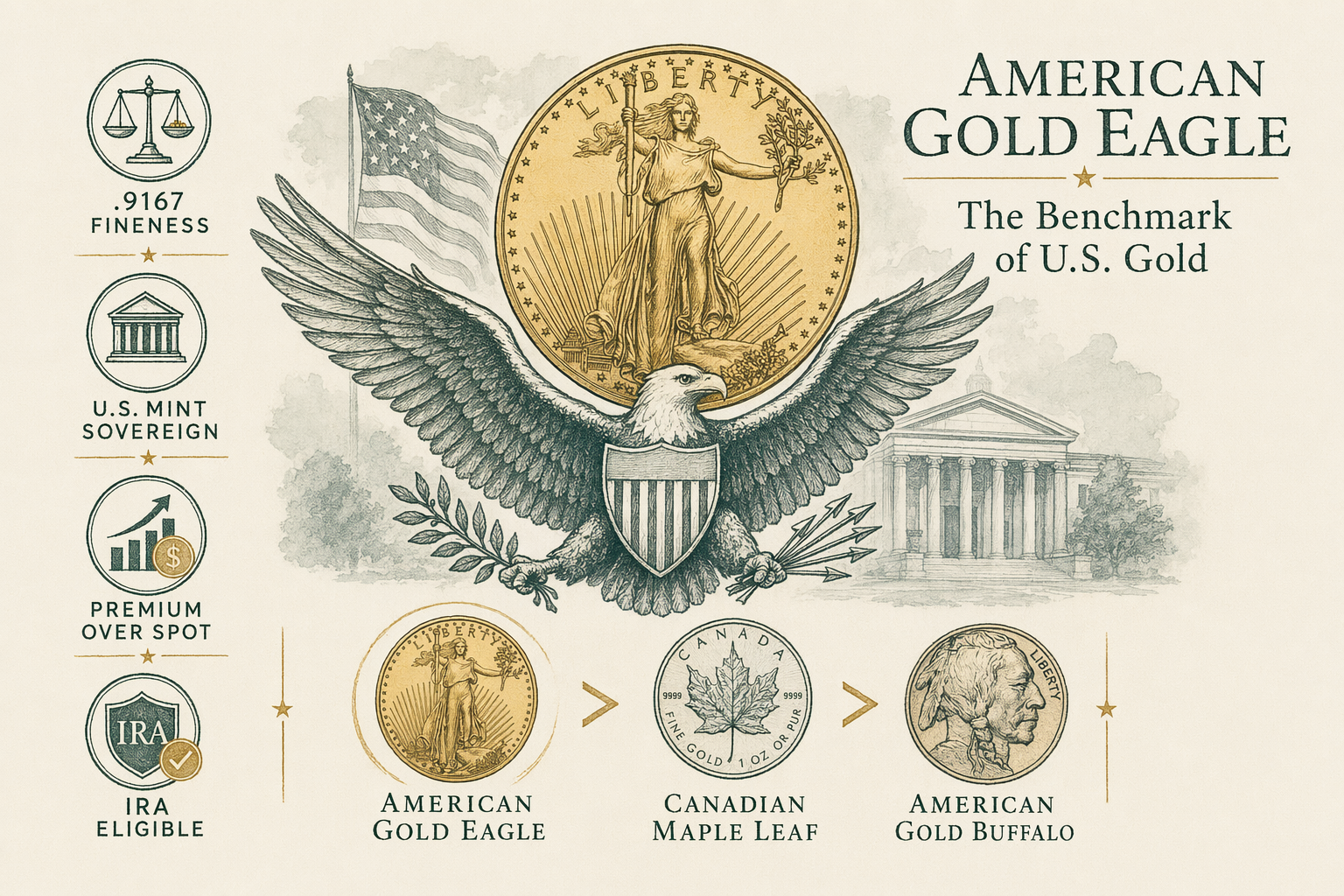
The American Gold Eagle is the United States Mint's flagship bullion coin program, authorized by the Gold Bullion Coin Act of `1985` and first struck in `1986`. The obverse carries Augustus Saint-Gaudens's `1907` Liberty design, originally created for the US Mint's `$20` Double Eagle and considered one of the high points of American coin design. The reverse depicts a family of bald eagles by sculptor Miley Busiek. The program issues four sizes — `1 oz`, `1/2 oz`, `1/4 oz`, `1/10 oz` — denominated `$50`, `$25`, `$10`, and `$5` respectively, with the dollar denomination essentially symbolic of legal-tender status rather than melt value.
The Eagle's market role since `1986` has been to give US investors a recognizable, government-minted bullion coin sold through a network of authorized purchasers (large bullion dealers like APMEX, JM Bullion, and Money Metals Exchange). Annual mintage volume tracks investor demand: roughly `1.4 million troy ounces` of bullion `1 oz` Eagles in `2020` (a high-demand year), down to roughly `300,000 oz` in lower-demand years. The Eagle has the strongest US retail name recognition of any modern bullion coin and is the default product at most US coin shops.
Fineness — 91.67% gold, plus copper and silver
The bullion American Gold Eagle is `22`-karat — `91.67%` gold, `3%` silver, `5.33%` copper. The alloy was a deliberate choice: the Mint wanted a coin that resisted handling damage better than the `24`-karat `99.99%`-pure soft-gold coins issued by Canada, Australia, and others. The Eagle's harder surface holds up to circulation and stacking without easily showing milk-spots or nicks. Despite the alloy, each `1 oz` Eagle contains exactly `1 troy oz` of actual gold by mass — the coin is heavier overall (`33.93 grams` versus `31.10 grams` for a pure `1 oz` coin) because of the added silver and copper.
The `22`-karat composition has one practical consequence: an Eagle does not satisfy the standard `99.5%`-fineness IRA-eligibility threshold that applies to bars and most coins under IRC Section `408(m)`. Congress carved out a specific statutory exception making the American Gold Eagle IRA-eligible despite its fineness. This carve-out is unusual and worth knowing: it means the Eagle is IRA-eligible by name, not by satisfying the general fineness rule. The Gold Buffalo (`99.99%`), Canadian Maple Leaf (`99.99%`), Australian Kangaroo (`99.99%`), and Austrian Philharmonic (`99.99%`) qualify via the general fineness rule.
Sovereign-mint legal-tender status
The American Gold Eagle is legal tender in the United States at its denomination — `$50` for the `1 oz` coin. This denomination is symbolic, not commercial; nobody spends a `1 oz` Gold Eagle at face value when its melt value is over `$2,000`. The legal-tender status matters for two practical reasons. First, it gives the coin a clean regulatory status under federal coin and counterfeit law (Title `18` of the US Code) that bars from private mints do not enjoy in the same way. Second, it underpins retail liquidity: every US coin shop recognizes the Eagle by sight, and bid/ask spreads on Eagles at retail are typically tighter than on private-mint rounds of equivalent weight.
Sovereign-mint status also produces an indirect IRS reporting carve-out. The American Gold Eagle is specifically excluded from the IRS Form `1099-B` reporting requirements that apply to sales of certain quantities of certain other bullion products to dealers (e.g., `25 oz` or more of `Krugerrands`, `Maple Leafs`, or `Mexican Onzas`). This is a niche but real consideration for sellers of large quantities. The exclusion does not change a holder's underlying tax obligation; it changes only the dealer-side reporting trigger.
Eagle vs Maple vs Buffalo
The three most popular `1 oz` sovereign gold coins in the US market are the American Gold Eagle, the Canadian Gold Maple Leaf, and the American Gold Buffalo. The Eagle is `22`-karat (`91.67%`) with a hardened alloy. The Maple is `24`-karat (`99.99%`) and softer; modern Maples carry security features including a radial-line pattern and a micro-engraved maple leaf privy mark. The Buffalo is also `24`-karat (`99.99%`) and is the US Mint's pure-gold sister to the Eagle, struck since `2006`.
On retail premium, the Maple is typically the cheapest of the three, followed by the Eagle, with the Buffalo carrying the highest premium (often `1-3%` above the Eagle). On US retail liquidity, the Eagle leads, followed by the Maple, then the Buffalo. On purity-of-gold-per-coin, the Maple and Buffalo lead at `1.0000 troy oz` of pure metal in a `1.0000 troy oz` coin, where the Eagle delivers `1.0000 troy oz` of gold in a heavier `1.0911 troy oz` coin. Reasonable buyers hold a mix; the absolute 'best' coin depends on whether you optimize for purity, premium, US recognition, or coin durability.
Real-world example — three Eagles, one Maple, one Buffalo
Consider a buyer purchasing `5 oz` of gold in `1 oz` sovereign coins from APMEX at an illustrative moment when LBMA spot is `$2,400/oz`. The buyer compares: three `1 oz` Gold Eagles at a `$2,520` retail price each (`5.0%` premium), one `1 oz` Maple Leaf at `$2,475` (`3.1%` premium), one `1 oz` Buffalo at `$2,545` (`6.0%` premium). Total: `$2,520 × 3 + $2,475 + $2,545 = $12,580`. The same `5 oz` in `1 oz` Maples only would have cost `$2,475 × 5 = $12,375`, a savings of `$205`. The same `5 oz` in `1 oz` Eagles only would have cost `$12,600`. The buyer pays `$205` more for the Eagle-Maple-Buffalo mix than for an all-Maple stack, in exchange for the broader recognition mix and the symbolic value of three sovereign mints.
On resale `5` years later, the spreads can flip. US coin shops typically buy back Eagles at or near spot, where Maples may carry a slightly wider buy-side discount at smaller US shops less familiar with the Canadian product. The premium paid at purchase is partially recovered by tighter resale spreads on Eagles. The total cost-of-ownership math depends on holding period, dealer recognition, and the specific shops in the buyer's region. The summary remains: each coin trades off small percentage points of premium against marginal differences in liquidity and brand.
Common misconceptions about the Eagle
**'The Eagle is not pure gold so it has less value.'** No. Each `1 oz` American Gold Eagle contains exactly `1 troy oz` of actual gold. The added silver and copper increase coin weight but not gold content. The coin's gold value tracks spot identically with a `99.99%`-pure coin of the same gold weight.
**'The Eagle is the best US coin because the Mint backs it.'** The US Mint backs the Eagle's specifications (`22 karat`, exactly `1 troy oz` of gold). It does not back the market price or guarantee a minimum buyback price. Resale liquidity comes from private bullion dealers, not the Mint.
**'The Buffalo and Eagle are interchangeable.'** Operationally for storage and IRS purposes they're similar, but the Buffalo is `24`-karat (softer surface) and the Eagle is `22`-karat (harder, more durable). The Buffalo also carries a higher retail premium. Choose based on whether you prioritize purity (Buffalo) or surface durability and slightly lower premium (Eagle).
What this means for you
The American Gold Eagle is a defensible default `1 oz` gold coin for a US-based buyer. Strong US recognition, tight retail spreads, IRS-named IRA eligibility despite the `22`-karat fineness, and Form `1099-B` reporting carve-out are real advantages. It is not the cheapest option per ounce — the Maple Leaf typically beats it on premium — and it is not the purest — the Buffalo and Maple both deliver `99.99%` pure gold in a `1 oz` coin. The 'best' coin for you depends on whether you optimize for premium, purity, US shop recognition, or pure-gold-per-coin. A mixed stack is reasonable. As always, BullionLens does not provide personalized investment advice; consult a licensed adviser before making allocation decisions.
Want to talk this through? Book a 30-min research call →
Frequently asked questions
-
Why is the American Gold Eagle not pure gold?
The Eagle is 22-karat (91.67% gold, 3% silver, 5.33% copper) — the alloy makes the coin more durable than 99.99% pure coins, reducing surface damage from handling. Each Eagle still contains 1 troy oz of actual gold. -
Is the American Gold Eagle IRA-eligible?
Yes. Despite being 22-karat (below the 99.5% fineness threshold for most IRA gold), the Eagle is specifically named in IRC Section 408(m) as IRA-eligible. The Buffalo (99.99%) and Maple (99.99%) also qualify. -
Is the Eagle better than the Maple Leaf?
Different tradeoffs. The Maple is purer (99.99% vs 91.67%) and often slightly cheaper at retail. The Eagle has stronger US recognition and tighter resale spreads on US soil. Mix is reasonable. -
Where does BullionLens get its data on this topic?
Primary sources cited in the article. For market data we lean on the LBMA daily fixings, COMEX volume reports, IRS publications, SEC filings, and the World Gold Council's annual reports. We do not cite secondary aggregators as authority.
In plain English We're an editorial desk. Educational only — talk to a licensed adviser before doing anything with retirement assets.