IRS-approved gold coins for an IRA
Which gold coins meet IRS Section 408(m) requirements for inclusion in a Gold IRA. Fineness thresholds, sovereign coin exceptions, and disallowed numismatics.
The Section 408(m) fineness rule
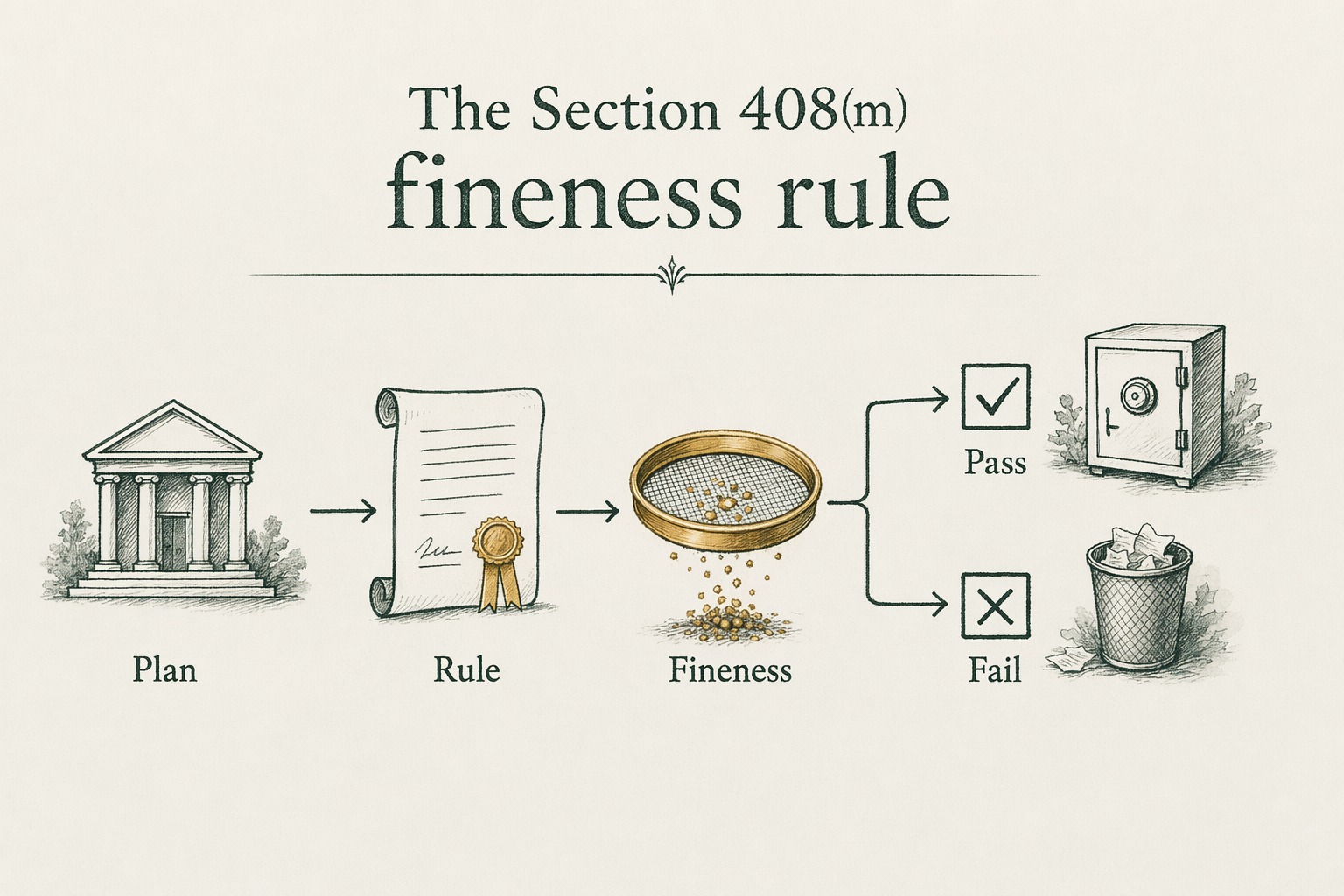
Internal Revenue Code Section `408(m)(3)` sets the fineness rule for IRA-permitted precious metals. The default rule: gold must be at least `99.5%` fine (`.995` or higher), silver at least `99.9%` fine (`.999` or higher), platinum and palladium at least `99.95%` fine (`.9995` or higher). The metal must be in the physical possession of an IRS-approved trustee or depository — investor-personal possession is not permitted while the metal is in an IRA wrapper.
The fineness rule excludes most circulating-era gold coins (US pre-`1933` Double Eagles, Half Eagles, Saint-Gaudens twenties — none of these meet `99.5%`), most numismatic-grade collector coins, and most jewelry-grade or alloyed coins. The rule was tightened in `1986` (the original IRA-eligibility scope was even narrower) and has been further refined by Treasury regulations interpreting which products qualify. The statutory language combined with the regulations produces a relatively short list of IRA-eligible gold coins, even though the gold-coin universe is vast.
American Gold Eagle — the named exception
The American Gold Eagle is `22`-karat (`91.67%` gold) — below the general `99.5%` fineness threshold. Despite this, the Eagle is IRA-eligible because IRC Section `408(m)(3)(A)` specifically names it. The statutory carve-out was added at the Eagle's `1986` creation; the language permits the Eagle into IRAs notwithstanding the general fineness rule. The same statutory pattern applies to the American Silver Eagle and the American Platinum Eagle.
This is unusual. For nearly every other gold product to be IRA-eligible, the product must independently satisfy the `99.5%` rule. The Eagle's named exception is a Congressional decision to favor the US Mint's flagship bullion product. Practical consequence: when a Gold IRA marketing company says 'American Gold Eagles are IRA-eligible,' they're correct, but the eligibility comes from the named-exception path, not from the general fineness rule. The Eagle's IRA-eligibility status is therefore as robust as any other named-permitted coin (the statute would have to be amended to remove it).
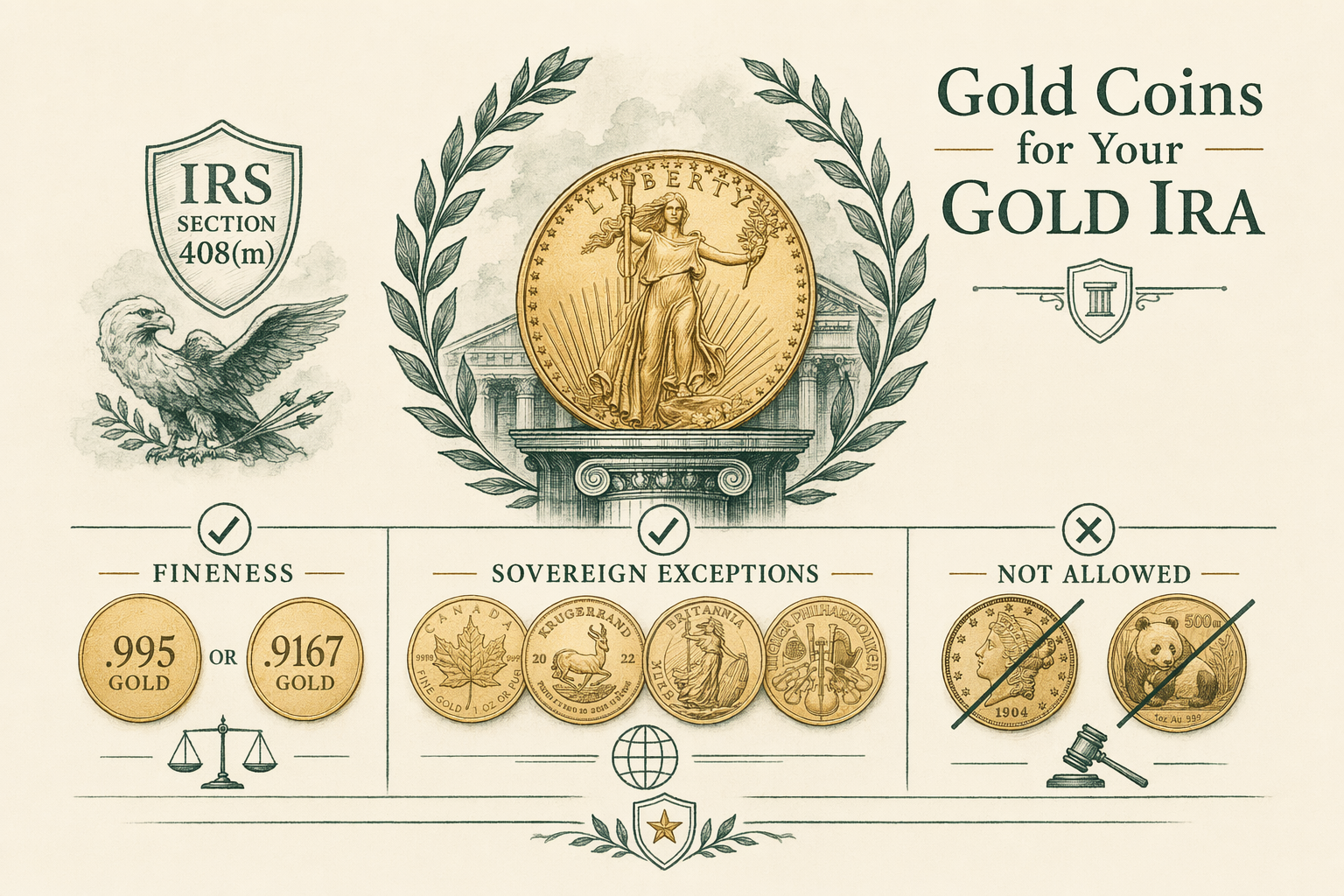
Other approved sovereign coins
Sovereign coins that satisfy the `99.5%` fineness rule and are commonly held in Gold IRAs include: American Gold Buffalo (`99.99%`, US Mint, struck since `2006`), Canadian Gold Maple Leaf (`99.99%`, Royal Canadian Mint, struck since `1979`), Austrian Gold Philharmonic (`99.99%`, Austrian Mint), Australian Gold Kangaroo / Nugget (`99.99%`, Perth Mint), Australian Gold Lunar series (`99.99%`, Perth Mint), Chinese Gold Panda (`99.9%`, China Mint), Swiss Gold (`99.99%`, Argor-Heraeus and other Swiss refiners — typically bars, not coins), and British Gold Britannia (`99.99%` since `2013`; older Britannias struck pre-`2013` at `91.67%` are generally not IRA-eligible).
Each Gold IRA custodian publishes its own list of IRA-eligible products it will purchase and store. The list is usually narrower than the universe of all `99.5%`+ fineness sovereign coins — custodians may decline less-common products for logistical reasons (depository familiarity, refiner verification, retail liquidity considerations). Before purchasing a specific coin, confirm with your custodian that it accepts the product. The most commonly purchased IRA-eligible gold coins are the American Eagle, American Buffalo, Canadian Maple Leaf, and Austrian Philharmonic; nearly every custodian accepts these four.
Coins explicitly excluded
Pre-`1933` US gold coins (Saint-Gaudens Double Eagles, Liberty Head Double Eagles, Indian Head Eagles, Half Eagles, Quarter Eagles) are not IRA-eligible. They are `90%` gold alloy (below the `99.5%` rule) and have no named-exception status under IRC `408(m)`. Marketing materials occasionally suggest these coins can go into an IRA; the IRS position is that they cannot. Holding a pre-`1933` gold coin in an IRA wrapper risks the IRS treating the entire account as distributed at fair market value, with tax + penalty consequences.
Other excluded items include South African Krugerrands (`91.67%`, not specifically named in the statute as a permitted exception); rare or 'numismatic' coins commanding a premium for collectability above bullion melt value; jewelry-grade gold; gold-plated items; and any gold whose form does not meet the depository's bailment standards (loose flakes, casting residue, etc.). The custodian's IRA-eligibility list is the authoritative document for what your specific account can hold; do not rely on Gold IRA marketing materials alone for product eligibility decisions.
The proof-coin question
American Gold Eagle proof coins (mirror-finish coins struck in low quantities, sold by the US Mint in plastic cases) are IRA-eligible under the same named-exception pathway as bullion Eagles. So are American Gold Buffalo proofs. The technical eligibility is identical to bullion-grade coins. The editorial question is whether proof coins make sense inside an IRA wrapper, given their typical markup over spot.
Proof Eagles and Buffalos commonly retail at `30-50%` (or higher) over spot, versus the `3-7%` premium on bullion-grade coins of the same gold content. The added premium does not increase the IRA's gold content — both proof and bullion versions contain the same `1 troy oz` of gold. From a pure investment-allocation perspective, an investor pays more premium per ounce of gold by choosing proofs. Gold IRA companies sometimes emphasize proof coins because they carry higher dealer markups (and therefore dealer commissions). The editorial recommendation across most Gold IRA reviews: stick with bullion-grade Eagles, Buffalos, or Maples at the lowest available markup unless you specifically want proofs for non-investment reasons.
Real-world example — building a $100,000 IRA-eligible stack
Consider a buyer with `$100,000` in a Gold IRA after rollover, ready to purchase IRA-eligible bullion. Option A — all bullion-grade `1 oz` American Gold Eagles at `$2,520` per coin (spot `$2,400` + `5%` premium): `$100,000 / $2,520 = 39.7` coins, so the buyer purchases `39` Eagles for `$98,280`, leaving `$1,720` in cash for fees and a small reserve. Gold content: `39 troy oz`. Option B — `1 oz` Canadian Maple Leafs at `$2,484` per coin (`3.5%` premium): `40` Maples for `$99,360`. Gold content: `40 troy oz`. Option C — all proof-grade American Gold Eagles at `$3,300` per coin (`37.5%` premium): `30` coins for `$99,000`. Gold content: `30 troy oz`.
The three options produce dramatically different gold content for the same dollar input. Option B (Maples) gives `40 oz` of gold; Option C (proofs) gives `30 oz` of gold — a `25%` gold-content deficit on identical IRA cash. The proof option carries no IRA-eligibility advantage; both bullion and proof variants qualify under the same named-exception pathway. Buyers should specifically request bullion-grade coins at the lowest available markup. The `tools/gold-ira-fee-comparison` worksheet on this site quantifies these tradeoffs across companies.
Common misconceptions about IRA-eligible coins
**'Pre-1933 gold coins are IRA-eligible because they're rare.'** No. Pre-`1933` US gold coins are `90%` alloy and not named-permitted under IRC `408(m)`. Holding them in an IRA risks the entire account being treated as distributed.
**'Proof coins are required for IRA holdings.'** No. Bullion-grade coins are IRA-eligible under the same named-exception or fineness-rule path as proofs. Proofs cost more per ounce of gold without providing additional IRA-eligibility status.
**'My Gold IRA company can hold any coin I want.'** No. The IRS rules (`408(m)`) and your custodian's published list jointly determine what's eligible. Always confirm with your custodian before purchasing.
What this means for you
IRA-eligible gold is a narrower category than 'gold coins' generally. The `99.5%` fineness rule plus specific named-exception coins (notably the American Gold Eagle) define what qualifies. Within the eligible universe, bullion-grade American Eagles, American Buffalos, Canadian Maple Leafs, and Austrian Philharmonics are the most-common and most-liquid choices. Proof coins are eligible but typically carry premium markups that reduce effective gold content for the dollar input. Pre-`1933` US gold coins and most numismatics are not eligible. Confirm your custodian's published list before purchasing, and choose bullion-grade products unless you specifically want proof issues for non-investment reasons. As always, BullionLens does not provide personalized advice; consult a licensed adviser.
Want to talk this through? Book a 30-min research call →
Frequently asked questions
-
What is the fineness rule for IRA gold?
Per IRC Section 408(m)(3), gold bullion held in an IRA must meet 99.5% fineness (0.995). The American Gold Eagle is the major exception — Eagles are 91.67% gold but are specifically named in the statute as IRA-eligible. -
Which sovereign coins are commonly held in Gold IRAs?
American Gold Eagle (the named exception), American Gold Buffalo (99.99%), Canadian Gold Maple Leaf (99.99%), Austrian Gold Philharmonic (99.99%), Australian Gold Kangaroo (99.99%), and a few others. Pre-1933 US gold coins are NOT IRA-eligible. -
Are proof coins IRA-eligible?
American Eagle proof coins are eligible if they meet the statute. But proof coins typically carry large markups; the editorial position is that bullion-grade coins make more sense inside an IRA wrapper than high-premium proofs. -
Where does BullionLens get its data on this topic?
Primary sources cited in the article. For market data we lean on the LBMA daily fixings, COMEX volume reports, IRS publications, SEC filings, and the World Gold Council's annual reports. We do not cite secondary aggregators as authority.
In plain English We're an editorial desk. Educational only — talk to a licensed adviser before doing anything with retirement assets.