Coins vs bars — the editorial decision tree
When to buy gold coins, when to buy gold bars, and the premium-over-spot tradeoffs. Sovereign mints, private mints, and resale market depth.
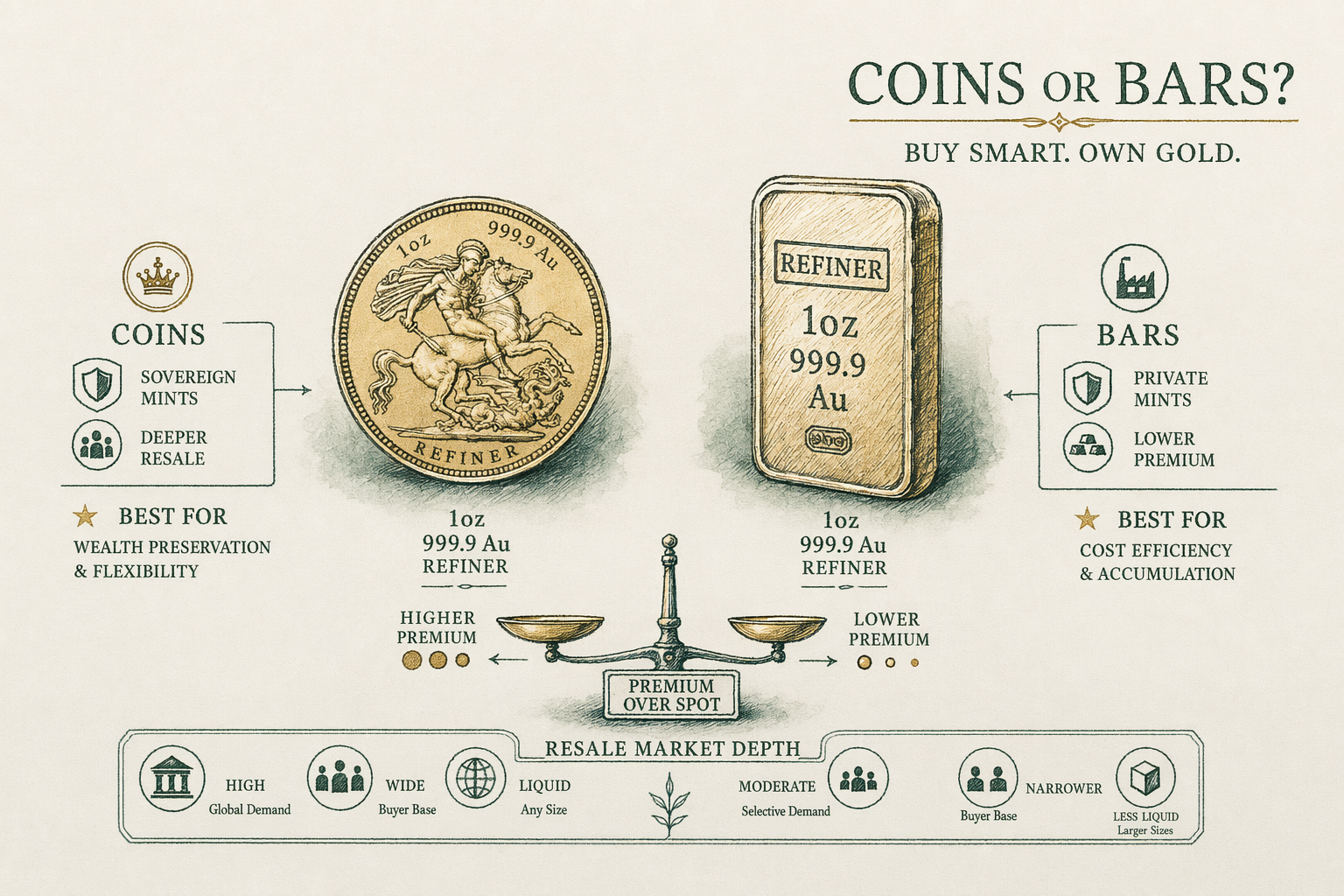
Sovereign coins — Eagle, Maple, Krugerrand, Britannia
Sovereign mint coins — those produced by a government-sanctioned mint and granted legal-tender status — are the dominant format for retail physical-bullion buying in the United States. Three reasons. First, the legal-tender status (the coin is technically legal currency at its face value in its issuing country) provides regulatory and tax clarity. Second, the sovereign mint's institutional credibility eliminates authentication doubt at resale. Third, the global recognition supports tighter retail-resale spreads than do unrebranded bars.
The American Gold Eagle, produced by the United States Mint since 1986, is the most widely traded sovereign gold coin in the US market by volume. Bullion-grade Eagles contain `1` troy ounce of gold of `.9167` fineness, alloyed with copper and silver for durability. Issued in `1` oz, `1/2` oz, `1/4` oz, and `1/10` oz denominations. Approved for inclusion in a Gold IRA under IRS Section 408(m).
The Canadian Gold Maple Leaf, produced by the Royal Canadian Mint since 1979, is the second-most-traded sovereign gold coin in the North American retail market. Maple Leafs are `.9999` fine — among the highest-fineness sovereign coins in regular production. They carry a slightly lower premium than American Gold Eagles at most direct-to-consumer dealers (often `0.5%` to `1.5%` less). Approved for inclusion in a Gold IRA.
The Krugerrand, produced by the South African Mint since 1967, was the original modern bullion coin and remains widely traded globally. Krugerrands are `.9167` fine, alloyed with copper for durability. They typically carry the lowest premium among the major sovereign coins, often `0.5%` to `1.5%` less than Maple Leafs at direct-to-consumer dealers. The Krugerrand is NOT approved for inclusion in a Gold IRA per current IRS guidance (it does not meet the `.995` fineness threshold).
The Britannia, produced by the Royal Mint of Great Britain, is `.9999` fine and is approved for inclusion in a Gold IRA. Britannias carry recognition and resale depth in the European retail market that is somewhat thinner in the US retail market. Premium structure is comparable to the Maple Leaf for US buyers.
Other relevant sovereign coins for bullion-grade buying include the Australian Gold Kangaroo/Nugget (Perth Mint, `.9999` fine, Gold IRA eligible), the Austrian Vienna Philharmonic (Austrian Mint, `.9999` fine, Gold IRA eligible), and the Chinese Gold Panda (China Mint, `.9999` fine, generally not Gold IRA eligible due to specific IRS coin-by-coin guidance though the situation has shifted historically).
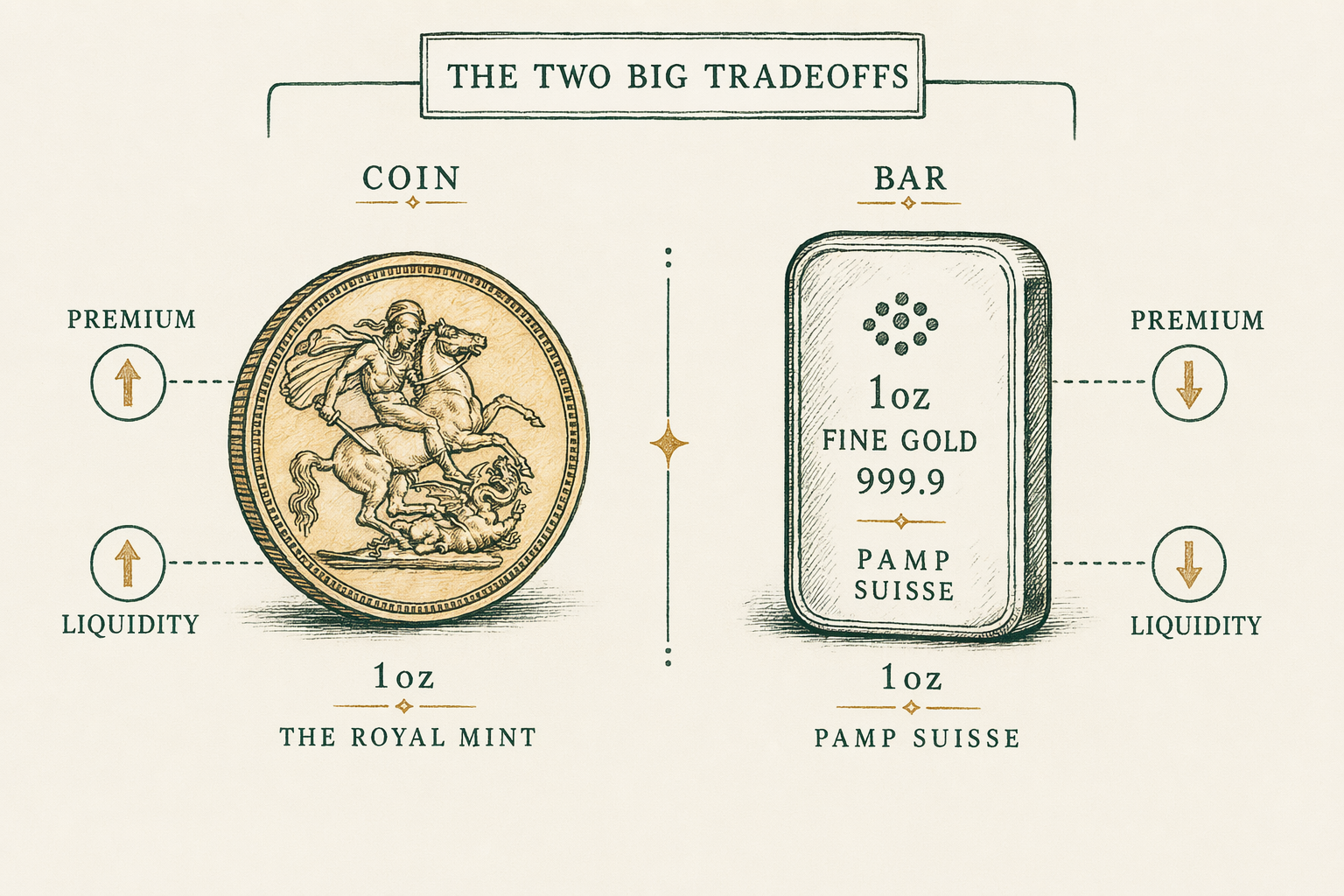
Private-mint rounds — cost-efficient ounces
Rounds — circular bullion pieces struck by private mints that are not government-sanctioned and do not carry legal-tender status — are sometimes confused with coins but are categorically different products. Rounds are priced as bullion-by-weight; coins are priced as bullion plus the sovereign-mint premium.
Major private mints producing widely traded gold rounds include Sunshine Minting, the Asahi refining group, Pamp Suisse, Argor-Heraeus, and Valcambi. Rounds typically come in `1` oz weight at `.9999` fineness, struck with mint-distinctive designs. Premiums run `1.5%` to `4%` over spot at direct-to-consumer dealers — meaningfully lower than sovereign-coin premiums.
The cost advantage comes from the absence of sovereign-mint overhead. Private mints do not pay the premium associated with operating a government mint, do not produce coins as legal tender, and do not maintain the institutional-promotion infrastructure that mints like the United States Mint maintain.
The tradeoff is recognition depth at resale. Rounds are recognized by every major bullion dealer in the country (APMEX, JM Bullion, Money Metals Exchange, SD Bullion, Provident Metals all routinely buy back rounds at or near spot). They are not always recognized at non-specialist coin shops. For a buyer planning to resell through major bullion dealers, the premium-savings of rounds is real cost savings. For a buyer planning to resell at local coin shops or to retail collectors, the premium-savings is offset by the narrower resale market.
Rounds are NOT approved for inclusion in a Gold IRA under IRS Section 408(m). The IRA-eligible category is restricted to certain coins and certain bars; rounds fall in neither category. For Gold IRA holdings, choose coins or bars only.
Cast vs minted bars
Bars subdivide into two production methods. Cast bars are produced by pouring molten gold into a mold; the resulting bar has a slightly rough, organic surface and edges. Minted bars are produced by striking a smooth pre-cut blank between dies; the resulting bar has a polished, uniform surface with crisp edges and design detail.
Cast bars cost less to produce. The premium-over-spot reflects this — cast bars typically run `0.5%` to `1.5%` less than minted bars of the same weight from the same refiner. The premium savings is most pronounced at larger weights (`10` oz and above) where the production-cost difference is meaningful relative to the gold content.
Minted bars carry higher per-ounce premium but offer superior recognition and presentation. Most retail-facing minted bars come with assay cards — sealed plastic packaging containing the bar with serial number, weight, fineness, and refiner stamp printed on the card. The assay card is a quality signal at resale and reduces authentication friction.
For most retail buyers acquiring bars in the `1` oz to `10` oz range, minted bars with assay cards are the practical default. The premium is modest, the resale presentation is cleaner, and the recognition is broader. PAMP Suisse, Credit Suisse (now part of UBS following the 2023 acquisition), Valcambi, and Argor-Heraeus minted bars in 1 oz and 10 oz weights are routinely available at every major US bullion dealer.
For institutional or higher-net-worth retail buyers acquiring bars in the kilogram and larger range, cast bars are the dominant format. The 1 kg cast bar at `0.999` fineness or higher from an LBMA Good Delivery refiner is the standard institutional unit. The 100 oz and 400 oz cast bars are the institutional dealer-network units, with the 400 oz London Good Delivery bar being the LBMA-standard institutional contract size.
Why bigger bars cost less per ounce
The premium-over-spot generally declines as bar weight increases, for two compounding reasons. First, the fabrication cost (refining, casting or striking, packaging) is a smaller fraction of the metal value when the metal value is larger. Second, larger bars are operationally cheaper for the dealer to handle (one inventory transaction covers more ounces) and the dealer's per-ounce margin can be thinner.
Indicative 2026-Q2 premium ladder at established direct-to-consumer dealers, for minted bars at `.999` fineness or higher from an LBMA Good Delivery refiner: • `1` oz bar: `2.5%` to `4%` over spot. • `10` oz bar: `1.5%` to `2.5%` over spot. • `1` kg bar (`32.15` oz): `1%` to `2%` over spot. • `100` oz bar: `0.8%` to `1.5%` over spot. • `400` oz London Good Delivery bar: `0.5%` to `1%` over spot (institutional channel, not direct-to-consumer retail).
Per-ounce savings compound. A buyer acquiring `100` oz across `100` × `1` oz bars at `3%` premium pays roughly `$5,800` in premium at a `$1,900/oz` spot price. The same buyer acquiring `100` oz as `1` × `100` oz bar at `1.2%` premium pays roughly `$2,280` in premium — `$3,500` less for the same gold content.
The tradeoff against larger-bar economics is resale flexibility. A `100` oz bar must be sold (or fractionally sold) as a single unit; you cannot easily liquidate `10` oz of a `100` oz bar without selling the whole bar. The granularity loss matters more for buyers who anticipate partial liquidation events than for buyers planning long-hold positions.
There is also an authentication friction at larger weights. The `100` oz bar represents a single high-value object whose authentication must be done at the bar level. Modern dealers routinely accept LBMA-refiner-stamped bars without independent assay, but for a buyer planning to resell to a non-specialist or to a private buyer, the authentication step looms larger for a `100` oz bar than for `100` × `1` oz coins.
Resale market depth by format
Resale market depth — the number of potential buyers willing to bid at-or-near spot for the specific product — is the second variable behind every coin-versus-bar decision. The deeper the resale market, the closer to spot you can liquidate.
Sovereign 1 oz gold coins (Eagle, Maple, Krugerrand, Britannia) have the deepest retail-resale market. Every major US bullion dealer routinely buys back these coins at or near spot from sellers of any size. Every local coin shop with bullion-buying capability recognizes them by sight. The retail-resale market is the deepest, the spreads are the tightest, and the operational friction is the lowest.
Private 1 oz rounds and 1 oz bars have moderate retail-resale depth. Major bullion dealers buy back at competitive spreads (often within `1%` of spot). Local coin shops may or may not — depends on the shop's policy and the buyer's familiarity with the specific mint.
`10` oz bars (private mint or sovereign) have moderate depth at major bullion dealers and limited depth at smaller dealers. Resale to private buyers is materially harder than for `1` oz coins because the unit value is too large for most individual private buyers to absorb.
Kilogram and larger bars have institutional resale depth and limited retail-resale depth. Major bullion dealers buy back at competitive spreads. Local coin shops typically cannot absorb a kilo bar as inventory at competitive bid. Resale to private buyers is operationally complex.
For a buyer building a position with anticipated partial-liquidation needs, the mix matters. A common practical mix: `30%` to `50%` of the position in `1` oz sovereign coins (for liquidity and operational simplicity in partial sales), `30%` to `50%` in `10` oz to kilo bars (for premium-savings on the bulk of the position), and `0%` to `20%` in fractional-ounce coins for very small partial sales. The specific mix depends on position size, time horizon, and liquidity preference.
How we sourced this
Premium ranges were compiled by sampling published advertised premiums at established direct-to-consumer bullion dealers (APMEX, JM Bullion, Money Metals Exchange, SD Bullion, Provident Metals) at multiple snapshot points across 2024-2026 against contemporaneous LBMA Gold Price fixings. Stress-episode premium data was triangulated against bullion-dealer press releases, World Gold Council market notes, and contemporary financial-news coverage from the relevant periods.
Sovereign-coin specifications draw from each issuing mint's published documentation: United States Mint specifications for the American Gold Eagle; Royal Canadian Mint for the Maple Leaf; South African Mint for the Krugerrand; Royal Mint for the Britannia; Perth Mint for the Kangaroo. Gold IRA eligibility cites IRS Publication 590-A and the IRS's published list of qualifying coins and bars.
LBMA Good Delivery refiner data draws from the LBMA's published Good Delivery List as maintained by the London Bullion Market Association. PAMP Suisse, Credit Suisse (now UBS group), Valcambi, Argor-Heraeus, and the Asahi refining group are all current LBMA Good Delivery refiners as of 2026-Q2.
In plain English
In plain English: sovereign 1 oz coins (Eagle, Maple, Krugerrand) cost more per ounce but sell back faster, anywhere. Bars cost less per ounce — bigger bars are cheapest per ounce — but resale is mostly through major bullion dealers and not local coin shops. A common practical mix is half sovereign coins for easy partial sales and half larger bars for bulk-position economics. If the gold is going into a Gold IRA, skip private rounds and Krugerrands; they are not on the IRS-approved list. The dealer reviews at /reviews/bullion-dealers/ cover which dealers price competitively for each format.
Want to talk this through? Book a 30-min research call →
Frequently asked questions
-
Which has the lowest premium over spot?
Bullion-grade 1 oz American Gold Eagles, Canadian Gold Maple Leafs, and private-mint 10 oz bars tend to have the lowest retail premiums. Kilo bars (32.15 oz) are the cheapest per-ounce format for serious buyers. -
Are sovereign coins worth the premium?
For retail resale they often are, because every coin shop in the country recognizes them by sight. For institutional volume the premium is harder to justify. -
Are private-mint rounds collectible?
No. Private-mint rounds (rounds, not coins — they are not legal tender) are priced as bullion. They do not carry numismatic premium. -
What is the difference between cast and minted bars?
Cast bars are poured molten into a mold (rougher finish, lower fabrication cost, often used for larger sizes). Minted bars are struck from a blank (smooth finish, higher fabrication cost, common in 1 oz and 10 oz).
In plain English We're an editorial desk. Educational only — talk to a licensed adviser before doing anything with retirement assets.