Are bank safe-deposit boxes insured for gold?
The truth about bank safe-deposit box coverage for gold and bullion: what banks insure, what they do not, and how to arrange your own coverage.
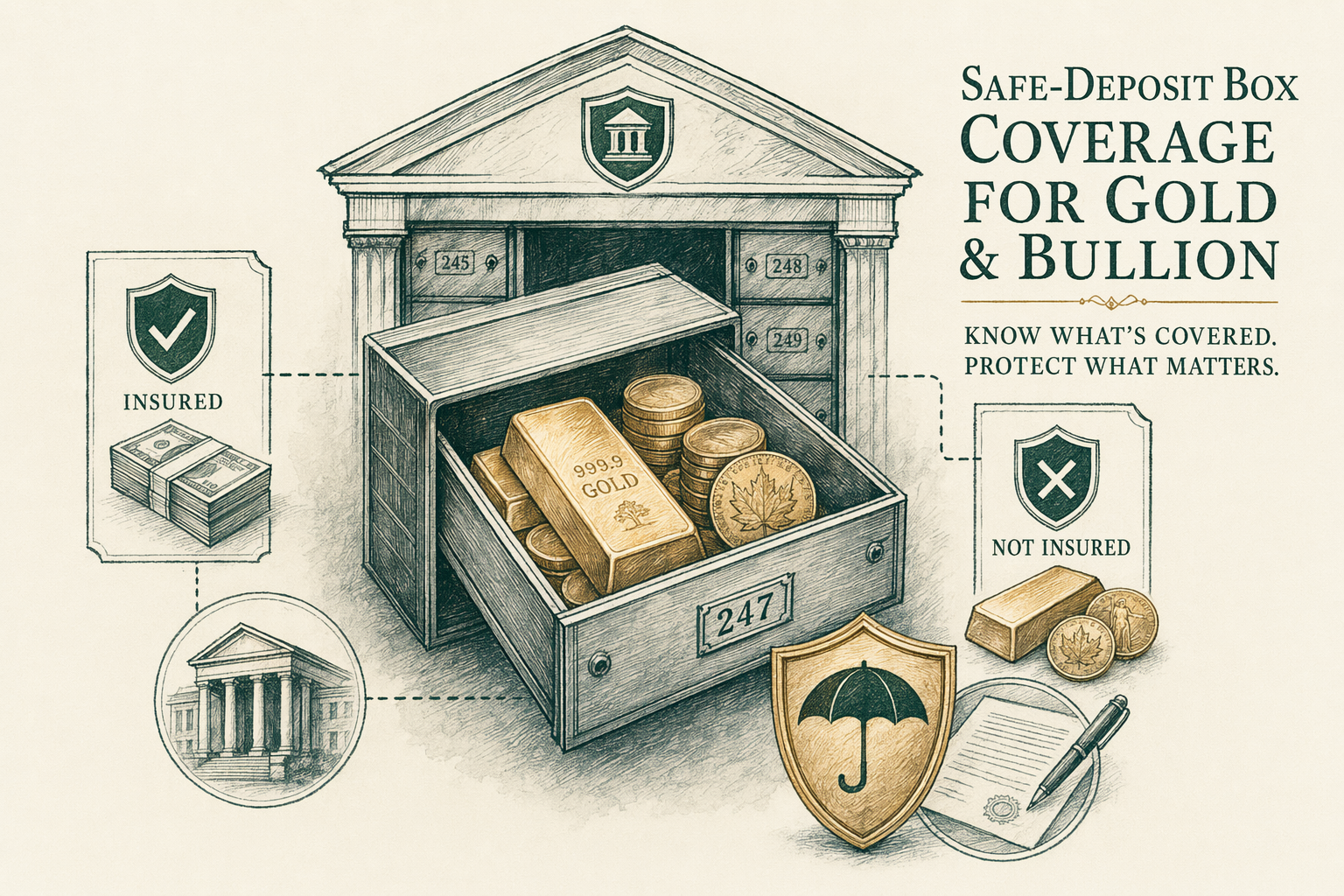
What banks actually insure
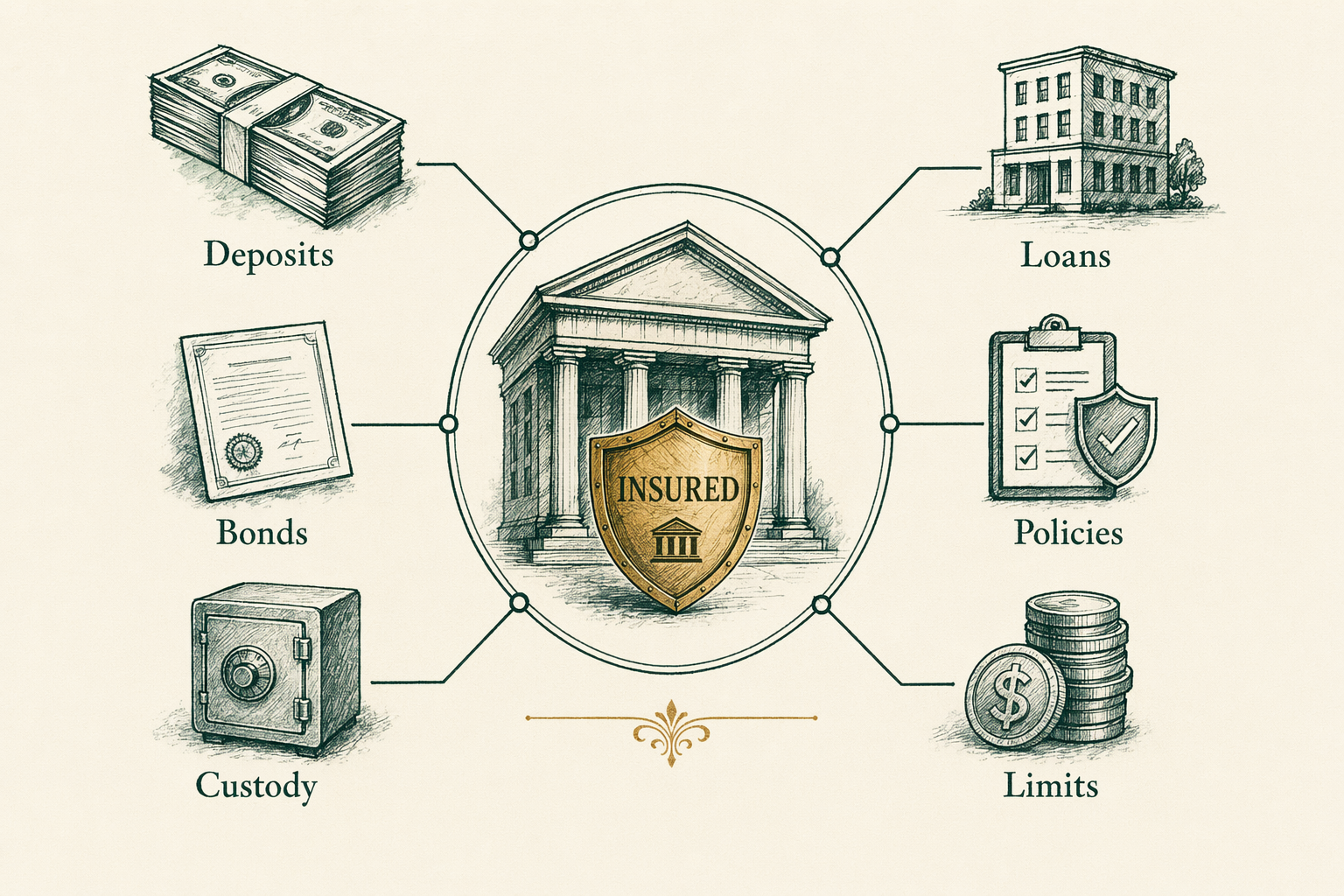
Banks carry insurance on their own operations: the physical building, the vault structure, the bank's general liability, FDIC-insured deposit accounts up to current limits, and the bank's own assets. None of those policies cover the contents of customer safe-deposit boxes. This is the single most-misunderstood fact about safe-deposit-box storage, and it appears explicitly in the safe-deposit-box rental agreement that customers sign when opening a box.
Read the contract before assuming. Standard safe-deposit-box rental agreements include language to the effect of: 'The bank assumes no responsibility for the contents of this box and provides no insurance for items stored within. The renter is responsible for arranging contents insurance separately.' This language varies in phrasing across banks but is structurally consistent. Bank operational coverage exists to protect the bank from claims arising from the bank's own negligence — water leak from a maintenance failure, fire from a bank-side electrical issue — and even those scenarios produce contested claims about who is responsible for the contents. Default position: assume `$0` of bank-provided contents coverage on bullion in a safe-deposit box.
Why most safe-deposit boxes have no contents coverage
The structural reason banks don't insure contents is that they don't know what's in the box. A safe-deposit-box rental is a leased space — the box's contents are private to the renter, the bank doesn't take inventory, doesn't appraise, doesn't issue a custodial receipt for specific items. Without an inventory or appraisal, the bank can't price an insurance product, and underwriters won't write coverage against unknown items.
This is structurally different from a depository or vault service that explicitly accepts gold under a custodial agreement. IRS-approved depositories like Delaware Depository, Brink's Global Services, and IDS Texas operate under bailment agreements where the depository takes specific custody of identified items (bars by serial number, coins by quantity and type), inventories them, and prices custodial insurance accordingly. The depository's insurance — typically institutional all-risk coverage via Lloyd's of London or comparable underwriters — applies because the depository knows exactly what it's holding. A bank safe-deposit box is the opposite end of the spectrum: leased space, no inventory, no custodial relationship, no insurance.
Scheduling a valuables rider
Most US homeowner's and renter's policies include an 'unscheduled valuables' sub-limit covering jewelry, watches, and certain other property at modest dollar amounts — typically `$200` to `$2,500` aggregate. This sub-limit usually applies to property anywhere in the world, including off-premises storage like a bank safe-deposit box. For meaningful coverage above the sub-limit, the policy needs a 'scheduled personal property' rider naming specific items at specific values.
For bullion specifically, scheduled coverage often requires either an appraisal or a dealer invoice showing the specific items by weight, fineness, and dollar value. The carrier issues an endorsement (rider) to the underlying homeowner's or renter's policy listing each scheduled item and the agreed-upon value. Annual premium for scheduled bullion coverage typically runs `$1` to `$2` per `$100` of insured value, depending on the carrier, the storage location (off-premises locations usually price higher), and any deductibles. Not every standard homeowner's carrier writes scheduled coverage for off-premises bullion; some explicitly exclude it. Ask your agent before assuming a rider is available.
Specialty bullion insurance carriers
If your homeowner's carrier won't schedule bullion or quotes prohibitive premiums, specialty carriers exist. Brokers placing Lloyd's of London syndicate coverage will write standalone bullion policies for high-value private collections, often with annual premiums in the `$0.50-$1.50` per `$100` insured-value range for off-premises storage in a documented secure location. Specialty bullion insurance is most readily available for collections above `$50,000-$100,000` in declared value; smaller amounts usually fit better under a homeowner's rider.
A few US-based brokers specialize in numismatic and bullion insurance and place coverage through Lloyd's syndicates or US carriers writing similar lines. Coverage terms typically require documented storage at a named location (your specific bank branch and box number, or your home safe with installation documentation), a current inventory list with serial numbers where available, and a current valuation. Policies usually carry a per-occurrence deductible and a per-event cap. The carriers do not insure speculative price moves — they insure physical loss (theft, fire, flood, mysterious disappearance under defined conditions). Read the policy's exclusions carefully before relying on it.
Documentation requirements
Whether you use a homeowner's rider or specialty bullion coverage, documentation is what makes a claim payable. The minimum documentation set: dealer invoices for each bullion purchase showing date, item description (mint, weight, fineness, serial number for bars), price paid, and dealer name; photographs of each item before storage, including any serial numbers visible; a current inventory list updated whenever you add or remove items; and the safe-deposit-box rental agreement (to prove the storage location).
Store the documentation outside the safe-deposit box. A common error: putting the only copy of the inventory and dealer invoices inside the box being insured. If the box is lost in a fire or flood, the documentation is lost with it. Best practice: keep originals in a separate location (different bank, home safe, fireproof file at the office), and keep digital copies in a cloud storage account or password manager. Update annually. If you ever need to file a claim, the carrier will ask for these records; absent them, the claim either pays out at the policy's default valuation (often well below your purchase cost) or is contested in ways that consume months of correspondence.
Real-world example — what happens after a vault flood
Consider an investor with `$80,000` of gold (`33 oz` of `1 oz` American Gold Eagles at illustrative current prices) stored in a branch-bank safe-deposit box. The branch experiences a basement-level water main rupture overnight; water seeps into the vault and damages several boxes. The investor's box is among them — when the bank notifies customers two days later, the gold coins inside are wet but physically intact, the dealer invoices and inventory list inside the box are soaked beyond recovery.
Bank's response under the rental agreement: the bank documents the incident, helps the customer dry the coins (the metal itself is undamaged — gold doesn't tarnish from water exposure), expresses regret, and points to the rental-agreement language disclaiming any responsibility for box contents. The bank does not pay for the damaged paperwork or any consequential loss. Customer's insurance position: if no homeowner's rider was scheduled, the customer's policy might pay the unscheduled-valuables sub-limit (perhaps `$1,500`) and nothing more. If a scheduled valuables rider was in place — naming the `33 oz` of Eagles at their declared value — the policy pays for any actual physical damage and replaces the documentation cost. The water-damage scenario itself is mild because gold is durable; in a fire or theft scenario, the unrecovered loss without insurance becomes catastrophic. The lesson: bank box ≠ insured storage.
Common misconceptions about safe-deposit coverage
**'FDIC insurance covers my safe-deposit box.'** No. FDIC insurance covers deposit accounts (checking, savings, CDs) up to current limits at FDIC-member banks against bank failure. It does not cover safe-deposit-box contents.
**'The bank has cameras and a vault, so the contents are safe.'** Operational security at the bank is real, but it does not equal insurance coverage. If theft or damage occurs despite security measures, the bank's coverage protects the bank, not you.
**'My homeowner's policy automatically covers gold in a bank box.'** Usually only up to a low unscheduled-valuables sub-limit (`$200-$2,500`). Meaningful coverage requires a scheduled-property rider, and some carriers exclude off-premises bullion entirely. Call your agent and read the declarations page.
What this means for you
If you store bullion in a bank safe-deposit box, the bank does not insure the contents. Default assumption: `$0` of bank-provided coverage. To get meaningful protection, you have two routes — schedule a valuables rider through your homeowner's or renter's carrier (requires invoices, possibly an appraisal, annual premium in the low percent range), or arrange specialty bullion insurance through a Lloyd's broker (more common for larger collections). Either route requires documentation stored outside the insured location. If documentation and ongoing insurance management feel like too much, an IRS-approved depository with custodial insurance built in is the alternative — at the cost of higher annual storage fees and a different access profile.
Want to talk this through? Book a 30-min research call →
Frequently asked questions
-
Does the bank insure the contents of my safe-deposit box?
Almost never. Bank insurance covers the bank's operations and the physical building, not the contents of customer safe-deposit boxes. You must arrange contents coverage separately. -
Will my homeowner's policy cover gold in a bank box?
Sometimes — but usually with a low cap on unscheduled valuables ($200-$2,500 typical) and a possible exclusion for off-premises storage. Read your policy or ask your agent. -
How do I get real coverage?
Schedule a valuables rider naming the specific items (or weight of bullion), often requiring an appraisal or dealer invoice. Specialty carriers like Lloyd's brokers also write bullion-only policies. -
Where does BullionLens get its data on this topic?
Primary sources cited in the article. For market data we lean on the LBMA daily fixings, COMEX volume reports, IRS publications, SEC filings, and the World Gold Council's annual reports. We do not cite secondary aggregators as authority.
In plain English We're an editorial desk. Educational only — talk to a licensed adviser before doing anything with retirement assets.