Should I store gold at home?
Home storage tradeoffs for physical gold: security, insurance, IRS rules for IRA holdings, and the practical case for and against.
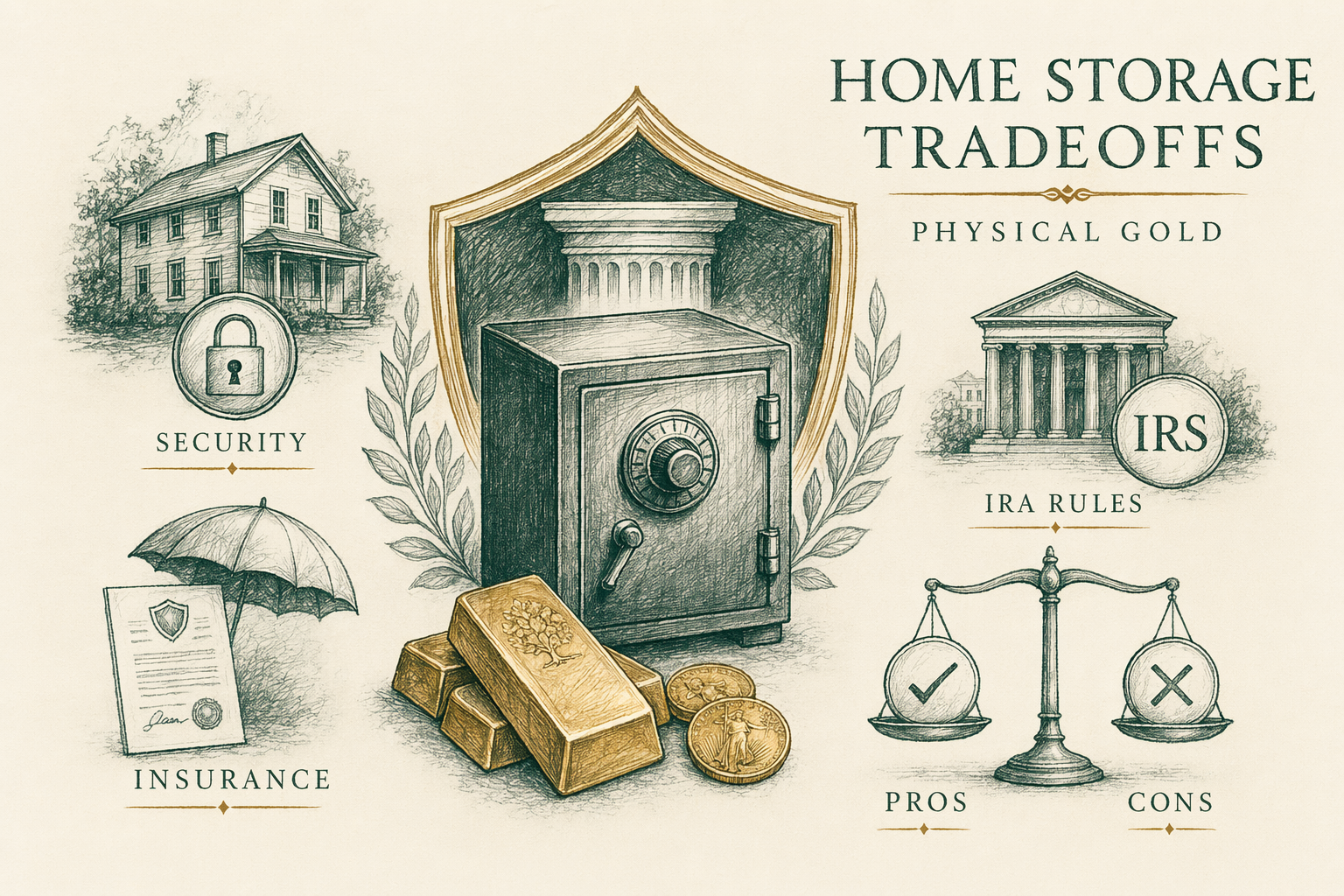
The IRS issue for IRA holdings
Gold IRA holdings require physical possession by an IRS-approved trustee or depository under IRC Section `408(m)`. The IRS has consistently taken the position that 'home-storage Gold IRA' arrangements — including LLC-based structures sometimes marketed as allowing the IRA owner to act as a trustee and store metal at home — do not satisfy this requirement. The `2021` case *McNulty v. Commissioner* (Tax Court memo decision) explicitly held that an IRA owner's home storage of IRA-held coins through an LLC structure failed Section `408(m)` and triggered a deemed distribution of the entire account value, with associated tax and `10%` early-withdrawal penalty.
The IRS position is consistent across multiple guidance documents and prior cases: IRA metals must be held by a qualified non-self trustee. The 'home-storage IRA' marketing is a known risk-creation pattern; the consumer downside is conversion of the entire IRA balance into a taxable distribution, often with penalty. For after-tax (non-IRA) gold holdings, home storage is fine — no IRS rule against it. For IRA holdings, the consistent legal position is: use an IRS-approved depository. The savings on storage fees (typically `$100-300/yr`) is not remotely worth the risk of a full-account-distribution tax event.
Home-safe options and ratings
For after-tax holdings stored at home, the safe specification matters. The Underwriters Laboratories (UL) and Insurance Services Office (ISO) standards rate safes for two distinct attack vectors: burglary resistance and fire resistance. Burglary ratings include B-rate (minimal protection), C-rate, RSC (Residential Security Container, light protection), TL-15 (resists tool attack for `15 minutes`), TL-30 (`30 minutes`), TL-30x6 (TL-30 on all six sides), and the TRTL series adding torch resistance. Fire ratings express how long the interior stays below a damage temperature in a standardized fire (`30 minutes`, `1 hour`, `2 hours` at common test temperatures).
A reasonable baseline for serious home storage: a bolted-down TL-30 burglary-rated safe with at least a `1-hour` UL fire rating. Costs scale from `$1,500` for a small TL-30 to `$5,000+` for larger units. Critical installation details: bolt the safe to a structural floor element (concrete slab or floor joist anchored through subfloor), not into hollow drywall or unanchored carpet. Hide the safe location from view of casual visitors — out of household traffic patterns, ideally in an interior space not visible from windows. The safe's rating is only as good as the installation; a `TL-30` safe sitting unbolted in a garage corner can be lifted and removed by two people with a hand truck.

Insurance considerations
Standard homeowner's policies cover unscheduled valuables (jewelry, coins, bullion) at a sub-limit typically in the `$200-2,500` range. Above this, a scheduled-property rider naming specific items at specific declared values is required for meaningful coverage. Carriers vary in willingness to schedule bullion at meaningful values — call your agent before buying significant metal and ask: 'Can you schedule `$100,000` of bullion stored in a TL-30 safe at our home address, and what's the annual premium?' Some carriers exclude bullion entirely; some price the rider at `$0.50-$2.00` per `$100` of insured value annually.
Specialty bullion insurance through Lloyd's of London syndicate brokers exists for collections that exceed standard homeowner's-rider capacity. Premiums are typically in the same range or slightly higher. The carrier will require documented storage specifics: safe rating, installation, alarm system status, occupancy patterns. Documentation discipline matters at claim time: keep dealer invoices, photographs, and updated inventory list stored OUTSIDE the safe being insured. A common claim-time failure: the inventory and invoices are in the safe that was stolen, leaving the policyholder unable to document basis or quantity. Store records at a different location.
Operational security (who knows)
The most-common home-storage failure mode is not safe-cracking; it's information leakage. Burglars target households they know to contain valuables. The fewer people who know about your bullion holdings, the smaller the attack surface. Categories of unnecessary risk: telling neighbors, friends, or extended family; mentioning holdings on social media or in conversation; allowing contractors (safe installers, electricians, alarm-system technicians) extended unsupervised access; storing the alarm code in the same place as the safe combination.
Necessary information sharing: a spouse or other co-owner needs access; an estate executor needs to know upon your incapacity or death. For estate planning, write down (in a sealed document held by your attorney or with your will) the location, combination, and inventory of any home-stored bullion — without this documentation, heirs may not know the holdings exist. Safe combinations should rotate when contractors leave (after safe installation, alarm system service, or any extended home access). Treat home-storage operational security with the same discipline you'd use for any high-value valuable; the most common burglary loss is the one made possible by information leakage, not safe-rating failure.
When home storage makes sense
Home storage makes sense for: smaller after-tax holdings where annual depository fees would consume a meaningful percentage of the position (e.g., a `$5,000` allocation where `$150/yr` storage represents `3%` annual drag); short-term holdings the owner expects to liquidate or move soon; emergency-access scenarios where the owner specifically wants metal accessible without third-party involvement; coin-collecting interests where the owner wants to handle the coins (incompatible with depository storage); and after-tax holdings the owner can responsibly secure with an appropriately-rated safe, scheduled insurance, and operational-security discipline.
Home storage makes less sense for: any IRA holdings (IRS rules); large after-tax positions where the depository's institutional insurance and access discipline dominate the cost-benefit math; owners who can't reliably maintain operational security (frequent house guests, contractors, social-media-prominent profile); owners in flood, fire, or earthquake-prone regions where the home itself is a higher-risk environment than a hardened depository; and owners who would not personally enforce safe-combination rotation or inventory documentation.
Real-world example — a $200,000 home-storage scenario
Consider an owner with `$200,000` of after-tax gold (approximately `83 oz` at illustrative `$2,400/oz` spot), considering home storage versus depository. Home-storage configuration: TL-30 safe (`$3,500` cost), professional bolted installation (`$500`), scheduled-valuables homeowner's rider at `$0.80 per $100 insured` (`$1,600/yr` premium), documentation stored at attorney's office. Year `1` cost: `$5,600` (one-time safe + install + first year premium). Year `2+` recurring: `$1,600/yr` insurance plus periodic combination rotation.
Depository alternative: Delaware Depository segregated allocated storage at roughly `$200/yr` for `83 oz` of gold (illustrative — depository rates vary). Year `1` cost: `$200`, Year `2+`: `$200/yr`. Over `10` years: home storage costs roughly `$5,600 + ($1,600 × 9) = $20,000`. Depository costs roughly `$2,000`. The depository is `$18,000` cheaper over the `10`-year window, plus the depository carries institutional all-risk insurance built into the fee. The home-storage owner pays substantially more for the convenience of physical possession. Whether that convenience is worth `$1,800/yr` depends on the owner's specific needs and risk tolerance. The math typically favors depository for sums above `$50,000`; home storage favors smaller positions or owners who specifically need physical access.
Common misconceptions about home storage
**'Home-storage Gold IRAs are legal.'** The IRS position is that they do not satisfy Section `408(m)`. The `2021` *McNulty v. Commissioner* decision affirmed this. The IRS treats home-storage Gold IRA arrangements as triggering deemed distribution of the entire account.
**'A home safe is enough security.'** A safe is a delay mechanism, not a guarantee. TL-30 means `30 minutes` of resistance to professional attack. Bolting, hiding location, alarm-system integration, and operational security all factor into actual outcomes.
**'My homeowner's insurance covers my gold automatically.'** Only up to the unscheduled-valuables sub-limit, typically `$200-2,500`. Scheduled-property rider required for meaningful coverage on bullion. Some carriers exclude bullion entirely.
What this means for you
For Gold IRA holdings, do not store at home. Use an IRS-approved depository. The IRS position is consistent and the downside (full-account deemed distribution with tax + penalty) is severe. For after-tax holdings, home storage can work for smaller positions or specific use cases (emergency access, coin-collecting interest), provided the owner uses an appropriately-rated safe, schedules valuables insurance, and maintains operational-security discipline. For larger after-tax positions (above roughly `$50,000`), depository storage is typically cheaper on a multi-year basis and provides institutional-grade insurance. Match the storage to the use case; do not assume one structure fits all sizes.
Want to talk this through? Book a 30-min research call →
Frequently asked questions
-
Can I store Gold IRA holdings at home?
The IRS has consistently taken the position that home storage does not satisfy Section 408(m) IRA requirements. Several 'home-storage Gold IRA' marketing structures have been challenged by the IRS. Use an IRS-approved depository for IRA holdings. -
Are home safes secure enough?
TL-15 and TL-30 rated safes resist tool attack for those minutes respectively. UL fire ratings matter independently. A bolted-down TL-30 with B-rate burglary protection is a reasonable baseline for serious home storage. -
Should anyone know my home gold storage?
Only the people who absolutely need to (spouse, estate executor). The more people who know, the larger the threat surface. Even contractors who install safes can be a risk. -
Where does BullionLens get its data on this topic?
Primary sources cited in the article. For market data we lean on the LBMA daily fixings, COMEX volume reports, IRS publications, SEC filings, and the World Gold Council's annual reports. We do not cite secondary aggregators as authority.
In plain English We're an editorial desk. Educational only — talk to a licensed adviser before doing anything with retirement assets.