Canadian Gold Maple Leaf vs American Gold Eagle
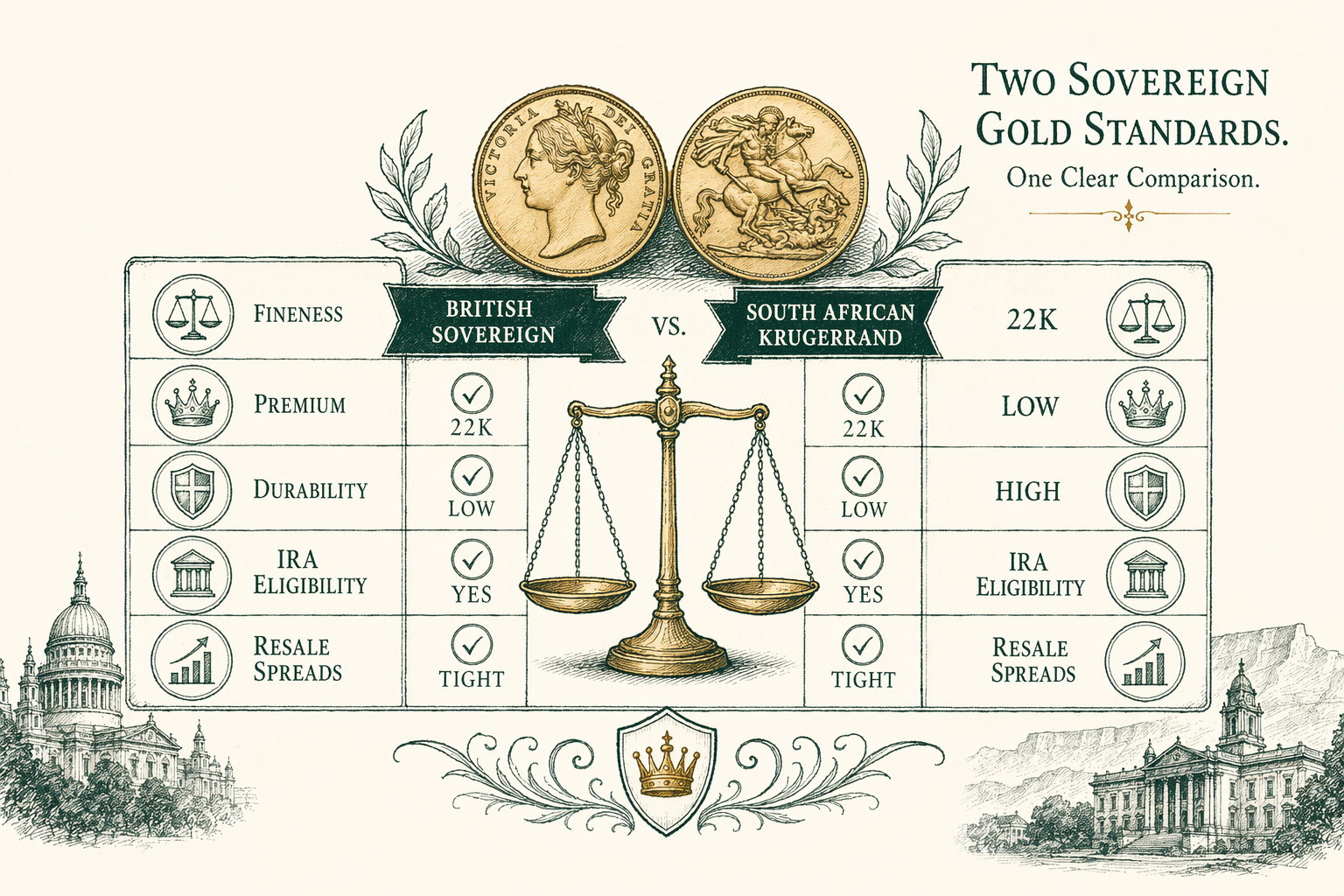
Side-by-side: fineness, premium, durability, IRA eligibility, and resale spreads on the two most-traded sovereign gold coins.
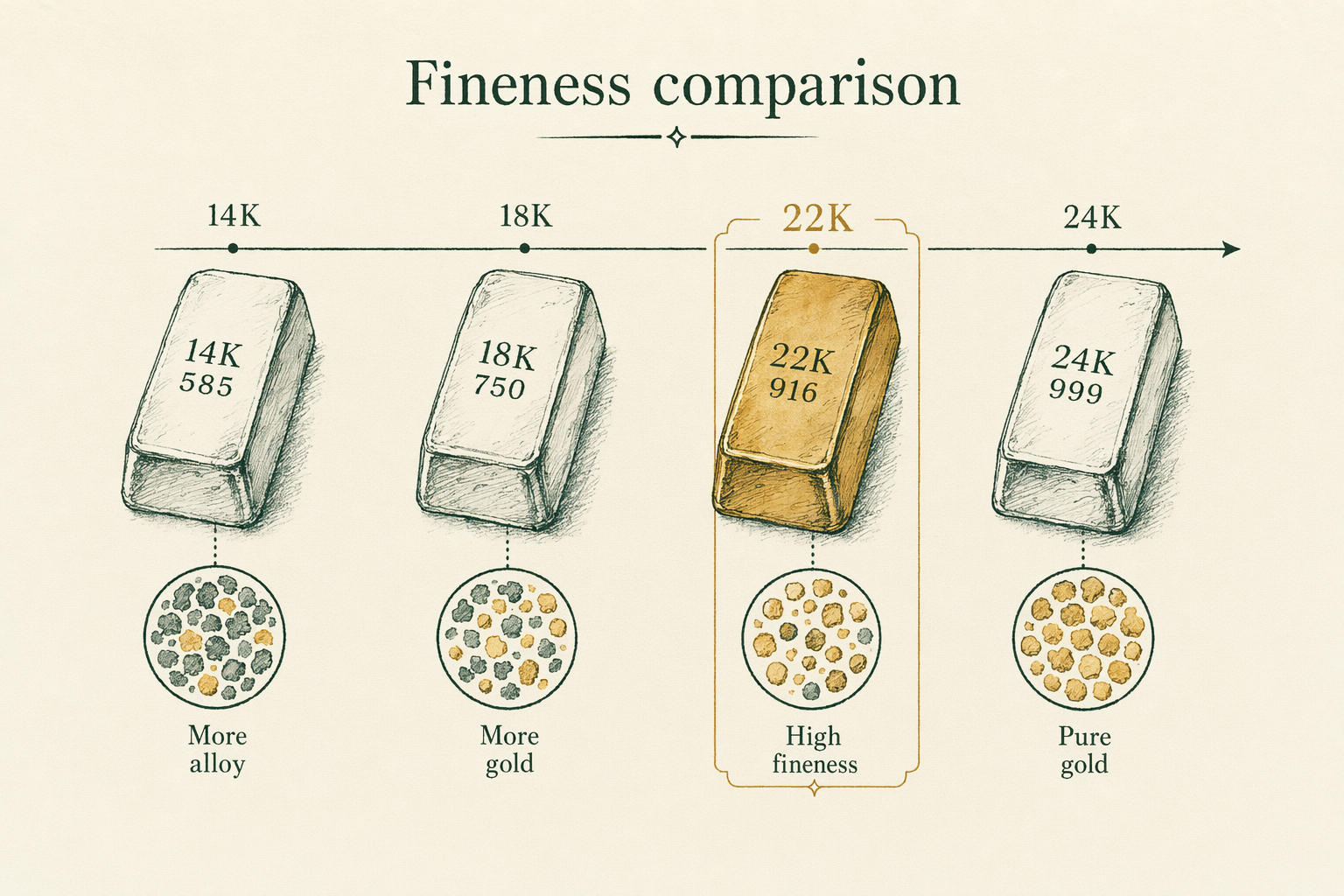
Fineness comparison
The Canadian Gold Maple Leaf is `99.99%` pure gold — `24`-karat, no alloy. A `1 oz` Maple Leaf weighs exactly `1.0000 troy ounces` (`31.10 grams`) and contains exactly `1.0000 troy ounces` of pure gold. The Royal Canadian Mint introduced the Maple Leaf in `1979`, and since `1982` the coin has been struck to `.9999` fineness. Beginning in `2007` the Mint released a `.99999` (`five nines`) `1 oz` Maple Leaf — even purer than the standard product, marketed as a specialty issue.
The American Gold Eagle is `22`-karat — `91.67%` gold, `3%` silver, `5.33%` copper. A `1 oz` Eagle weighs `1.0909 troy ounces` (`33.93 grams`) total, with the additional mass coming from the silver-copper alloy. Each Eagle still contains exactly `1.0000 troy ounces` of pure gold by mass. The Eagle is therefore not less gold than the Maple — it is more total coin to deliver the same `1 oz` of gold, intentionally so to gain hardness and durability.
Mint reputation and security features
Both the United States Mint and the Royal Canadian Mint (RCM) are sovereign mints with strong global reputations. The RCM is on the LBMA Good Delivery list for refiners. The US Mint produces the Eagle under the authority of the Gold Bullion Coin Act of `1985`. Both mints publish detailed annual reports, are subject to legislative oversight, and are recognized by every major bullion dealer worldwide.
Modern Maple Leafs carry security features designed to deter counterfeiting: a radial-line pattern visible on the reverse, a micro-engraved maple leaf privy mark added in `2013`, and (on some recent issues) bullion DNA serialization. The RCM markets these features explicitly as authentication aids. The American Gold Eagle's security relies primarily on its distinctive `22`-karat alloy weight and density profile, which differs from any plausible counterfeit material. Both designs are well-tested at the retail dealer level; both are routinely accepted by major US bullion dealers without additional authentication beyond visual inspection and weight verification.
Durability tradeoffs
Pure-gold `24`-karat coins are softer than the `22`-karat alloy used in the Eagle. The `Maple Leaf` shows surface damage (milk-spots, light scratches from contact with other coins) more readily than the Eagle. For investment storage in capsules or air-tite holders, this difference is minimal — the coins sit undisturbed in protective casing and never contact anything. For coins handled frequently (passed between buyer and seller, examined, stacked without capsules), the Eagle's harder surface holds up better.
'Milk-spotting' on Canadian Maple Leafs is a documented phenomenon: small white-cloudy surface spots that appear on some `24`-karat coins, attributed by some sources to manufacturing-process residue interacting with handling oils over time. The RCM has changed minting processes multiple times to reduce milk-spotting; the issue affects a subset of coins, not all. American Gold Eagles are not generally subject to the same surface issue due to the alloy composition. For long-term storage in protective housing, neither issue matters meaningfully; for active handling, the Eagle's surface is more forgiving.
Resale spread in US vs Canada
On US soil, the American Gold Eagle typically resells at tighter spreads than the Canadian Maple Leaf — every US coin shop recognizes the Eagle by sight, and bid prices tend to sit at or near spot for clean bullion-grade examples. The Maple Leaf is also widely recognized in the US, but smaller regional coin shops occasionally quote slightly wider buy spreads on Canadian product (citing 'we have to ship it to a wholesaler' or similar). Major online dealers (APMEX, JM Bullion, Money Metals) buy both at spot-tight prices.
In Canada and most of Europe, the Maple Leaf has tighter resale spreads than the Eagle. International bullion buyers frequently prefer `.9999`-fine product, and the Maple's recognition in European refining markets is at least as strong as the Eagle's. For a US-based buyer planning to hold and eventually sell in the US, the Eagle's slight retail liquidity advantage may outweigh the Maple's slight purchase-premium advantage. For a US-based buyer with potential international resale or refining exposure, the Maple's purer-gold structure has marginal advantages. The differences are modest; a mixed stack works for most buyers.
Real-world example — buying 10 oz in Maples vs Eagles
Consider an investor buying `10 oz` of gold in `1 oz` sovereign coins at an illustrative LBMA spot of `$2,400/oz` from a major US online dealer. All-Maple stack at a `3.5%` premium: `$2,484` per coin × `10` = `$24,840`. All-Eagle stack at a `5.5%` premium: `$2,532` per coin × `10` = `$25,320`. The Maple stack costs `$480` less than the Eagle stack, a savings of roughly `1.93%` on the total purchase. The buyer holds identical gold content (`10 troy ounces`) in both scenarios.
On resale `5` years later (assuming flat spot for the illustration), Eagle bid prices at a US shop might run `$2,395` per coin (slightly below spot) while Maples might run `$2,375` — a `$200` spread on the `10`-coin sale. The buyer who paid less for Maples ($24,840) recovers `$23,750` on resale; the Eagle buyer who paid more ($25,320) recovers `$23,950`. The Eagle buyer's purchase premium is partially recovered by tighter resale spreads. Total cost-of-ownership math depends on the dealer, the holding period, and the specific buy-back environment at sale time. For most retail buyers, the differences are modest enough that secondary factors (sovereign-mint preference, aesthetic, brand attachment) reasonably dominate the decision.
Common misconceptions about the comparison
**'The Maple Leaf has more gold than the Eagle.'** No. Each `1 oz` coin contains exactly `1 troy oz` of pure gold. The Maple is `1.0 oz` total weight (all gold). The Eagle is `1.09 oz` total weight (`1.0 oz` gold + alloy). Same gold, different total mass.
**'The Maple Leaf is always cheaper.'** Generally yes at retail, but not always — dealer pricing fluctuates, and certain Eagle issues at certain dealers occasionally come in below Maple prices during promotions. Check current pricing rather than assuming.
**'You can't lose money buying either one.'** Both coins track spot gold for their physical-content value. If spot gold falls, the coin's resale value falls with it. Sovereign-mint status does not prevent market-price losses.
What this means for you
Both the Canadian Gold Maple Leaf and the American Gold Eagle are excellent sovereign `1 oz` gold coins. The Maple is purer (`24`-karat versus `22`-karat) and typically slightly cheaper at retail. The Eagle is harder-surface, has slightly tighter US-resale liquidity, and is IRS-named in IRA-eligibility rules. The 'right' choice depends on whether you optimize for purity, premium, handling durability, US-shop resale convenience, or some mix. A reasonable approach for a US-based buyer: mix both, weighting toward whichever the local market is pricing better at the time of purchase, and treating sovereign-mint preference as a tiebreaker. As always, BullionLens does not provide personalized investment advice.
Want to talk this through? Book a 30-min research call →
Frequently asked questions
-
Which has a higher gold content?
The Canadian Maple Leaf is 99.99% pure gold (1 oz fine gold weight = 1 oz total weight). The American Eagle is 91.67% pure but still contains 1 oz of actual gold (total weight is 1.0909 oz including alloy). -
Are Maple Leafs cheaper at retail?
Often by $5-$30 per coin versus Eagles, varying by dealer and time. The price gap is not consistent — check current dealer pricing. -
Which is more durable for handling?
The Eagle's copper-silver alloy makes it more scratch-resistant. Pure-gold Maples are softer and show handling damage more easily. For investment-grade storage neither matters; for circulation handling the Eagle wins. -
Where does BullionLens get its data on this topic?
Primary sources cited in the article. For market data we lean on the LBMA daily fixings, COMEX volume reports, IRS publications, SEC filings, and the World Gold Council's annual reports. We do not cite secondary aggregators as authority.
In plain English We're an editorial desk. Educational only — talk to a licensed adviser before doing anything with retirement assets.