How to spot counterfeit gold coins
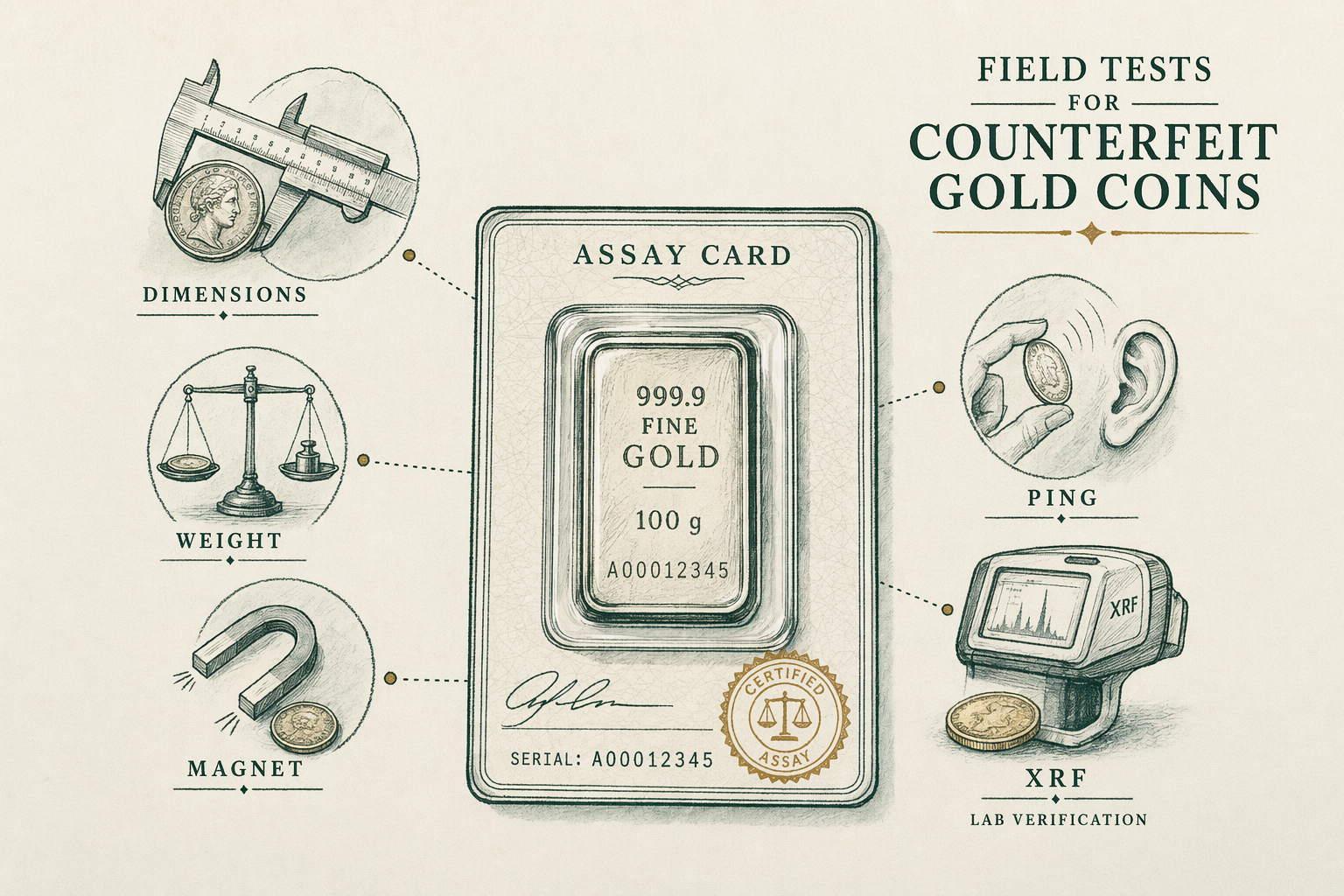
Field tests for counterfeit gold coins: dimensions, weight, magnet test, ping test, and the XRF lab method for high-value verification.
Why counterfeits exist and where they appear
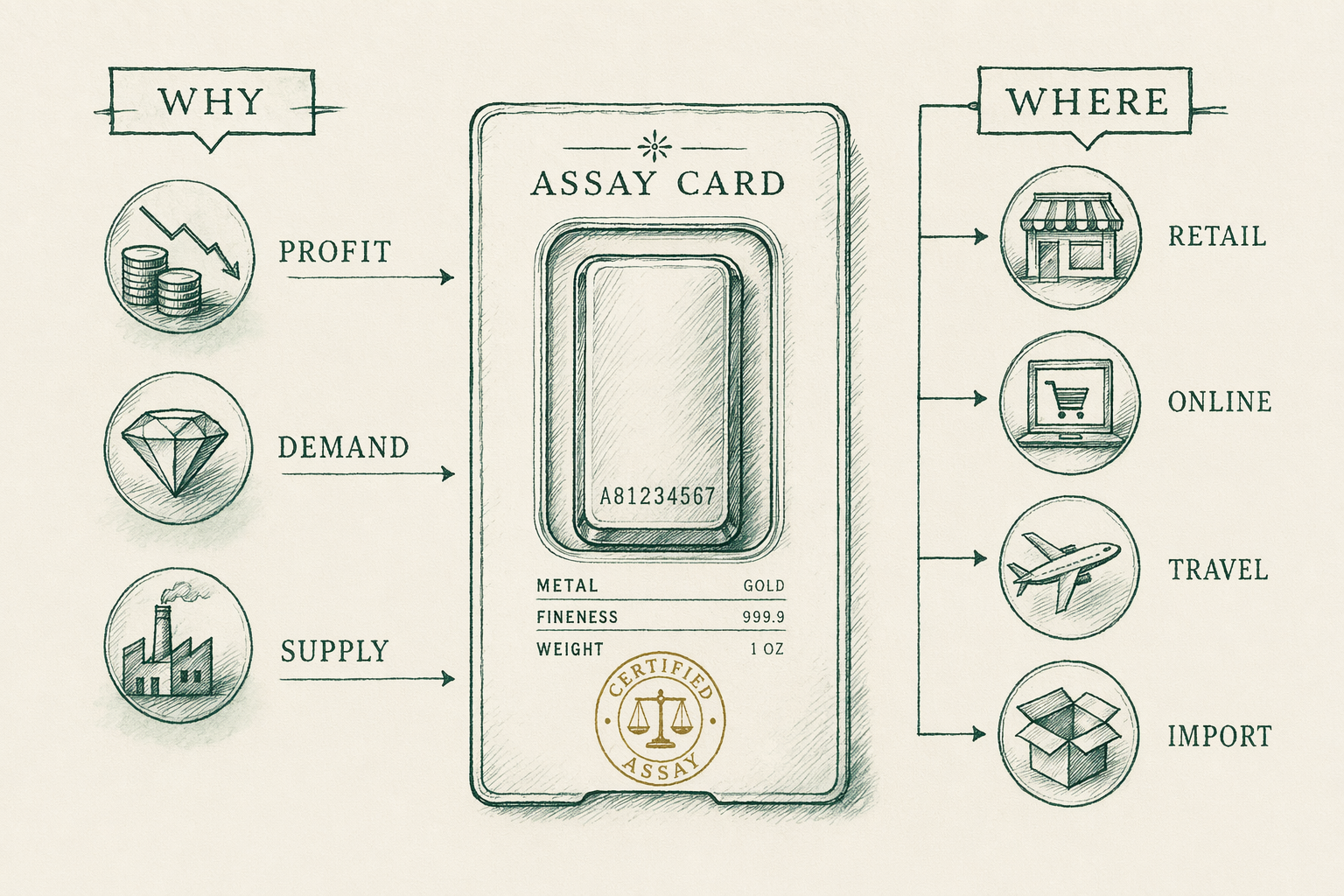
Counterfeit gold coins exist because the underlying spread is large. A `1 oz` American Gold Eagle sells for over `$2,500` at retail; the same form factor in cheaper metals (tungsten core with thin gold cladding, brass, gold-plated copper) can be manufactured for under `$50` per piece in offshore operations. The arithmetic supports a large counterfeit industry, especially in markets without strong dealer-verification infrastructure. Counterfeits show up primarily in private-party transactions (estate sales, individual seller marketplaces, pawn shops in low-volume areas), at unfamiliar dealers, and in international or refurbished markets.
Reputable US bullion dealers (APMEX, JM Bullion, Money Metals Exchange, Provident Metals, SD Bullion) verify every inbound coin through commercial-grade equipment and have minimal counterfeit exposure in their retail product. Estate buyers, eBay and Craigslist sellers, and private-party transactions are where counterfeit risk concentrates. The mitigations below are most relevant when buying from sources outside the established dealer chain, but they're worth knowing even when buying from major dealers — verification habits scale to any future transaction including resale documentation.
Dimensional check with calipers
Sovereign gold coins are minted to tight dimensional specifications. A genuine `1 oz` American Gold Eagle measures `32.70 mm` in diameter and `2.87 mm` in thickness. A `1 oz` Canadian Gold Maple Leaf measures `30.00 mm` diameter and `2.87 mm` thickness. The Royal Canadian Mint and US Mint publish exact specifications; any deviation outside a few hundredths of a millimeter signals a problem.
Digital calipers accurate to `0.01 mm` are inexpensive (`$15-30` at any hardware retailer) and are the cleanest first-pass authentication tool. Measure diameter at multiple points around the rim (counterfeits sometimes have inconsistent dimensions). Measure thickness at multiple points across the face. If anything is off by more than `0.05 mm` from published specs, treat the coin as suspect pending further verification. Sovereign-mint specifications are available on the issuing mint's website (usmint.gov, mint.ca, perthmint.com, etc.); a five-minute lookup confirms the exact target dimensions.
Weight check with a 0.01g scale
Gold's density (`19.32 g/cm³`) is higher than nearly every other metal except tungsten and a few platinum-group metals. A counterfeit using a less-dense metal core (brass at `8.5 g/cm³`, copper at `8.96 g/cm³`) of the same dimensions as a real coin will weigh less. A genuine `1 oz` American Gold Eagle weighs `33.93 grams` (total weight including alloy); the same form factor in brass would weigh only about `15 grams`. A digital jewelry scale accurate to `0.01 g` (cost: `$20-40` for a reliable model) catches this immediately.
Tungsten counterfeits are the harder case. Tungsten has density `19.25 g/cm³` — almost identical to gold's `19.32`. A tungsten-cored fake with gold cladding can match both dimensions and weight to within field-test tolerances. This is why weight alone is not a sufficient counterfeit test for high-value transactions. Always combine weight with at least one other test (ping, magnet, or XRF) before accepting an unfamiliar coin. The combination of dimensions + weight catches the cheap brass and copper fakes that account for the bulk of low-skill counterfeits; tungsten cores require the more sophisticated tests below.
The magnet test
Gold is not ferromagnetic. A genuine gold coin will not stick to a magnet, regardless of how strong. A neodymium 'rare earth' magnet (the strongest readily-available magnet, cost `$5-10`) is the standard tool. Hold the magnet near the coin; if there's any attraction at all, the coin contains ferromagnetic metal (iron, steel, nickel) and is not real gold. The magnet test rules out the easiest, lowest-skill counterfeits (steel cores plated with gold leaf, brass with magnetic alloy contamination).
Limitations: the magnet test does not catch tungsten counterfeits (tungsten is paramagnetic but weakly, and most counterfeits use formulations that test non-magnetic). It also does not catch lead-based fakes (lead is non-magnetic but much less dense than gold; the weight test catches these). The magnet test is a cheap, fast, useful preliminary filter — it eliminates `60-70%` of low-quality counterfeits in seconds. It is not sufficient on its own for high-value verification.
The ping test (acoustic frequency)
When struck on edge, gold coins ring with a distinctive high-frequency tone (typically around `4,000-5,000 Hz` for `1 oz` sovereign coins). The tone reflects the metal's specific elastic modulus and density; gold's combination produces a characteristic ring that counterfeits made from cheaper metals (or tungsten cores with damping characteristics) generally cannot replicate. The 'ping test' has been used by traders informally for centuries; modern smartphone apps (such as 'CoinTrust' or 'BullionTest') analyze the recorded acoustic spectrum against known reference profiles.
Method: hold the coin balanced on a fingertip (do not grip it tightly; this damps the ring), tap the edge sharply with a metal striker or another coin, listen for the characteristic ring. The ping app records `2-3 seconds` of audio and extracts the dominant frequency. Genuine sovereign coins produce a clean, sustained high-frequency tone; counterfeits typically produce a duller, lower-frequency, or quickly-damped sound. The ping test is effective on bare coins; it does not work well on coins in capsules or assay cards (the capsule damps the ring). For coins still in original packaging, this test is unavailable.
XRF as the definitive lab test
X-ray fluorescence (XRF) testing measures the surface composition of a coin non-destructively. An XRF analyzer (handheld or benchtop) emits X-rays at the coin's surface; the metal absorbs and re-emits characteristic X-rays at frequencies specific to each element. The analyzer's software identifies elements and quantifies their concentration. A genuine `1 oz` Gold Eagle reads `91.67%` gold + `3%` silver + `5.33%` copper; deviations from this profile signal a counterfeit.
XRF is non-destructive — it does not damage the coin. Most major US coin shops and bullion dealers have XRF capability and will test customer-submitted coins for `$5-20` per coin, or free for products they're considering buying. Limitations: XRF reads only surface composition (a few microns deep); a thin gold cladding over a tungsten core will read as `100%` gold on the surface. Combined with a weight + dimensions check (which catches the tungsten core via density anomalies, since the surface XRF cannot detect what's beneath), XRF is the gold standard for retail-level authentication. For very high-value individual coins (`50+ oz` gold bars), refineries can perform destructive assay testing (drilling a small sample) for institutional-grade verification.
Real-world example — checking a 1 oz Eagle from an estate sale
Consider a buyer evaluating a `1 oz` American Gold Eagle at an estate sale, asking price `$2,400` (close to spot). Sequence: pull out digital calipers, measure diameter (`32.70 mm` matches spec) and thickness (`2.87 mm` matches). Pull out the `0.01 g` jewelry scale, weigh (`33.93 g` matches). Hold a neodymium magnet near the coin — no attraction, passes. Balance on fingertip, tap with metal striker — clean high-frequency ring, ping app shows `~4,500 Hz` dominant frequency consistent with reference profile. Four tests passed; the coin is almost certainly genuine.
If the buyer wants final verification before paying `$2,400`, they can stop by a local coin shop offering XRF on the way home for a `$10` test fee. The XRF shows `91.5%` gold + `3.1%` silver + `5.4%` copper — within margin of spec for a genuine `1 oz` Eagle. Total verification time: under `10` minutes for the field tests + a `5`-minute coin-shop stop for XRF. Total cost of verification tools: about `$60` (calipers + scale + magnet + smartphone app), reusable indefinitely. The buyer pays `$2,400` for a verified coin with documented authentication. This level of verification is overkill for a major-dealer purchase (the dealer already did equivalent or better testing); it is essential for any private-party transaction.
Common misconceptions about counterfeit detection
**'If it looks real, it is real.'** Modern counterfeits are visually convincing. Optical inspection alone is insufficient. The four-test combination (caliper, scale, magnet, ping) takes minutes and catches the bulk of counterfeits.
**'The magnet test catches all fakes.'** No. Tungsten-cored fakes are non-magnetic and pass the magnet test. Always combine multiple tests.
**'XRF can be fooled.'** XRF reads the surface; gold-clad tungsten cores will read as `100%` gold on the surface. Combine XRF with weight + dimensions for full verification. No single test is foolproof; the combination is what catches sophisticated fakes.
What this means for you
For purchases from established US bullion dealers (APMEX, JM Bullion, Money Metals, Provident Metals, SD Bullion), counterfeit risk is minimal — these dealers run commercial-grade verification on every inbound coin. For private-party purchases (estate sales, individual sellers, eBay, Craigslist), spend `15` minutes and `$60` on the basic test kit: digital calipers, `0.01 g` scale, neodymium magnet, and a ping-test smartphone app. For high-value purchases, add a `$10` XRF test at a local coin shop. The combination catches the vast majority of counterfeits at a vanishingly small cost compared to the loss exposure on an unauthenticated coin. As always, BullionLens does not provide personalized advice; for any high-value purchase, professional appraisal at a bonded coin dealer is the standard of care.
Want to talk this through? Book a 30-min research call →
Frequently asked questions
-
What's the simplest counterfeit test?
Caliper plus scale. Genuine 1 oz Gold Eagles are 32.7mm diameter, 2.87mm thick, 33.93g total weight. Counterfeits using cheaper metals will fail at least one dimension or the weight check. -
Does the magnet test work?
Gold is not magnetic. A coin that attracts a strong neodymium magnet contains ferromagnetic alloy and is not real gold. Caution: not all counterfeits are magnetic — tungsten-cored fakes pass the magnet test. -
What is the ping test?
Real gold coins emit a distinctive high-frequency ring when struck on edge. Apps and devices analyze the acoustic spectrum for the signature frequency. Effective on bare coins; less effective on encapsulated coins. -
How definitive is XRF testing?
X-ray fluorescence reads the surface composition non-destructively. Reputable coin shops and refineries offer XRF testing for a small fee. It is the gold standard (sorry) for verification.
In plain English We're an editorial desk. Educational only — talk to a licensed adviser before doing anything with retirement assets.