What is XRF testing for gold?
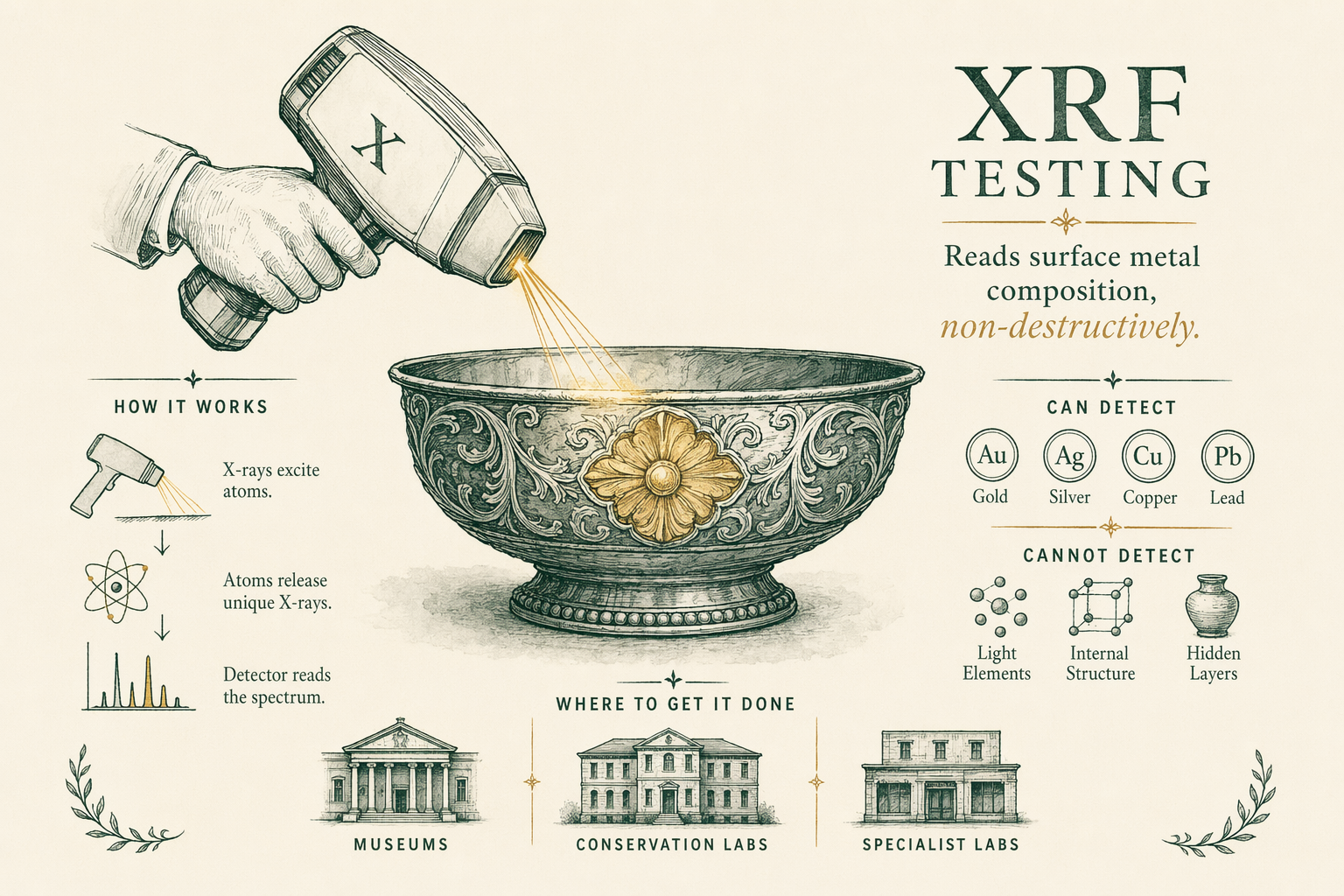
X-ray fluorescence testing reads surface metal composition non-destructively. How it works, what it can and cannot detect, and where to get it done.
The underlying physics
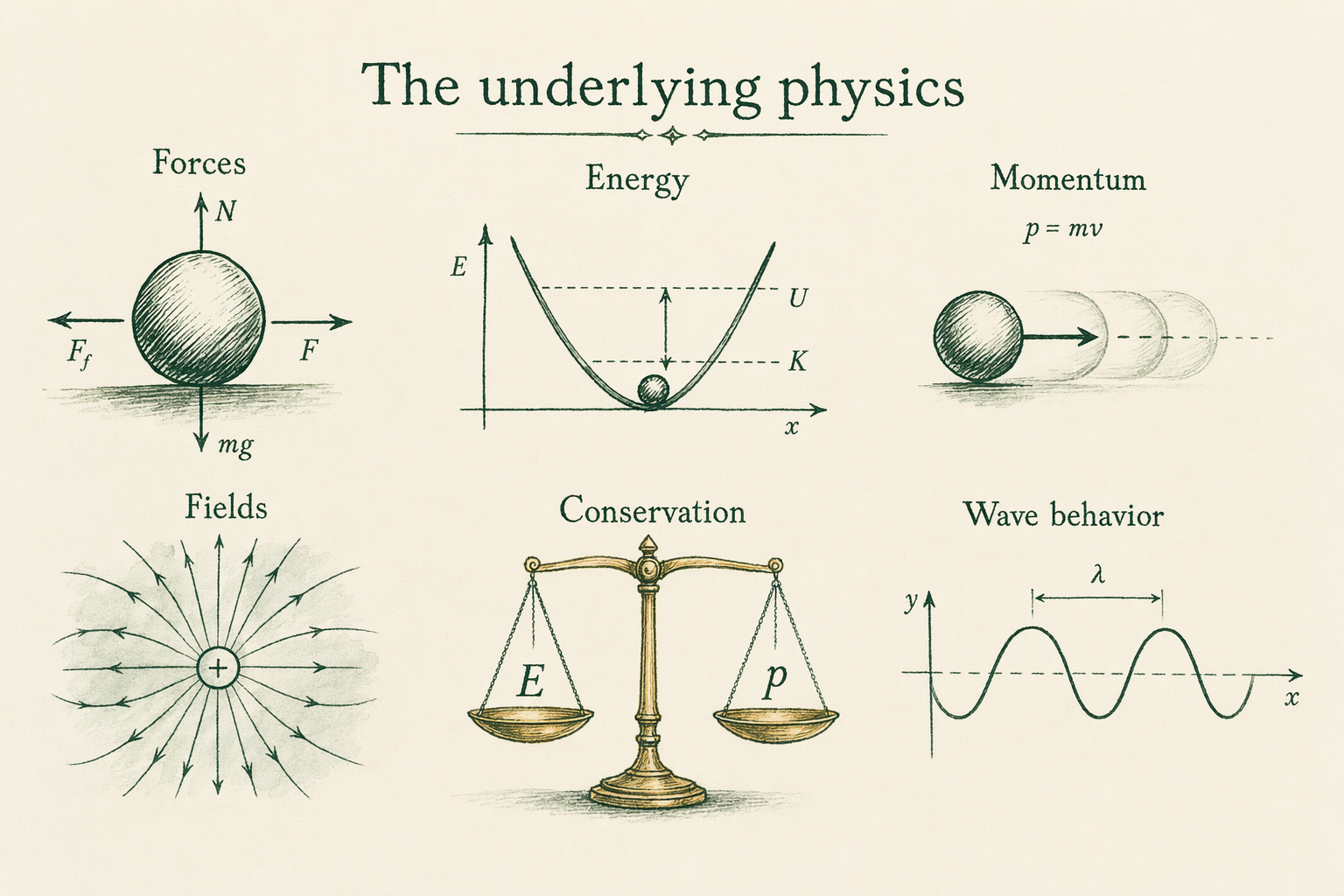
X-ray fluorescence (XRF) testing exploits a basic atomic-physics phenomenon: when a material is bombarded with high-energy X-rays, the inner-shell electrons of its atoms get knocked into higher energy states, then drop back down emitting characteristic 'fluorescence' X-rays at frequencies specific to each element. Gold's characteristic fluorescence frequencies are different from copper's, silver's, tungsten's, or any other metal's. By measuring the spectrum of emitted fluorescence and matching observed peaks against reference spectra, an XRF analyzer identifies and quantifies the elements present in a sample.
The technique was developed in the early `20th` century, became commercially viable in the `1970s-1980s` for laboratory use, and miniaturized into handheld units (Bruker, Olympus, Thermo Fisher Scientific are major manufacturers) over the `2000s-2010s`. A modern handheld XRF unit weighs `1-2 kg`, costs `$15,000-50,000` new, runs on rechargeable battery, and produces composition readings in seconds. The technique is non-destructive (no sample preparation, no damage to the test item) and quantitative (it reports percentages, not just yes/no answers).
What XRF measures (and what it does not)
XRF measures the elemental composition of the surface region of a tested item. For a typical handheld XRF analyzer operating on a gold coin, the test cycle runs `10-30 seconds`; the analyzer's software displays element percentages — '`91.7%` Au + `3.0%` Ag + `5.3%` Cu' for a genuine American Gold Eagle. The accuracy is typically `0.1-0.5%` absolute on each element for the major constituents. Trace elements (parts per million) are at the limit of handheld-XRF resolution; for trace-level work, laboratory-grade benchtop XRF or other techniques (ICP-MS, mass spectrometry) are required.
XRF does NOT measure: total weight (the analyzer doesn't weigh the coin); dimensions (it doesn't measure thickness or diameter); internal structure (it reads only the surface); or specific isotope ratios (it identifies elements, not their isotopic composition). All of these are limitations relative to the broader question 'is this coin genuine.' XRF answers 'what's on the surface' very well. For 'is the entire coin solid gold throughout,' XRF needs to be combined with weight, dimensions, and (for high-value items) ultrasonic or destructive testing.
Surface vs core composition
X-rays at the energies used by handheld XRF analyzers penetrate only a few microns to a few tens of microns into a metallic sample before being substantially absorbed. The analyzer therefore reads composition averaged over the top `10-50 micron` layer of the test item. For a solid-gold coin where the surface composition matches the bulk composition (true of all genuine sovereign and refiner-grade bullion), this is perfectly representative — the surface reading IS the coin's composition.
For a counterfeit consisting of a non-gold core with a gold cladding (gold electroplating, gold leaf, hot-dipped gold coating), the surface reading detects only the cladding. A `10`-`50 micron`-thick gold layer over a tungsten or brass core will read as essentially `100%` gold on the surface; the tungsten or brass underneath is invisible to surface XRF. This is the structural limitation: XRF alone cannot rule out a thickly-clad fake. Combining XRF with weight, dimensions, and (for high-value items) ultrasonic thickness measurement covers the gap. The ultrasonic test reads internal density variations; if the coin's density profile shows a non-gold core under a gold surface, the combined tests catch the fake.
Costs and where to find a tester
Most established US coin shops have an XRF analyzer on premise — the equipment is now standard for any shop that buys customer bullion (the shop needs to verify what it's purchasing). Customer testing services at retail coin shops typically run `$5-25` per item, with many shops offering free testing for items they're being asked to buy. Major bullion refineries (Manfra, Tordella & Brookes; Hugh Wood; Stack's Bowers Galleries for high-end coins) offer XRF and other verification services for institutional or specialty volumes.
For occasional buyers verifying private-party purchases, the right approach is: identify a coin shop within reasonable driving distance that offers XRF testing, call ahead to confirm availability and pricing, bring the item in (with original purchase documentation if available) for the test. A `15`-minute coin-shop visit producing documented composition reading is a low-friction way to verify any uncertain purchase. For frequent buyers or those with large positions, some specialty bullion dealers offer XRF testing as part of larger-customer services. Major online dealers (APMEX, JM Bullion) accept returns within their stated window if a buyer's outside XRF testing finds discrepancies.
Limits of XRF for tungsten-cored counterfeits
Tungsten counterfeits are the harder case for XRF. Tungsten's density (`19.25 g/cm³`) is nearly identical to gold's (`19.32 g/cm³`), so a tungsten-cored fake with a thick gold cladding can match dimensions, weight, and surface XRF composition simultaneously. The combination defeats the three most accessible field tests. Detecting these requires either ultrasonic thickness testing (which reads internal density variations through the metal), specific-gravity testing using water displacement at high precision, or destructive sampling (drilling for laboratory composition analysis).
Ultrasonic thickness testers cost `$300-2,000` for handheld units and are owned by some refineries and specialty coin dealers (not typically at retail coin shops). Specific-gravity testing at high precision requires a laboratory-grade balance and careful technique; some coin shops have specific-gravity testers but they're less common than XRF. For institutional bar verification — `400 oz` Good Delivery bars, kilo bars over `$60,000` — refineries perform formal assay (destructive drilling and lab analysis) which produces an absolute composition reading at the cost of slight bar damage. For retail-scale gold coins (`1 oz` Eagles, Maples), the combination of caliper + scale + magnet + ping + XRF catches the vast majority of counterfeits without requiring tungsten-specific testing; tungsten-cored fakes of retail `1 oz` coins are uncommon because the manufacturing cost approaches the underlying gold value.
Real-world example — XRF testing a 1 oz Eagle and a suspect bar
Consider a buyer evaluating two items: a `1 oz` American Gold Eagle from an estate sale and a `10 oz` private-mint gold bar from a private-party seller. XRF test at a local coin shop, both items in the same visit. The `1 oz` Eagle reads `91.5%` Au + `3.1%` Ag + `5.4%` Cu — within margin of spec for the genuine product. Combined with the visual inspection, weight (`33.93g`), and dimensions (`32.7mm × 2.87mm`), the Eagle is confirmed genuine.
The `10 oz` bar reads `99.9%` Au on the surface, matching the bar's printed `.999` fineness claim. However, the bar's measured weight comes in at `311.5g` (it should be `311.0g` for a genuine `10 oz` bar — slight over-weight is normal in the manufacturing tolerance, but the buyer notes the small variance). The buyer asks for an ultrasonic thickness test for additional verification; the shop's ultrasonic reading shows uniform density consistent with solid gold throughout, no internal core or void. Combined with the surface XRF, dimensional check, and ultrasonic, the bar is confirmed genuine. Total verification cost: `$15` for the Eagle XRF + `$30` for the bar XRF and ultrasonic. Investment of `$45` and `30 minutes` documents two purchases worth tens of thousands of dollars. Verification economics typically favor doing the tests.
Common misconceptions about XRF
**'XRF is destructive.'** No. XRF is non-contact, non-destructive. The item is not altered by the measurement. Bring the coin in, test, leave with the coin in its original condition.
**'XRF catches all counterfeits.'** No. XRF reads only surface composition. Gold-clad tungsten cores can fool XRF alone. Combine XRF with weight, dimensions, and (for high-value items) ultrasonic thickness testing.
**'XRF requires laboratory access.'** No. Most established coin shops have handheld XRF analyzers on premise. Customer testing is widely available at retail-friendly pricing (`$5-25` per item, sometimes free).
What this means for you
X-ray fluorescence testing is the gold standard for surface composition verification of bullion coins and bars. Non-destructive, fast (`30 seconds`), inexpensive (`$5-25` per item at retail coin shops), widely available across the US. For private-party purchases, estate sales, or any unfamiliar item, XRF is the right second-line authentication tool after the field tests (caliper, scale, magnet, ping). XRF combined with dimensional and weight verification catches the vast majority of retail-scale counterfeits. For very high-value items (large bars, institutional purchases), add ultrasonic thickness testing to cover the tungsten-clad failure mode. As always, BullionLens does not provide personalized advice; for any significant purchase, professional appraisal at a bonded coin dealer is the standard of care.
Want to talk this through? Book a 30-min research call →
Frequently asked questions
-
How deep does XRF read?
Typical handheld XRF reads roughly 10-50 microns into the surface. That detects gold-plated counterfeits with non-gold cores, BUT a thick gold-plated tungsten core can fool surface XRF. For high-value bars, ultrasonic thickness testing complements XRF. -
Is XRF destructive?
No. XRF is a non-contact, non-destructive technique. The coin or bar is not altered by the measurement. -
Where can I get XRF testing?
Most established coin shops have an XRF analyzer. Refineries offer it for institutional volumes. Costs typically run $5-$25 per item at retail. -
Where does BullionLens get its data on this topic?
Primary sources cited in the article. For market data we lean on the LBMA daily fixings, COMEX volume reports, IRS publications, SEC filings, and the World Gold Council's annual reports. We do not cite secondary aggregators as authority.
In plain English We're an editorial desk. Educational only — talk to a licensed adviser before doing anything with retirement assets.