COA, assay, and authenticity
Certificate of Authenticity, assay cards, refiner stamps, serial numbers, and the field tests that catch counterfeits before you wire the money.
What a Certificate of Authenticity actually is
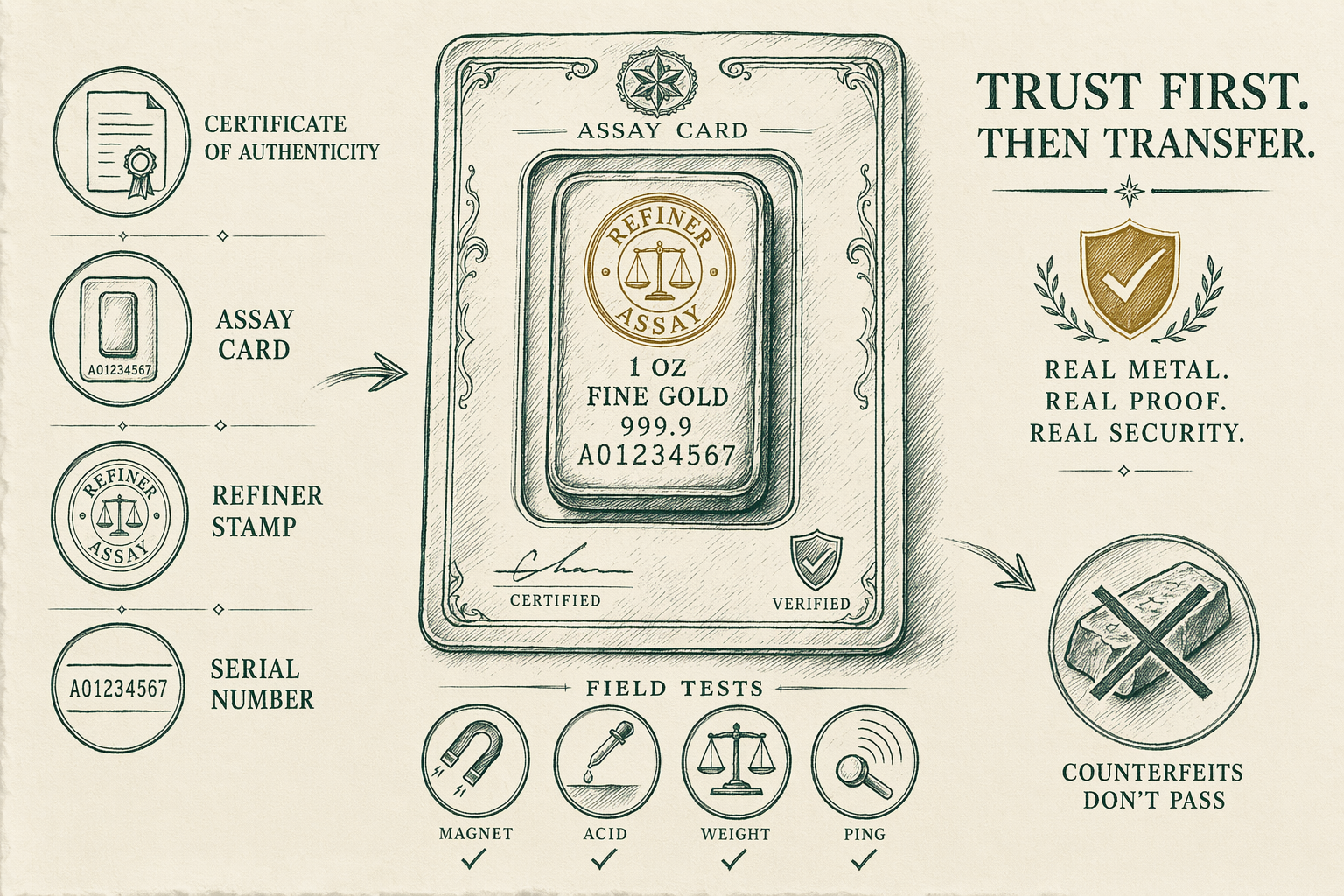
A Certificate of Authenticity (COA) is a document issued by a mint or refiner attesting that the accompanying coin or bar meets the stated weight, fineness, and origin specifications. COAs are common with proof and special-issue coin sets (where the mint produces a coin with collector intent) and with some specialty bars.
The strength of a COA depends almost entirely on the credibility of the issuing institution rather than on the COA paper itself. A COA from the United States Mint or the Royal Canadian Mint or PAMP Suisse provides meaningful authentication credibility because the institution's reputation is itself the underwriting. A COA from a private-mint round operation has weaker authentication credibility because the institution's reputation is less well-established and a counterfeit COA from a private-mint round operation is itself plausibly counterfeit.
COAs are routinely counterfeited along with the underlying bullion. A counterfeit gold coin packaged with a counterfeit COA is sometimes encountered in the wild — sometimes sophisticated enough to pass casual inspection. The COA alone is not authentication; the COA plus the underlying physical authentication mechanisms (refiner stamp, assay-card sealing, dealer-side test) is.
For bullion-grade buying (the dominant retail use case), most modern products do not come with a separate paper COA in any meaningful sense. Bullion coins (American Gold Eagle, Canadian Maple Leaf) come in their original mint packaging with mint-provided documentation that effectively serves as a COA equivalent. Bullion-grade bars come either with no documentation (raw cast bars) or with assay-card packaging (next section).
Practical guidance: do not pay a premium for a COA on bullion-grade product where the COA is the primary authentication mechanism. Pay for refiner reputation, mint reputation, and sealed-assay packaging — those are the underwriting that gives a COA whatever value it carries.
Assay cards and sealed bars
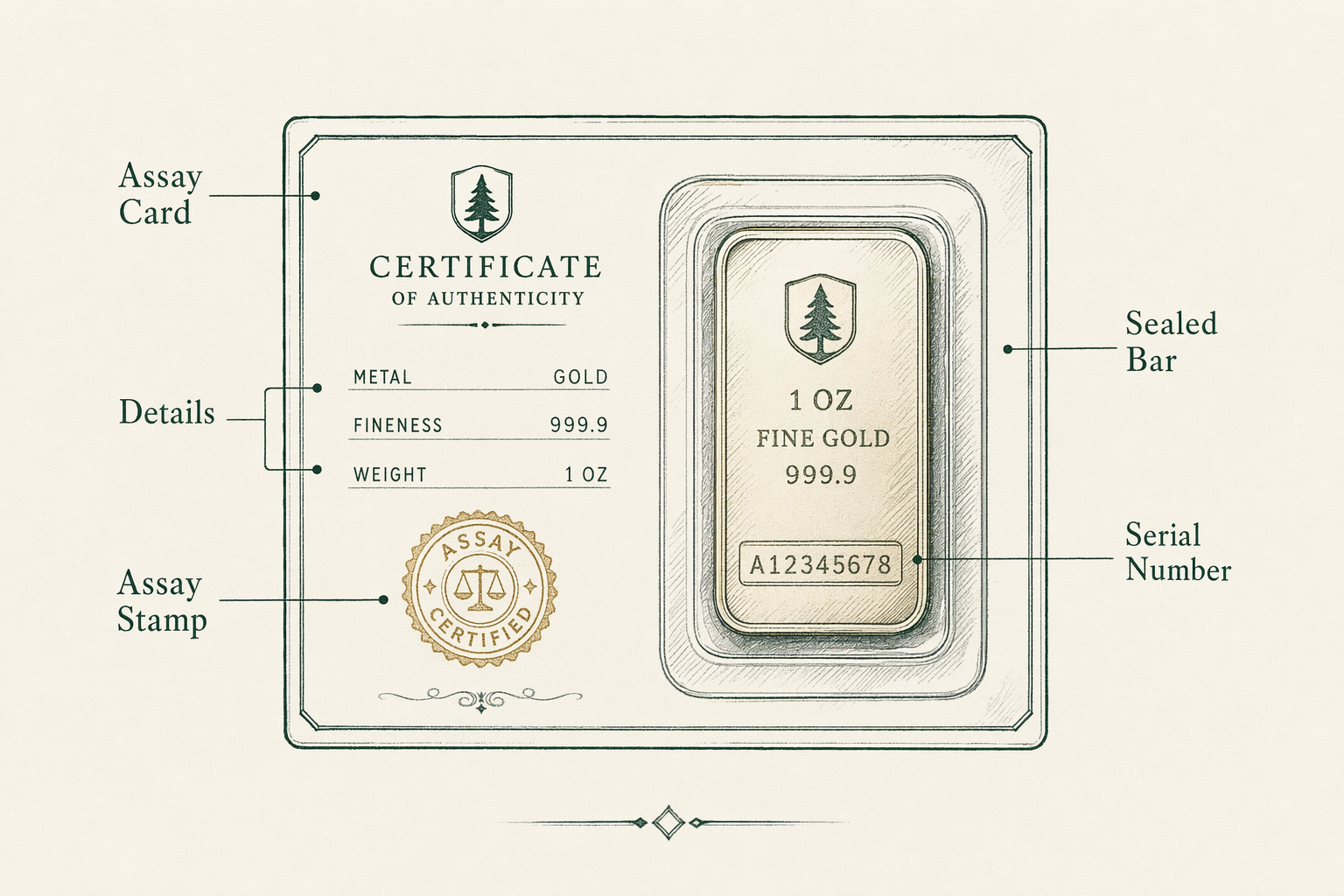
An assay card is a sealed-plastic package containing a small bar (typically `1 g` to `1 oz`), with the bar's serial number, weight, fineness, and refiner stamp printed on the surrounding plastic card. The format was popularized by PAMP Suisse and Credit Suisse in the 1980s and is now the industry standard for retail-facing small-bar packaging.
The structural value of the assay-card format: the seal between the plastic card and the bar is tamper-evident. The serial number on the card matches the serial number stamped on the bar itself (a buyer can verify the match through the clear plastic). The card's printing includes the refiner's signature mark. Modern assay cards also include security features (holographic strips, microprinted serial echoes, sometimes RFID or NFC chips) similar to currency anti-counterfeiting features.
Sealed-assay bars from LBMA Good Delivery refiners are the operational gold standard for retail-bar buying. PAMP Suisse, Credit Suisse (now UBS group), Argor-Heraeus, Valcambi, and Perth Mint all produce sealed-assay-card-packaged bullion bars in the `1 g` to `1 oz` range that retail dealers handle routinely. Their reputation is the underwriting; the sealed-assay packaging is the verification mechanism.
Larger bars (`10 oz` and above) typically do not come in sealed-assay-card packaging — the bar is too large for the card format to be practical. They come instead with a paper assay certificate from the refiner and rely on the refiner stamp on the bar itself plus dealer-side authentication. The 100 oz and kilo bars from LBMA Good Delivery refiners are authenticated by the refiner stamp plus the dealer's receiving-side X-ray fluorescence test, with the paper assay certificate as documentation.
If you receive an assay-card bar with a broken or compromised seal, treat the bar as unauthenticated regardless of refiner stamp. Counterfeit operations sometimes acquire genuine assay cards from circulation, replace the genuine bar with a tungsten-cored counterfeit, and re-seal — though detection rates on re-seals are high at any reputable dealer with proper authentication procedures.
Refiner stamps and the LBMA Good Delivery list
Every bullion bar carries a refiner mark stamped or embossed into the metal. The mark identifies the refiner that produced the bar. The refiner's reputation, in turn, is the institutional underwriting of the bar's stated weight, fineness, and integrity.
The LBMA Good Delivery List is the institutional benchmark for refiner accreditation. Maintained by the London Bullion Market Association, the list specifies the refiners whose `400 oz` London-Good-Delivery gold bars meet the LBMA's institutional-good-delivery standards. As of 2026-Q2, the LBMA Good Delivery List includes approximately `75` accredited refiners worldwide for gold (the list is updated as refiners are added or, more rarely, removed).
Major LBMA Good Delivery refiners active in the retail market include PAMP Suisse, Credit Suisse (now UBS group), Argor-Heraeus, Valcambi, Metalor, Heraeus, Asahi (which acquired the Johnson Matthey US refining operations), and the Perth Mint. Refiners outside the LBMA list also produce retail bullion (Sunshine Minting, Royal Canadian Mint refining, and others), with their own accreditation chains (COMEX-approved, NYMEX-approved, etc.).
For Gold IRA eligibility, the IRS approves bars from refiners on the LBMA Good Delivery, COMEX, NYMEX, or NYSE-LIFFE accredited lists. The /guides/coins-vs-bars/ guide covers the IRA-eligibility implications in more detail.
Counterfeit operations sometimes reproduce refiner stamps. The stamp alone is not authentication — the stamp plus the refiner's intrinsic features (weight to `0.01g`, dimensions to specified tolerances, surface finish characteristics, sometimes proprietary anti-counterfeiting features) is.
Serial numbers and traceability
Modern sealed-assay-card bars carry a unique serial number stamped into the bar and printed on the assay card. The serial number is the traceability anchor.
The serial number is useful at two distinct points in the bullion lifecycle. At purchase, the serial number lets the buyer (and the dealer) cross-reference the bar against the refiner's published serial-number range and (where the refiner offers it) a serial-number-lookup database confirming the bar's authenticity. At allocated storage, the serial number identifies the specific bar held in the depository on the holder's behalf — the depository's holdings statement references the same serial number, providing a clean property-law chain of identification.
Some refiners (PAMP Suisse, Argor-Heraeus, Valcambi notable here) maintain online serial-number-verification services where a buyer or dealer can enter the serial number and receive confirmation of the bar's production-record. The verification service does not guarantee authentication (a counterfeit operation could in principle replicate a known-genuine serial number) but does flag inconsistencies and reproduction-batches that did not exist at the refiner.
For Gold IRA storage in allocated form (segregated or commingled), the serial number is load-bearing. The depository's holdings statement to the IRA holder lists the bars by refiner, serial number, weight, and fineness. The holder can cross-reference the statement against the bars' physical presence (where the depository permits audited visits — typically Delaware Depository and some IDS facilities offer this).
Serial-number-free bullion (most cast bars, some smaller minted bars without assay-card packaging) is harder to track through allocated storage and is generally less suited to IRA-allocated holding for that reason.
Field tests buyers can run
Before wiring money for a high-value bullion purchase, four field tests provide meaningful authentication signal at low equipment cost. These tests do not replace lab-grade authentication for genuinely high-value purchases but do catch a large fraction of casual counterfeiting attempts.
Test one: digital caliper measurement. A genuine American Gold Eagle measures `32.70mm` in diameter and `2.87mm` in thickness. A Canadian Maple Leaf measures `30.00mm` in diameter and `2.87mm` in thickness (post-2014 series with security ring). A digital caliper accurate to `0.01mm` (commonly available for under `$40`) can measure these dimensions and compare against the mint's published specifications. Counterfeit operations using tungsten cores often produce coins that are slightly wider or thicker to compensate for tungsten's lower density relative to gold.
Test two: precision weight measurement. A genuine 1 oz American Gold Eagle weighs `33.93g` (gross weight, gold plus alloy). A genuine 1 oz Maple Leaf weighs `31.10g` (the Maple Leaf is `.9999` fine so its gross weight matches its troy weight). A digital pocket scale accurate to `0.01g` (commonly under `$30`) measures the weight against published spec. Weight deviation outside the mint's published tolerance band (typically `±0.05g` for sovereign coins) flags an authentication issue.
Test three: magnet test. Gold is not magnetic. A neodymium magnet held against a genuine gold coin produces no detectable attraction. Magnetic attraction immediately disqualifies the coin as gold. This test catches steel-and-iron-cored counterfeits trivially. It does not catch tungsten-cored counterfeits (tungsten is also non-magnetic), nor copper-cored counterfeits, so it is necessary but not sufficient.
Test four: ping test (sometimes called acoustic test). A genuine gold coin struck or balanced on a finger and tapped lightly produces a distinct ringing tone at a characteristic frequency related to the coin's metal density and geometry. Tungsten-cored or other-cored counterfeits produce a duller, shorter tone. Apps for smartphones exist that record and analyze the tone against known-genuine acoustic signatures. The ping test is sensitive to counterfeits with internal voids or non-gold cores; it requires a moment of practice to perform reliably.
Lab-grade tests for high-value purchases
For high-value purchases (typically `$10,000` and above per single piece, or large purchases of any kilogram-and-larger bars), two lab-grade tests provide near-definitive authentication.
X-ray fluorescence (XRF) testing is the standard institutional authentication mechanism for incoming bullion at major dealers. An XRF instrument exposes the bar to X-rays, measures the spectrum of fluorescent emission from the bar's surface, and identifies the chemical composition to high precision (sub-percent at major element level). XRF is non-destructive — the test does not mark the bar — and takes seconds per test. XRF identifies tungsten-cored counterfeits trivially (tungsten's emission spectrum is unmistakably different from gold). It is limited to surface-layer analysis (the X-rays penetrate only a fraction of a millimeter), so a counterfeit with a thick gold cladding can in principle defeat XRF on the visible surface; this is why XRF is typically combined with precision weight measurement at major dealers.
Specific-gravity (Archimedes) testing measures the bar's density by weighing it in air and again submerged in water; the ratio yields specific gravity, which for pure gold is `19.32` and which decreases for tungsten-cored counterfeits (tungsten's specific gravity is `19.25`, close enough to gold to be a defensive feature, but the alloyed-gold-around-tungsten composition has overall density that differs detectably from solid gold). This test is destructive only in that the bar gets wet; it can be performed on coins and bars without marking. Combined with XRF, specific-gravity testing provides high-confidence authentication.
Many local coin shops with bullion-buying capability maintain XRF equipment and will perform XRF testing on a brought-in bar for a small fee (often `$25` to `$50` per test). For private-party transactions or significant purchases, paying for an XRF test before completion is a reasonable diligence step. The dealer's own XRF test on bullion received into inventory is a useful behind-the-scenes authentication layer most retail buyers never see.
The /reviews/bullion-dealers/ hub covers which dealers maintain explicit authentication procedures for bullion received into inventory. Major direct-to-consumer dealers (APMEX, JM Bullion, Money Metals Exchange) all maintain documented authentication procedures including weight, dimension, and XRF testing on incoming inventory.
How we sourced this
Citations draw from the LBMA's published authentication guidance (Good Delivery List specifications), the World Gold Council's anti-counterfeiting working-group materials (especially the WGC's 'Gold Bar Integrity' framework), and the published mint specifications from the named sovereign mints: United States Mint Gold Eagle specifications, Royal Canadian Mint Gold Maple Leaf specifications including the 2014-and-later security-features series, Perth Mint Australian Gold Kangaroo specifications.
Field-test methodology draws from the bullion-dealer industry's published authentication procedures (most major dealers publish at least a summary description of their incoming-inventory authentication procedures) and from contemporary numismatic-authentication literature. XRF testing technical specification draws from the relevant ASTM standards (ASTM E1621 covering general XRF methodology) and the published technical materials from XRF instrument manufacturers (notably Thermo Fisher Scientific and Olympus/Evident).
Specific-gravity test methodology is well-established physics; the application to bullion authentication is described in standard numismatic-authentication references.
In plain English
In plain English: a COA on its own is not authentication — it's only as credible as the institution that issued it. For bars, the assay-card seal plus refiner stamp plus serial number is the practical authentication chain. For coins, the mint stamp plus the dimensional specs is the chain. Buy from established sovereign mints and LBMA Good Delivery refiners through established dealers. Run the four field tests (caliper, weight, magnet, ping) for any meaningful purchase. For high-value pieces ($10,000+ per piece), pay for an XRF test before completion — many local coin shops perform XRF for $25-$50. The cheap field tests catch most casual counterfeits; the lab tests catch the sophisticated ones.
Want to talk this through? Book a 30-min research call →
Frequently asked questions
-
What is a Certificate of Authenticity?
A document issued by the mint or refiner attesting that the accompanying coin or bar meets the stated weight, fineness, and origin. COAs vary in quality; the underlying refiner reputation matters more than the certificate itself. -
What is an 'assay card'?
A sealed plastic card containing a smaller bar (1g to 1 oz) with serial number, weight, fineness, and refiner stamp printed on the card. PAMP Suisse and Credit Suisse popularized the format. -
What is the LBMA Good Delivery list?
A list maintained by the London Bullion Market Association of refiners whose gold bars meet institutional good-delivery standards (400 oz London bars). LBMA accreditation is a quality signal for smaller bars as well. -
Can I test a coin myself?
Yes — caliper (dimensions to four decimal places), digital scale (weight to 0.01g), magnet test (gold is not magnetic), and ping test (specific gravity by acoustic frequency). For high-value purchases, X-ray fluorescence (XRF) testing at a coin shop is non-destructive and definitive.
In plain English We're an editorial desk. Educational only — talk to a licensed adviser before doing anything with retirement assets.