What is a 'disqualified person' in an IRA?
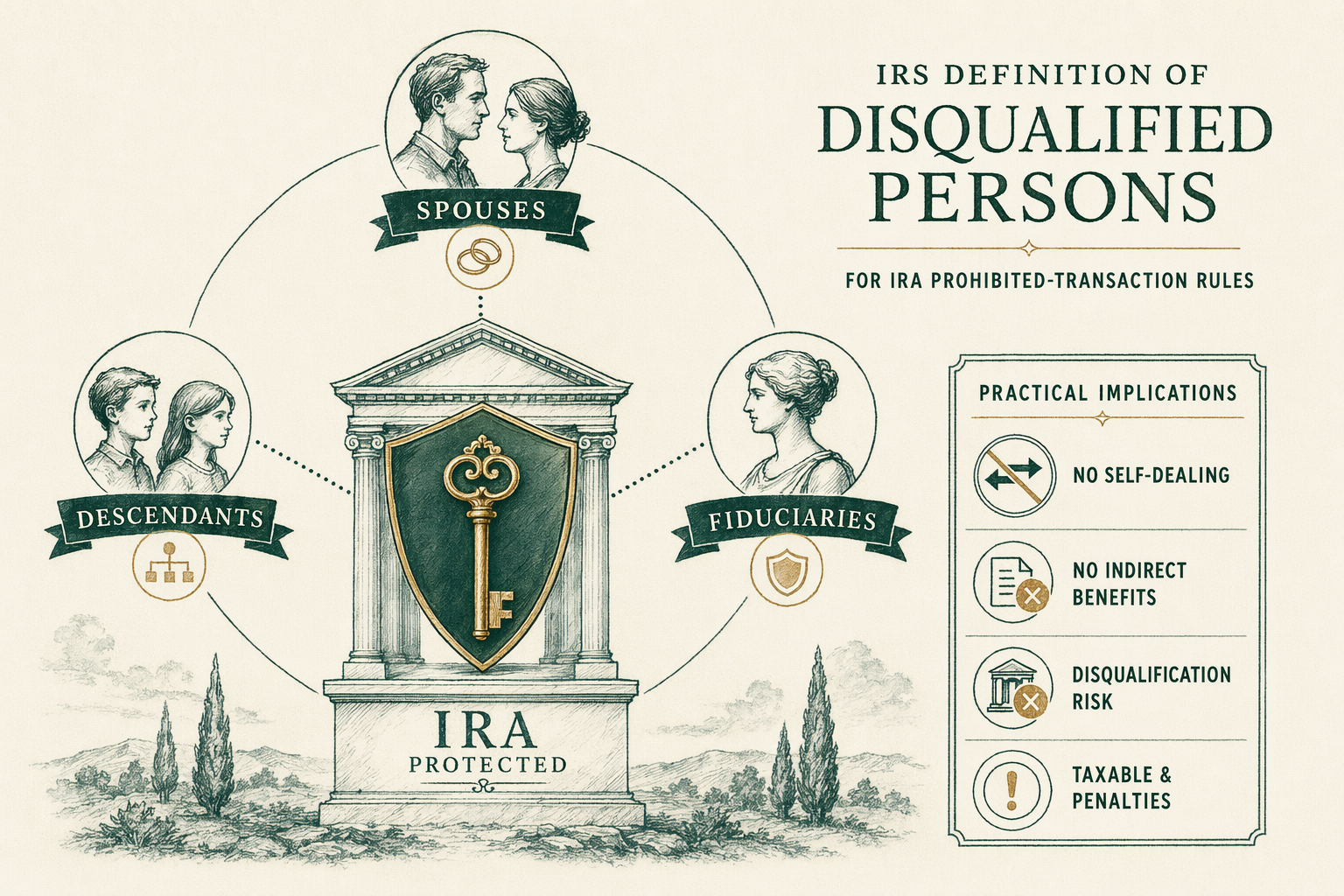
IRS definition of disqualified persons for IRA prohibited-transaction rules: spouses, descendants, fiduciaries, and the practical implications.
The statutory definition
Internal Revenue Code § 4975(e)(2) defines a "disqualified person" with respect to a plan (including an IRA) as including the following categories: (A) a fiduciary; (B) a person providing services to the plan; (C) an employer any of whose employees are covered by the plan; (D) an employee organization any of whose members are covered by the plan; (E) an owner of 50% or more of certain entity types specified in the statute; (F) a member of the family of any individual described in (A)-(E); and (G) certain entities owned by disqualified persons.
For a self-directed IRA, the IRA holder is themselves a disqualified person with respect to the IRA (under the fiduciary category), and so are the IRA holder's family members in the specifically enumerated categories. The IRS provides further detail in Publication 590-A and in Treasury Regulation § 54.4975. Read the primary statute and regulations directly before relying on this summary — the disqualified-person definitions are precisely written and the precision matters.
Family relationships included
IRC § 4975(e)(6) defines "member of the family" for the disqualified-person rules as: the individual's spouse, ancestors, lineal descendants, and any spouse of a lineal descendant. This is the list — written narrowly. Each term has a specific meaning.
**Spouse**: the IRA holder's current legal spouse. Former spouses post-divorce are not included.
**Ancestors**: parents, grandparents, great-grandparents, and so on, in the direct lineal line going up. Includes adoptive ancestors per IRC § 4975 family-relationship rules.
**Lineal descendants**: children, grandchildren, great-grandchildren, and so on, in the direct lineal line going down. Includes adopted children.
**Spouses of lineal descendants**: the IRA holder's son-in-law, daughter-in-law, grandson-in-law, granddaughter-in-law, and so on. Notably included as a category, even though they share no blood relationship with the IRA holder.
Family relationships NOT included (e.g., siblings)
The IRC § 4975(e)(6) family list is exhaustive — anyone not on the list is not a family-relationship disqualified person for IRA purposes. The most consequential omissions are:
**Siblings (brothers and sisters)** — NOT a disqualified person under the family rules. Transactions between an IRA and the account holder's brother or sister are not per se prohibited.
**Aunts, uncles, cousins** — NOT disqualified under the family rules.
**Step-parents and step-children** — NOT disqualified under the family rules unless they otherwise qualify (e.g., a step-parent who is the spouse of the IRA holder's parent is the spouse of an ancestor, which is not on the list either).
**Friends, business partners, neighbors** — NOT disqualified under the family rules; may be disqualified under fiduciary or service-provider rules in specific contexts.
The sibling exception in particular is well-documented in case law and IRS guidance. Some self-directed IRA strategies make use of this exception (e.g., a sibling buying an investment property the IRA owns, at fair market value). Such strategies require careful tax advisory review — the sibling exception applies to the family relationship rule, but other prohibited-transaction rules (e.g., self-dealing through entities) can still apply.
Fiduciary relationships
Beyond family relationships, IRC § 4975(e)(2) categorizes fiduciaries and service providers as disqualified persons. A fiduciary is defined in IRC § 4975(e)(3) as any person who: (A) exercises discretionary authority or control over the plan's management or assets; (B) provides investment advice for compensation; or (C) has discretionary authority or responsibility for plan administration.
For a self-directed IRA, the IRA holder almost always functions as a fiduciary by directing investments. The IRA custodian (Equity Trust, STRATA, etc.) is typically NOT a fiduciary in this sense because the custodian executes directed transactions rather than exercising discretion — the IRS rules differentiate "directed custodian" from "discretionary trustee" precisely for this reason.
A separately-engaged advisor who provides investment advice for compensation IS a fiduciary. If a Gold IRA marketing sales rep's compensation depends on the size of the IRA purchase, the rep is in fiduciary territory under the statutory definition. The compensation linkage is the diagnostic, not the title.
Practical examples of prohibited transactions
**Example 1**: An IRA holder uses IRA funds to buy a rental property from his daughter. PROHIBITED — daughter is a lineal descendant.
**Example 2**: An IRA holder uses IRA funds to buy a rental property from his sister at fair market value. NOT PROHIBITED under the family rules — sister is not in the IRC § 4975(e)(6) family list. Caveat: other prohibited-transaction rules can still apply if the sister has an entity relationship that triggers the rules separately.
**Example 3**: An IRA holder borrows `$10,000` from the IRA for a personal emergency, with intent to repay. PROHIBITED — IRA-to-IRA-holder loans are self-dealing and the IRA loses tax-favored status. The full account is a deemed distribution.
**Example 4**: An IRA holder personally guarantees a loan against IRA-owned real estate. PROHIBITED — personal guarantee constitutes use of personal credit on behalf of the IRA, a form of self-dealing.
**Example 5**: An IRA holder pays for property improvements on IRA-owned real estate out of personal funds. PROHIBITED — "sweat equity" and personal-fund contributions to IRA-owned assets are forms of self-dealing.
**Example 6** (Gold IRA-specific): An IRA holder takes a `1 oz American Gold Eagle` from the depository for personal photography use, with intent to return. PROHIBITED — any personal use, however brief, is a deemed distribution.
The pattern is consistent: the IRA must operate at arm's length from the IRA holder personally and from the holder's family-list members. Routine investment management (directing the custodian to buy bullion through a recognized dealer) is fine. Anything that mixes personal use, personal benefit, or family-list transactions with IRA assets is the territory the prohibited-transaction rules cover.
Want to talk this through? Book a 30-min research call →
Frequently asked questions
-
Who is a disqualified person?
Per IRC Section 4975, disqualified persons include the IRA owner, the IRA owner's spouse, ancestors, lineal descendants, spouses of lineal descendants, and certain fiduciaries and entities controlled by these parties. -
Are siblings disqualified?
Notably, siblings are NOT in the statutory list of disqualified persons. Transactions between an IRA and the account holder's brother or sister are not per se prohibited — but consult a tax adviser before relying on this distinction. -
What happens in a prohibited transaction?
The IRA loses its tax-favored status as of the start of the year in which the transaction occurred — meaning the entire account becomes a distribution, with associated taxes and possible early-withdrawal penalty. -
Where does BullionLens get its data on this topic?
Primary sources cited in the article. For market data we lean on the LBMA daily fixings, COMEX volume reports, IRS publications, SEC filings, and the World Gold Council's annual reports. We do not cite secondary aggregators as authority.
In plain English We're an editorial desk. Educational only — talk to a licensed adviser before doing anything with retirement assets.