What is a self-directed IRA?
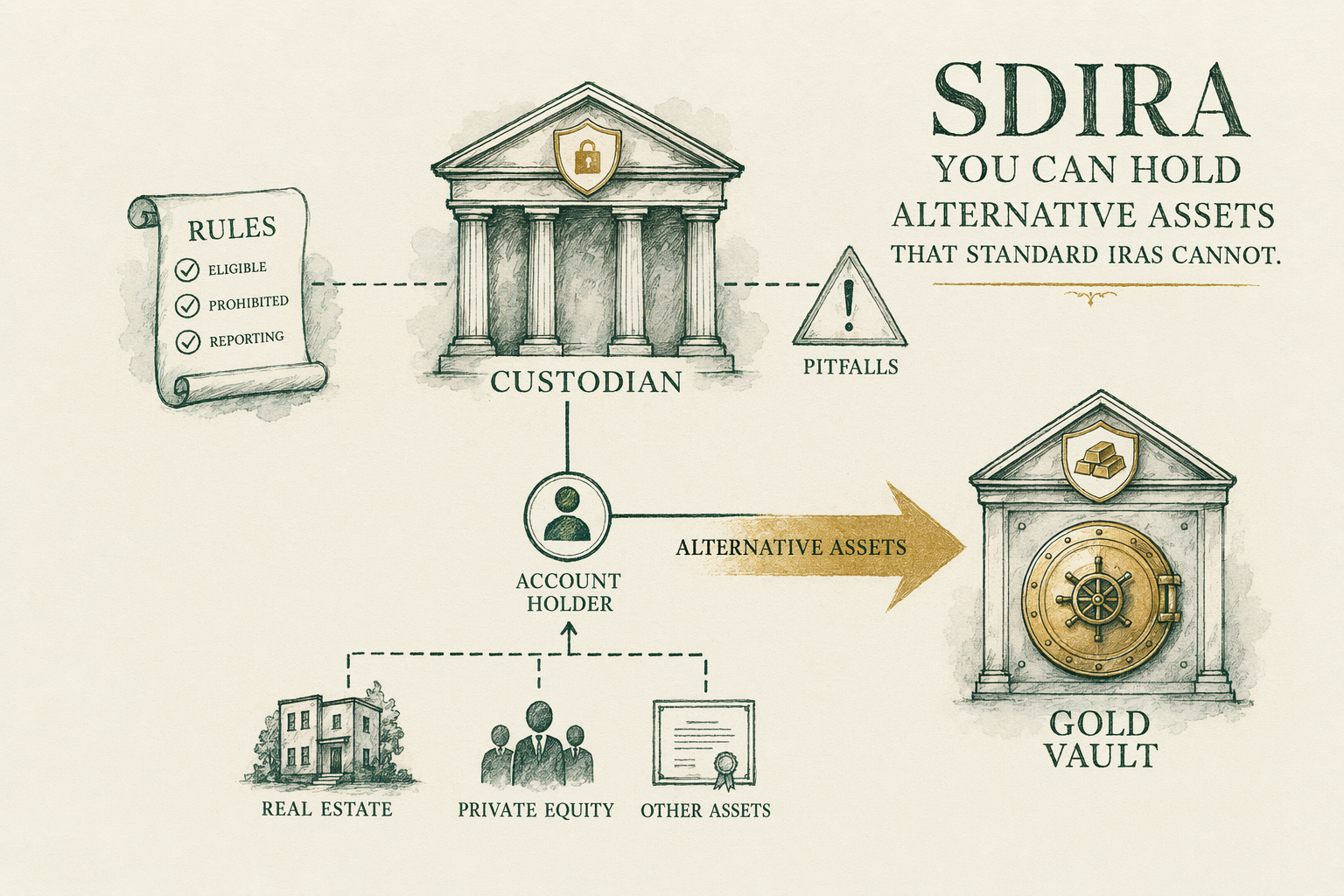
Self-directed IRAs let you hold alternative assets — gold, real estate, private equity — that standard IRAs cannot. The custodian, the rules, and the pitfalls.
Definition under IRS rules
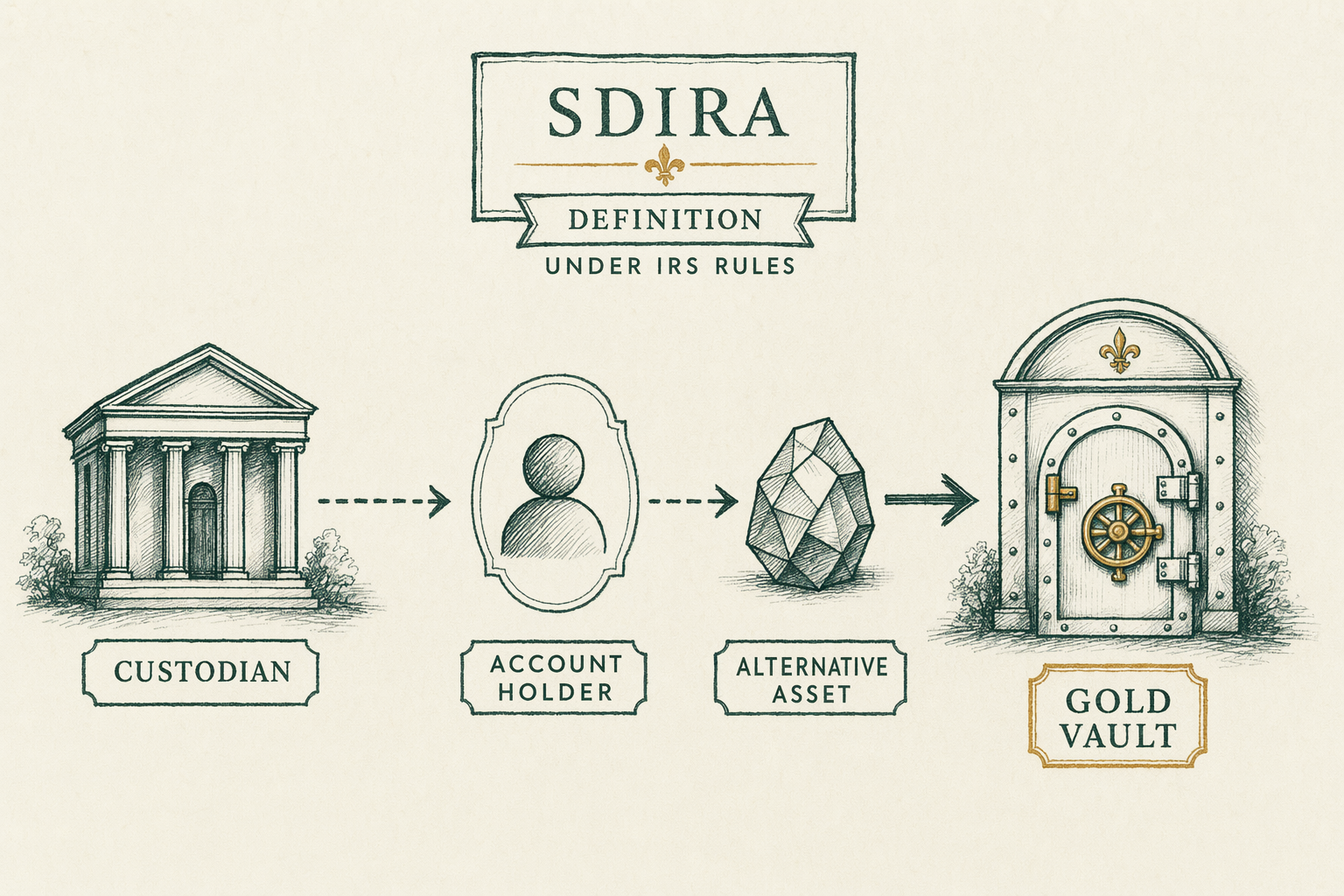
A self-directed IRA (SDIRA) is, under IRS rules, the same legal vehicle as any other Individual Retirement Account — it is governed by IRC Section `408` (Traditional IRAs) or `408A` (Roth IRAs), with identical contribution limits, distribution rules, and tax-deferral treatment. The 'self-directed' distinction is a custodian-services distinction, not a tax-code distinction. A self-directed IRA is one where the custodian permits the account holder to direct investments into asset classes (physical precious metals, real estate, private notes, LLCs) that retail brokerage IRAs do not support.
Retail brokerage IRAs (at Fidelity, Vanguard, Schwab, Merrill Lynch, etc.) limit holdings to publicly-traded securities — stocks, bonds, mutual funds, ETFs, money-market funds. They do not support physical precious metals, direct real estate, private equity, promissory notes, or other alternative assets. To hold those asset classes inside an IRA, you need a self-directed IRA at a custodian that supports them: Equity Trust Company, STRATA Trust Company, Kingdom Trust, IRA Financial, and a handful of others specialize in this niche.
What an SDIRA can hold
Asset classes commonly held inside SDIRAs include: IRS-approved physical precious metals (gold, silver, platinum, palladium meeting fineness rules) held at IRS-approved depositories; direct real estate (residential rental properties, commercial real estate, raw land); private equity and venture-stage investments; promissory notes (you lend to a borrower, the IRA receives interest); tax liens and tax deeds; LLCs and limited partnerships; certain cryptocurrencies (via custodians offering this service); and other alternative assets the IRS does not categorically prohibit.
Each asset class has its own administrative complexity inside an SDIRA. Real estate inside an IRA requires the IRA itself to hold title (not the individual), to receive all rental income directly, to pay all expenses (including unexpected ones) from IRA funds, and to follow strict prohibited-transaction rules. Promissory notes require the IRA to be the named lender. The complexity grows quickly past gold. Most SDIRAs holding alternatives are dedicated to one or two asset classes — typical pattern: a Gold IRA holding bullion at Delaware Depository, plus possibly a real-estate sleeve held separately.
What an SDIRA cannot hold
IRS rules under IRC Section `408(m)` and related provisions prohibit certain assets in any IRA, self-directed or not. Prohibited assets include: collectibles in the traditional sense (artwork, antiques, rugs, gems, stamps, alcoholic beverages, etc.) — the prohibition is at the asset-class level; life insurance contracts; S-corporation stock; and certain other categories. Physical precious metals are technically 'collectibles' under Section `408(m)`, but they are specifically permitted via the carve-outs for IRS-approved fineness levels and named sovereign coins.
Other practical restrictions arise from prohibited-transaction rules rather than asset-class prohibition. An SDIRA cannot hold real estate that the account holder or a disqualified person uses personally; cannot invest in an entity controlled by the account holder (in most configurations); cannot lend to disqualified persons; cannot purchase property from disqualified persons. The asset class itself is permitted, but the specific transaction may be prohibited. This is where SDIRA pitfalls concentrate; novice investors sometimes execute prohibited transactions believing they were structuring around them.
Custodian responsibilities
The custodian is the IRS-recognized fiduciary holding the SDIRA account. Custodian responsibilities include: maintaining the IRS-recognized trust company status under federal and state banking laws; processing contributions, distributions, and rollovers per IRS rules; issuing Forms `1099-R` (distributions) and `5498` (contributions); holding title to assets in the IRA's name (real estate deeded to '[Custodian Name] FBO [your name] IRA'); processing required reporting to the IRS; and providing periodic account statements to the account holder.
Custodians do NOT provide investment advice in the SDIRA context. They process transactions the account holder directs. They do not vet investment quality, do not recommend assets, and do not warn against bad investments. The 'self-directed' designation explicitly places the investment-decision burden on the account holder. The custodian's compliance responsibilities are administrative — keeping the account's tax status intact through proper reporting and proper title structure — not advisory. This compliance-only posture is why SDIRA scams sometimes succeed: the custodian processes a transaction the account holder directs, even if the underlying investment is fraudulent. The custodian's role is custody, not protection from bad decisions.
Prohibited transactions
IRC Section `4975` defines 'prohibited transactions' that destroy an IRA's tax-favored status. Categories include: direct or indirect sale, exchange, or lease between the IRA and a 'disqualified person' (account holder, spouse, ancestors, lineal descendants, and certain entities); lending money between the IRA and a disqualified person; furnishing goods, services, or facilities between the IRA and a disqualified person; transfer of the IRA's assets for the benefit of a disqualified person; act by the fiduciary using IRA assets for their own interest; receipt by the fiduciary of consideration from any party dealing with the IRA in connection with a transaction.
The consequence of a prohibited transaction is severe: the IRS deems the entire IRA distributed as of the first day of the year in which the prohibited transaction occurred. The full account value becomes taxable income for that year, plus the `10%` early-withdrawal penalty if the account holder is under age `59½`. Distributing an entire SDIRA via a prohibited transaction can produce tax bills in the tens or hundreds of thousands of dollars on otherwise-intact retirement savings. The rule is strict; consult a CPA specializing in self-directed IRAs before executing any transaction that involves the account holder personally or any family member.
Why most IRAs are not self-directed
Most IRAs are at retail brokerages (Fidelity, Vanguard, Schwab, etc.) and limit holdings to publicly-traded securities. The reasons are structural: retail brokerages have business models built around volume processing of securities trades, not the bespoke administrative work of holding alternative assets. Real estate inside an IRA requires deed processing, rent collection, expense management, and lawyer coordination — none of which fit the retail-brokerage operating model. Physical precious metals require depository relationships, allocated-storage administration, and shipment logistics outside the standard securities-clearing pipeline.
SDIRA custodians (Equity Trust, STRATA Trust, etc.) have specialized operating models built around the administrative complexity of alternative assets. Their fee schedules reflect the higher per-account administrative cost: an SDIRA typically costs `$80-200/yr` in maintenance fees versus near-zero for a retail brokerage IRA. The fee premium pays for the operating overhead. For investors who specifically want alternative-asset exposure inside an IRA wrapper, the SDIRA structure is the available path; for investors whose retirement assets are entirely in stocks and bonds, a retail brokerage IRA is simpler and cheaper.
Real-world example — an SDIRA holding gold and real estate
Consider a `55`-year-old with a `$500,000` Traditional IRA rolling over from a former employer's `401(k)` to a self-directed IRA at Equity Trust. The account holder allocates `$200,000` to a Gold IRA sleeve (gold bullion stored at Delaware Depository), `$200,000` to a single-family rental property purchased through the IRA (deed in Equity Trust's name FBO the account holder, rent collected by Equity Trust, expenses paid from IRA cash), and keeps `$100,000` in money-market-fund holdings inside the IRA cash position. Annual custodian fees: roughly `$300-500` for the combined SDIRA covering both sleeves. Annual storage on the gold: roughly `$200`. Annual real-estate management fees: separately negotiated.
Prohibited-transaction risks the holder must avoid: cannot use the rental property personally (no overnight stays for the holder or family); cannot rent to a disqualified person at any rate; cannot perform repairs personally on the property (sweat equity = prohibited contribution); must pay all property expenses from IRA cash, not personal funds. The administrative discipline required is meaningful and ongoing. The structural benefit: tax-deferred compounding on both the gold appreciation and the real-estate rental income inside the IRA wrapper. For an investor specifically wanting alternative-asset diversification inside a retirement account, the SDIRA is the available tool; the operating overhead is the price.
Common misconceptions about self-directed IRAs
**'Self-directed IRAs are special legal vehicles.'** No. Legally identical to standard IRAs under Sections `408`/`408A`. The 'self-directed' label reflects the custodian's services scope, not a different tax-code provision.
**'The custodian vets investments.'** No. SDIRA custodians process transactions but do not evaluate investment quality or warn against fraudulent assets. The account holder is fully responsible for investment due diligence.
**'I can use IRA-owned property myself.'** No. Personal use of IRA assets by a disqualified person (account holder, spouse, ancestors, lineal descendants) is a prohibited transaction triggering deemed full-account distribution. The rule is absolute.
What this means for you
Self-directed IRAs are the structural path to holding alternative assets — including physical gold — inside an IRA tax wrapper. They are legally identical to standard IRAs but administratively more complex; custodians are specialized firms with fee schedules reflecting the higher operating overhead. Prohibited-transaction rules are strict and the penalty (deemed full-account distribution) is severe. For Gold IRA holdings specifically, the SDIRA structure is the standard path; for broader alternative-asset strategies (real estate, private equity), the operational complexity expands. As always, BullionLens does not provide personalized advice; consult both a licensed adviser and a CPA familiar with SDIRA rules before establishing or executing transactions in a self-directed IRA.
Want to talk this through? Book a 30-min research call →
Frequently asked questions
-
How is a self-directed IRA different from a regular IRA?
Legally they are the same vehicle. 'Self-directed' is a custodian-services distinction — the custodian permits the account holder to direct investments into asset classes (physical metals, real estate, private notes) that retail brokerage IRAs do not support. -
What can a self-directed IRA hold?
IRS-approved physical precious metals, real estate, private equity, promissory notes, tax liens, LLCs, limited partnerships, cryptocurrency (via certain custodians), and other alternative assets — subject to prohibited-transaction rules. -
What is a prohibited transaction?
An IRS-defined transaction that destroys the tax-favored status of the account. Examples: self-dealing (renting an IRA-owned property to yourself), purchases from disqualified persons, and personal use of IRA assets. -
Where does BullionLens get its data on this topic?
Primary sources cited in the article. For market data we lean on the LBMA daily fixings, COMEX volume reports, IRS publications, SEC filings, and the World Gold Council's annual reports. We do not cite secondary aggregators as authority.
In plain English We're an editorial desk. Educational only — talk to a licensed adviser before doing anything with retirement assets.