What is a numismatic coin?
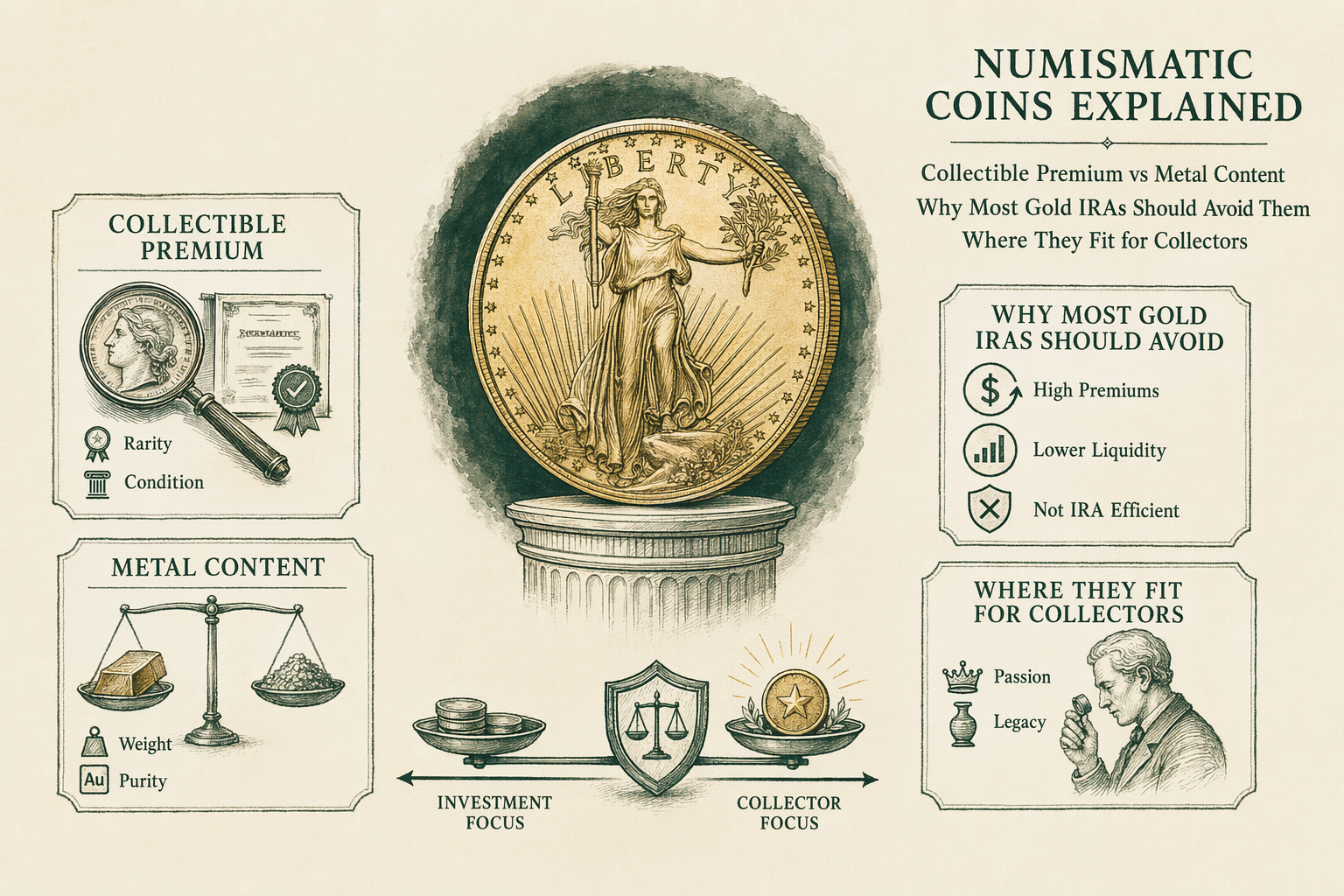
Numismatic coins explained: collectible premium vs metal content, why most Gold IRAs should avoid them, and where they fit for collectors.
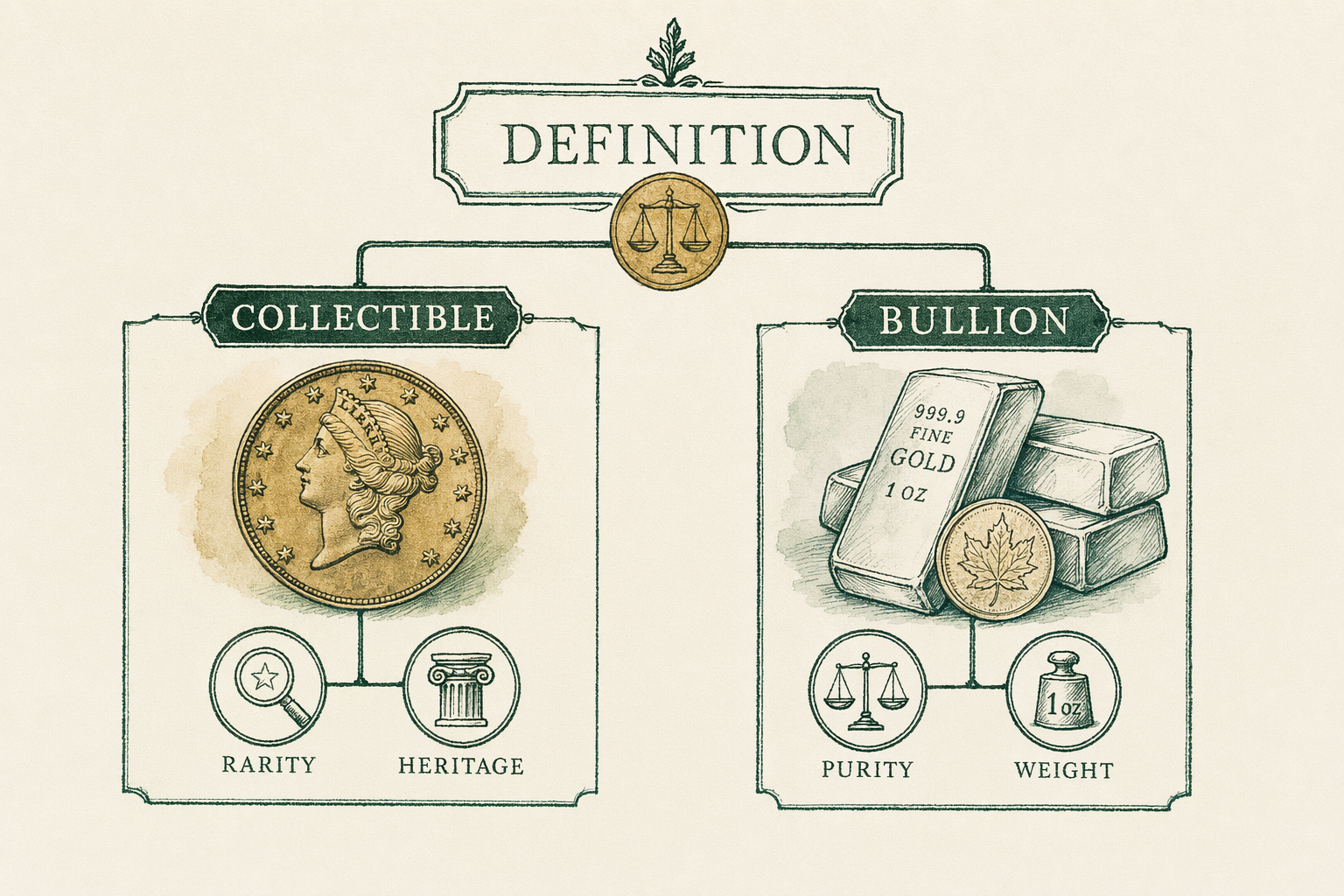
Definition — collectible vs bullion
A **bullion coin** is valued primarily on its metal content. A `1 oz American Gold Eagle` contains `1 troy oz` of gold (`0.9167` fineness with a copper-and-silver alloy for durability, or `1 oz` pure for the post-2021 Type 2 design); its market value tracks the gold price plus a small premium that reflects mint and dealer margins. Buy or sell, the price moves with the gold price.
A **numismatic coin** is valued on a combination of metal content AND a collectible premium that reflects rarity, condition, historical significance, or market-demand factors. A pre-1933 US `$20 Saint-Gaudens Double Eagle` in a high grade contains roughly `0.97 troy oz` of gold but trades at multiples of melt value depending on the specific year, mint mark, and grade. The collectible premium can dwarf the metal content for rare coins.
The line between the two categories is not always sharp. Some coins (modern proof Eagles, certain commemorative issues) sit in the middle — bullion-grade metal content but with a collectible-premium element from the mint's marketing. For Gold IRA and tax-treatment purposes, the IRS rules (IRC § 408(m)) define eligibility by reference to specific coin types and fineness rules, not by the bullion-vs-numismatic distinction itself. Snapshot as of `2026-Q2`.
Grading and slabs (PCGS, NGC)
The numismatic market relies on third-party grading services to provide standardized condition assessments. The two dominant US grading services are:
**PCGS (Professional Coin Grading Service)**: Founded 1986, headquartered in California, the largest US grading service by volume. PCGS grades, encapsulates, and seals each coin in a tamper-evident plastic holder (a "slab") with a serial number and the grade on the label.
**NGC (Numismatic Guaranty Company)**: Founded 1987, headquartered in Florida, the second major US grading service. Similar slab-and-grade system to PCGS.
Both services use the Sheldon Scale (1-70) and both are widely accepted in numismatic markets. PCGS-graded and NGC-graded coins of the same coin and grade typically trade at similar prices, though PCGS coins often carry a slight premium reflecting market-share dominance.
Slabbed coins are easier to evaluate, easier to authenticate, and easier to resell than raw (ungraded) coins. The trade-off is that the slab cannot be removed without breaking the seal, so the coin cannot be examined out-of-slab without giving up the grading service's authentication.
Raw (ungraded) numismatic coins require the buyer's own evaluation or an expert's appraisal. For most retail buyers, slabbed coins from PCGS or NGC are the appropriate format.
Why most Gold IRAs should avoid numismatics
**IRA eligibility**: IRC § 408(m) limits IRA-eligible gold coins to a specifically enumerated list (American Gold Eagle, American Buffalo, Canadian Maple Leaf, Austrian Philharmonic, Australian Kangaroo, and certain others) PLUS bullion-grade bars meeting `0.995` fineness from approved refiners. Pre-1933 US gold coins (Saint-Gaudens, Liberty Head) are typically `0.900` fineness and are NOT IRA-eligible. Most slabbed numismatic coins fail the IRA-eligibility rules.
**Markup risk**: Some Gold IRA sales scripts have steered buyers into "premium" or "proof" coins at markups several times higher than bullion-grade Eagles. The buyer pays a `15-25%` premium for a coin that buys back at a much lower spread on resale. This is one of the recurring complaint patterns in the BBB records of Gold IRA marketers — "I paid for premium coins and they buy back at melt value."
**Liquidity risk**: Numismatic coins have a narrower resale market than bullion. The premium that justified the purchase may not be present at sale, depending on collector demand cycles. For a retirement-account holding that may need to be liquidated to satisfy RMDs or distribution, the bullion-coin liquidity is structurally better.
**Tax treatment**: Numismatic coins are taxed as collectibles under IRC § 408(m)(3) — same `28%` long-term collectibles cap as bullion. Inside an IRA, the wrapper rules apply, so the collectibles tax does not apply current. The IRA distribution at retirement is taxed as ordinary income regardless of whether the underlying asset is bullion or numismatic.
**Net guidance for Gold IRAs**: Stick to the specifically enumerated bullion-grade coins (American Gold Eagle is the workhorse). Avoid numismatic and proof coins inside the IRA. The bullion-coin route preserves the simplest IRA-eligibility math, the tightest buyback spread, and the most reliable liquidity at distribution age.
When numismatics make sense
Outside the IRA wrapper, numismatic coins can be a legitimate purchase for buyers who: (1) have a specific collector interest in a series and value the coin as a collectible, not just as a precious-metals exposure; (2) have access to a reputable specialty dealer (Heritage Auctions, Stack's Bowers, certain regional specialists) and the diligence patience to evaluate specific issues; (3) plan to hold long-term and have realistic expectations about the resale process; (4) understand that numismatic market cycles can move independently of the gold price.
For a buyer who wants precious-metals exposure as a financial asset, the bullion route — Eagles, Maple Leafs, bars — is structurally simpler and economically more efficient. For a buyer who genuinely wants to collect — to learn about specific issues, to build a focused collection, to own coins for the historical and aesthetic value — the numismatic route is the right one, and the bullion route would miss the point.
The mistake to avoid: buying numismatic coins as a bullion substitute. Pay the collector premium when you want the collector experience, not when a sales rep tells you they will appreciate faster than Eagles.
Want to talk this through? Book a 30-min research call →
Frequently asked questions
-
What's the difference between a bullion coin and a numismatic coin?
A bullion coin trades primarily on its metal content. A numismatic coin's price includes a collectible premium (rarity, condition, historical significance) above metal value. Premium can range from a few percent to many multiples of melt value. -
Are numismatic coins IRA-eligible?
Most are not. IRS Section 408(m) generally permits bullion-grade coins meeting fineness rules (plus the named Eagle exception). Most pre-1933 US gold coins and graded slabs are NOT IRA-eligible. -
What is a 'slab'?
A coin grading service (PCGS or NGC) authenticates and grades a coin, then encapsulates it in a tamper-evident plastic holder with grade and serial number. The slab provides standardized resale grading. -
Where does BullionLens get its data on this topic?
Primary sources cited in the article. For market data we lean on the LBMA daily fixings, COMEX volume reports, IRS publications, SEC filings, and the World Gold Council's annual reports. We do not cite secondary aggregators as authority.
In plain English We're an editorial desk. Educational only — talk to a licensed adviser before doing anything with retirement assets.