What is the Brink's precious metals vault service?
Brink's Global Services depository operations, IRS-approved storage, insurance, and the vault locations used for Gold IRA storage.
Brink's corporate background
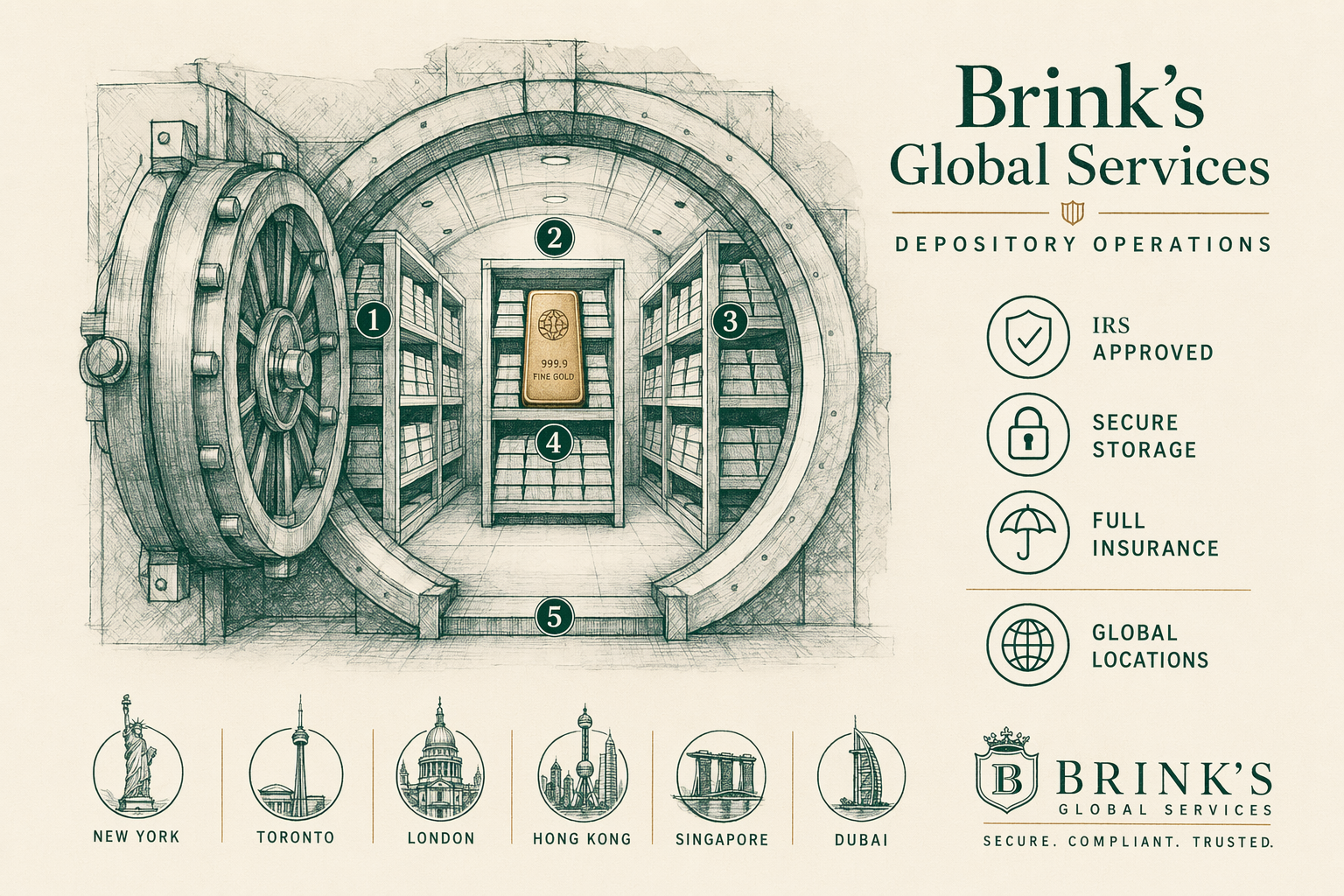
The Brink's Company (NYSE: `BCO`) is a publicly-traded global security and cash-management company headquartered in Richmond, Virginia, founded originally in `1859`. Brink's operates across multiple business segments — armored transportation, ATM management, cash logistics, and depository custody services. The custody segment, branded as 'Brink's Global Services' (BGS), is the part of the business that serves bullion clients, financial institutions, and Gold IRA custodians.
Brink's parent-company status as a public NYSE-listed entity provides additional transparency relative to private depository operators. SEC filings (`10-K`, `10-Q`, proxy statements) are available via EDGAR. The custody segment is one of several business lines; depository revenues are not as prominently disclosed in segment reporting as the armored-cash and ATM segments. Brink's `165+`-year operating history is one of the longest in the security and cash-management industry; depository operations have been a meaningful business line for decades.
Depository service vs armored-car business
The same brand 'Brink's' covers two distinct service lines. The armored-car business handles cash and valuables transportation for retailers, financial institutions, and government clients — the iconic Brink's truck. The depository business operates fixed-location vault facilities offering custody of bullion, securities, fine art, jewelry, and other high-value items for institutional and individual clients. The same regulatory and operational frameworks (anti-money-laundering, KYC, audit discipline) apply across both segments, but the customer-facing service is different.
For Gold IRA storage, the relevant Brink's offering is the depository service — long-term custody at fixed-location vaults with allocated bookkeeping, periodic inventory verification, and insurance coverage. The depository service is not the same as Brink's transit/cash-in-transit insurance, which covers items in armored-vehicle movement. Customers shipping bullion to a Brink's depository typically use Brink's-affiliated logistics for the transit leg, but the storage product is the depository service, distinct from the transit operation.

IRS-approved storage locations
Brink's operates depository facilities in multiple US locations used for Gold IRA storage. Reported facility locations include Salt Lake City (Utah), New York, and Los Angeles, with additional regional facilities serving institutional clients. The specific facility used for a given Gold IRA account is set by the IRA custodian and the depository — most Gold IRA custodians offering Brink's storage default to the Salt Lake City facility for bullion custody, with other locations available for institutional or specialty arrangements.
IRS approval applies to the depository operator (Brink's) rather than to individual facility locations, but each facility must meet the operating standards under which the approval was granted. Customers can typically choose between Brink's facility locations within their custodian's offering, though some custodians simplify the choice to a single default location. Specific facility selection rarely matters operationally — modern audited depositories function similarly across locations — but may matter for buyers with a regulatory-jurisdiction preference or a desire for non-East-Coast custody.
Insurance arrangements
Brink's depository operations carry institutional all-risk insurance coverage through Lloyd's of London syndicates and comparable major underwriters. The policy structure covers theft, mysterious disappearance, and physical damage to stored items, with per-occurrence limits in the hundreds of millions of dollars range across the operation. Specific policy details (limits, deductibles, exclusions) appear in the storage agreement provided to each client.
Insurance coverage at a Brink's depository is at the institutional level rather than the per-client level — Brink's holds the policy, not each customer. In a stress scenario, the customer's recovery flows through Brink's policy via the depository's claim process, not via a customer-direct claim against the underwriter. For allocated holdings with clean documentation, the legal pathway is to assert title and obtain release of the specific bars/coins; the insurance is the depository's protection against operational losses, not the customer's primary recovery vehicle for properly-allocated metal. Read your storage agreement carefully for the specific insurance terms applicable to your account configuration.
Which Gold IRA custodians use Brink's
Brink's depository is offered as a storage option by multiple Gold IRA custodians, including Equity Trust Company (alongside Delaware Depository), STRATA Trust Company (alongside Delaware Depository and IDS), Kingdom Trust, and others. The specific custodian-depository pairing available to you depends on the Gold IRA marketing company you work with and the custodian they pair with. Some Gold IRA marketing companies default clients to Brink's; others default to Delaware Depository; many offer a choice.
Selecting Brink's over Delaware Depository (the most common alternative for Gold IRA storage) is typically a tiebreaker decision — both are major IRS-approved depositories with strong operational records, audited insurance arrangements, and segregated/commingled-allocated configurations available. Brink's offers broader US geographic coverage (multiple facility locations); Delaware Depository's single-location concentration in Wilmington offers operational simplicity. For most clients the practical difference is minor; the custodian's published list of available depositories typically determines the realistic choice set.
Real-world example — Brink's allocated storage configuration
Consider a Gold IRA owner with `40 × 1 oz` Gold Eagles stored at Brink's Salt Lake City facility under STRATA Trust Company custodianship, in segregated allocated storage. Annual storage fee (illustrative — confirm current Brink's rates with your custodian): roughly `$150-200/yr` for this position size in segregated allocated. Documentation: STRATA Trust provides monthly account statements; Brink's provides a separate custody confirmation listing the specific coins held under bailment.
The owner periodically (annually is reasonable) reviews the holdings statement, cross-references against the original purchase invoice, and confirms that quantities and weights match. Brink's allocated holdings should not enter Brink's bankruptcy estate in a stress scenario, subject to clean documentation. Brink's `165`-year operating history, public-company parent (NYSE: BCO), and institutional insurance arrangements collectively make the counterparty-risk profile competitive with other major IRS-approved depositories. The choice between Brink's and Delaware Depository (the most common alternative) is typically a function of which one your custodian offers and any geographic-jurisdiction preference; both are defensible for serious retirement-asset custody.
Common misconceptions about Brink's vaults
**'Brink's truck pickup = Brink's depository custody.'** Different service lines from the same parent company. The armored-car business handles transit; the depository business handles long-term custody. Don't conflate the two on a storage decision.
**'Brink's NYSE listing means my metal is insured by Brink's stock value.'** No. The NYSE listing reflects Brink's parent company's equity. Storage insurance is via Lloyd's syndicates underwriting Brink's depository operations; it is independent of the company's stock-market valuation.
**'Brink's is significantly better/worse than Delaware Depository.'** Neither is obviously better. Both are major IRS-approved depositories with strong operational track records, audited insurance, and standard allocated-storage configurations. The 'best' depository for any given customer is usually determined by which one the custodian offers.
What this means for you
Brink's depository service is one of the major IRS-approved Gold IRA storage options, offered alongside Delaware Depository at most Gold IRA custodians. Public-company parent (NYSE: BCO), `165+`-year operating history, multiple US facility locations, institutional insurance via Lloyd's syndicates. Whether Brink's is the right depository for any specific account depends primarily on which depository your custodian offers and any geographic-jurisdiction preference. The practical operational differences between Brink's and Delaware Depository are minor for standard segregated allocated storage of Gold IRA bullion. As always, BullionLens does not provide personalized advice; confirm depository selection with your custodian and read the storage agreement before signing.
Want to talk this through? Book a 30-min research call →
Frequently asked questions
-
Is Brink's depository the same as Brink's armored cars?
Same parent company. Brink's (NYSE: BCO) operates both armored logistics and depository custody services. The depository business serves bullion clients and financial institutions. -
Where are Brink's vaults located?
Brink's operates depositories in multiple US locations including Salt Lake City, New York, and Los Angeles. Specific facility used for Gold IRA storage is set by the IRA custodian. -
Is Brink's insured for Gold IRA storage?
Yes. Brink's carries institutional insurance for its custody operations. Confirm the specific coverage on your storage agreement. -
Where does BullionLens get its data on this topic?
Primary sources cited in the article. For market data we lean on the LBMA daily fixings, COMEX volume reports, IRS publications, SEC filings, and the World Gold Council's annual reports. We do not cite secondary aggregators as authority.
In plain English We're an editorial desk. Educational only — talk to a licensed adviser before doing anything with retirement assets.