What is Delaware Depository?
Delaware Depository background, IRS-approved status, allocated and segregated storage, insurance coverage, and how Gold IRA custodians use it.

Founding and corporate background
Delaware Depository Service Company is a private depository organization headquartered in Wilmington, Delaware, operating as a bullion depository since `1999`. The company is one of the most-used IRS-approved depositories for Gold IRA storage, with documented partnerships with multiple major Gold IRA custodians (Equity Trust, STRATA Trust, and others) and Gold IRA marketing companies (Augusta Precious Metals defaults clients to Delaware; Birch Gold offers it as an option). Delaware Depository's Wilmington location places it in the same state-level regulatory jurisdiction as a large fraction of US trust companies and corporate registrations.
The company operates as a dedicated bullion depository rather than as a side-line custody business of a larger security or cash-management operation. This focused operating model means staff specialization, documentation discipline, and audit procedures are oriented entirely toward precious-metals custody — different operating posture from Brink's depository business (a side line of a much larger logistics company) or HSBC's vault operations (a fraction of a global commercial-banking franchise). Operational specialization is not the same as superior outcomes, but it does signal that the depository's revenue model depends on getting bullion custody right.
IRS-approved depository status
Delaware Depository qualifies as an IRS-approved depository for Gold IRA holdings under IRC Section `408(m)` and applicable Treasury regulations. The approval requires the depository to meet standards for vault security, audit discipline, insurance coverage, segregation of customer property from depository assets, and the operational integrity needed to support the bailment relationship that allocated storage requires. Delaware Depository has held this status continuously since its operation began.
IRS approval is at the depository operator level, not at the individual-customer level. Once your IRA custodian directs metal to Delaware Depository, the depository operates under the existing approval framework. Customer-level documentation (storage agreement, account confirmation, periodic holdings statements) flows through the depository to the custodian and ultimately to you. Verify your specific custodian-Delaware relationship at account opening — most custodians make Delaware a default option for Gold IRA storage and process the paperwork automatically, but the bailment relationship is real and worth understanding.
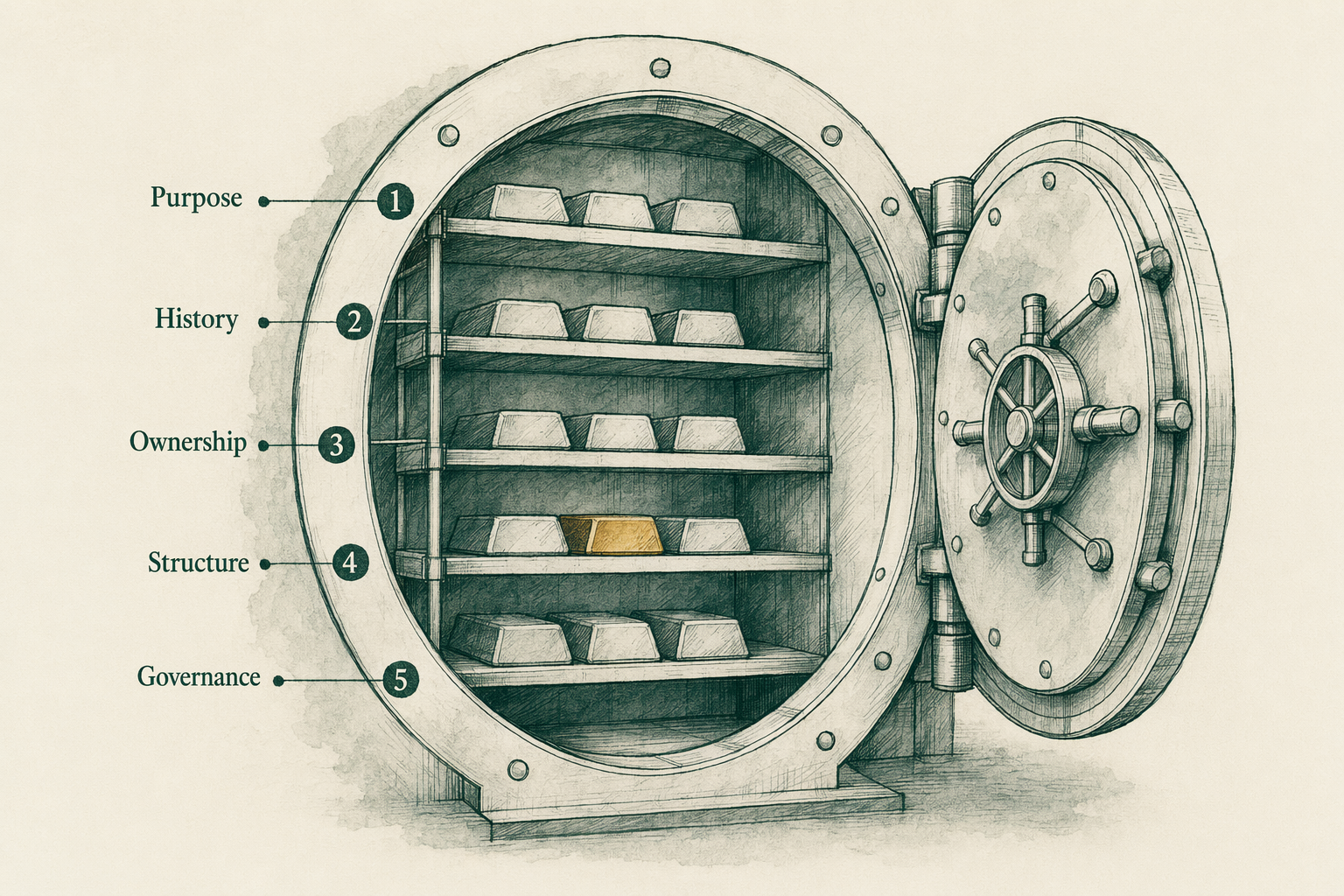
Allocated, segregated, and commingled options
Delaware Depository offers two main allocated storage configurations for Gold IRA holdings. Segregated allocated: your specific bars and coins are stored physically separate from other clients', in their own compartment or vault section, with bar-level serial-number tracking and your account number associated with each item. Commingled allocated (sometimes called 'allocated, commingled storage'): your specific bars and coins are individually tracked in records but stored on shelves alongside other clients' bars of the same type and refiner.
Both configurations are legally allocated — the metal is yours by serial number, the depository is bailee not owner, the bars/coins should not enter the depository's bankruptcy estate in a stress scenario. The practical difference: segregated provides additional physical separation, which simplifies certain audit and inspection scenarios but does not change the legal title structure. Most Gold IRA custodians default new accounts to commingled allocated for cost reasons; segregated is available on request at higher annual fees. Read your storage agreement for the specific configuration applied to your account.
Insurance coverage
Delaware Depository carries institutional all-risk insurance coverage via Lloyd's of London syndicates, covering theft, mysterious disappearance, and physical damage to stored bullion. Policy limits are at the institutional level (per-occurrence in the hundreds of millions of dollars range across the operation) rather than per-customer. The depository's insurance is part of why standard storage fees are positioned as they are — the insurance, audit, and physical-security overhead are bundled into the annual storage charge.
Specific policy details — deductibles, exclusions, limits, and claim procedures — appear in the storage agreement and any insurance schedule provided to customers. Read the agreement carefully before signing significant Gold IRA assets into custody. Allocated holdings with clean documentation are generally protected by the bailment structure rather than primarily by insurance recovery; the insurance covers the depository's exposure to operational losses (theft, casualty) rather than serving as the customer's primary recovery vehicle for properly-allocated metal in a depository-bankruptcy scenario. Understanding what the insurance does and does not cover is part of evaluating any custody arrangement.
Fee snapshot
Delaware Depository's published annual storage fees (illustrative as of `2026-Q2`, confirm with the depository directly): commingled allocated storage runs approximately `$75-150/yr` for moderate gold positions; segregated allocated runs approximately `$100-250/yr` depending on metal weight; non-IRA bullion storage outside an IRA wrapper is available at different rate schedules. Fees scale with the metal weight stored, not just the dollar value — so silver and PGM positions carry higher storage costs per dollar than gold due to their lower-density and bulkier physical footprint.
Storage fees are typically billed annually in advance and prorated at exit. The Gold IRA custodian (Equity Trust, STRATA Trust, etc.) bills the customer for storage as a pass-through; the depository invoices the custodian, who recovers the cost from the IRA. Closing fees apply at account distribution or transfer to another depository — Delaware charges a per-transaction fee plus shipping costs for physical relocation. Compare the published fee schedule against your IRA custodian's storage-cost passthrough to confirm there's no margin layer being added between depository and customer.
Which custodians offer Delaware as an option
Delaware Depository is offered as a depository option by most Gold IRA custodians serving the US market, including Equity Trust Company, STRATA Trust Company, Kingdom Trust, Madison Trust, and others. Some Gold IRA marketing companies default clients to Delaware regardless of custodian; others give clients a choice between Delaware, Brink's, IDS Texas/Delaware, or other approved depositories.
Default-to-Delaware is common among Gold IRA marketing companies because Delaware Depository has historically combined a strong operational record, broad acceptance across custodians, focused-business operating model, and reasonable fee positioning. Customers who specifically prefer a different depository (Brink's for non-Delaware geographic preference, IDS Texas for Texas-based jurisdiction preference, etc.) can usually request the alternative through the custodian — confirm with the Gold IRA marketing company before account opening that your preferred depository is available within their workflow.
Real-world example — a $250,000 Gold IRA at Delaware
Consider a Gold IRA owner with `100 × 1 oz` Gold Eagles (approximately `$250,000` at illustrative spot) stored at Delaware Depository in segregated allocated storage under Equity Trust Company custodianship. Annual costs (illustrative — confirm current rates with custodian): Equity Trust IRA maintenance fee `$80/yr` + Delaware Depository segregated storage `$200/yr` = `$280/yr` recurring. Storage fee is invoiced through Equity Trust; both fees appear on the IRA account statement.
Documentation set: signed storage agreement from Delaware Depository (held by Equity Trust as custodian; customer can request copy); monthly account statements from Equity Trust showing the position; periodic depository holdings confirmations listing the specific `100 × 1 oz Gold Eagles` by quantity. The owner reviews documentation annually to confirm the holdings statement matches expected position. In a stress scenario (depository bankruptcy, regulatory action), the allocated holdings should not enter the depository's bankruptcy estate; the legal pathway is to file a claim asserting bailment and obtain release. The combination of `25+` years of Delaware Depository operating history, Lloyd's institutional insurance, and clean allocated documentation collectively makes the counterparty-risk profile competitive among major IRS-approved depositories.
Common misconceptions about Delaware Depository
**'Delaware Depository is owned by the State of Delaware.'** No. Delaware Depository Service Company is a private organization headquartered in Wilmington. The 'Delaware' in the name reflects the state of incorporation and location, not ownership by the state government.
**'IRS approval means the IRS insures the metal.'** No. The IRS approves the depository to hold IRA-eligible metals under Section `408(m)` standards; the IRS does not insure the metal. Insurance is via Lloyd's institutional underwriters arranged by the depository.
**'Segregated allocated is always required for an IRA.'** No. IRA holdings must be allocated (item-level title), but configurations include commingled allocated (cheaper, same legal title) and segregated allocated (more expensive, additional physical separation). Both satisfy IRS requirements.
What this means for you
Delaware Depository is one of the most-used and longest-established IRS-approved depositories for Gold IRA storage. Wilmington-based, operating since `1999`, focused exclusively on bullion custody, broadly accepted across Gold IRA custodians. Allocated storage configurations (segregated and commingled), Lloyd's institutional insurance, standard fee schedule in the industry-typical range. For most Gold IRA buyers, Delaware Depository is a defensible default — many Gold IRA marketing companies route accounts there as standard. Whether to choose Delaware over Brink's or IDS depends on geographic-jurisdiction preference and which option your custodian offers. As always, BullionLens does not provide personalized custody-structure advice; consult a licensed adviser for retirement-account decisions of significant size.
Want to talk this through? Book a 30-min research call →
Frequently asked questions
-
Where is Delaware Depository located?
Delaware Depository's primary vault is in Wilmington, Delaware. The company has operated as a bullion depository since 1999. -
Is Delaware Depository insured?
Yes. Delaware Depository carries institutional all-risk insurance via Lloyd's of London. Specific coverage details and limits are disclosed in the storage agreement; read the contract before signing. -
Which Gold IRA custodians use Delaware?
Many — including Equity Trust, STRATA Trust, and others. The custodian on your IRA controls the depository option; ask before opening. -
Where does BullionLens get its data on this topic?
Primary sources cited in the article. For market data we lean on the LBMA daily fixings, COMEX volume reports, IRS publications, SEC filings, and the World Gold Council's annual reports. We do not cite secondary aggregators as authority.
In plain English We're an editorial desk. Educational only — talk to a licensed adviser before doing anything with retirement assets.