Gold IRA tax decision tree
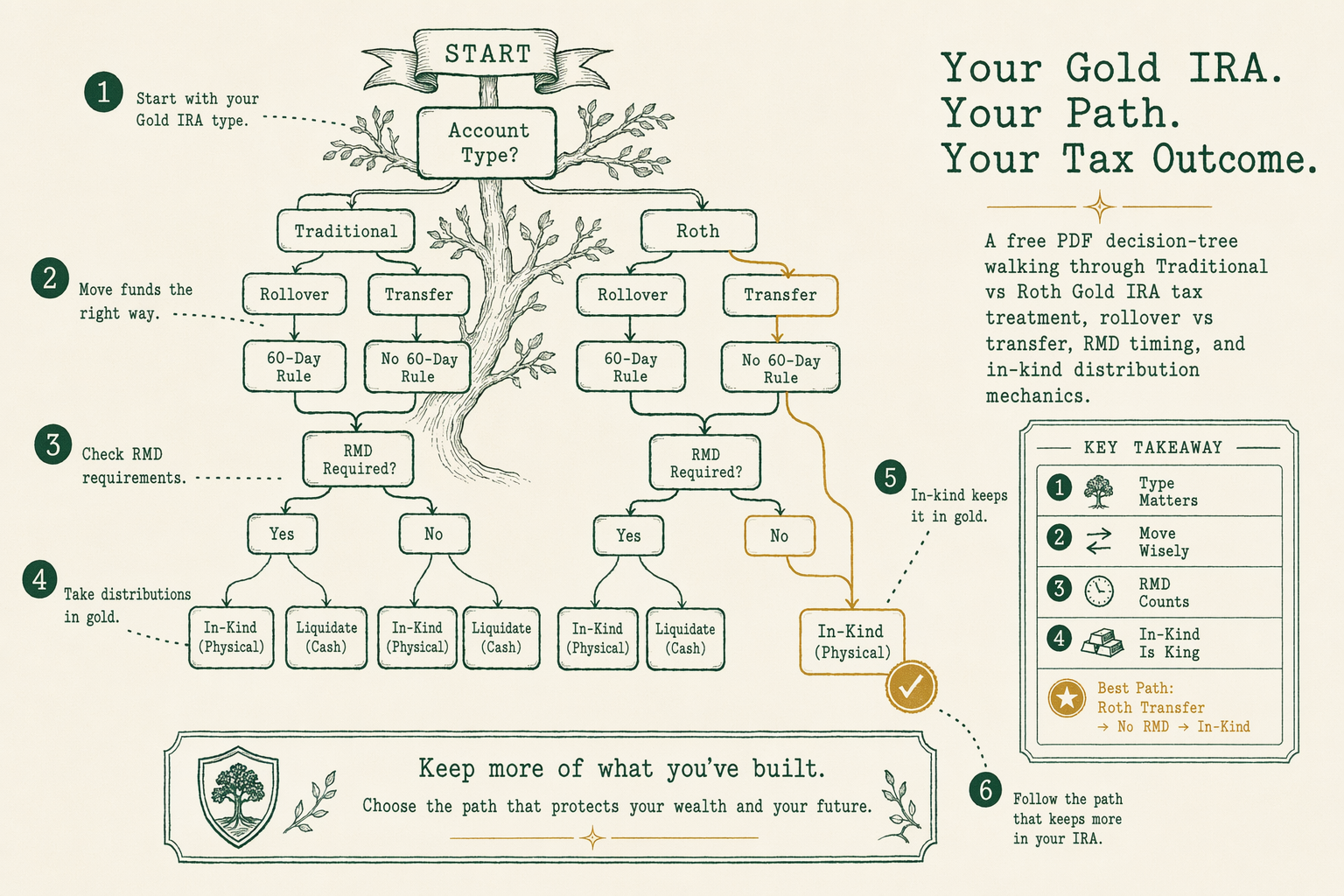
A free PDF decision-tree walking through Traditional vs Roth Gold IRA tax treatment, rollover vs transfer, RMD timing, and in-kind distribution mechanics.
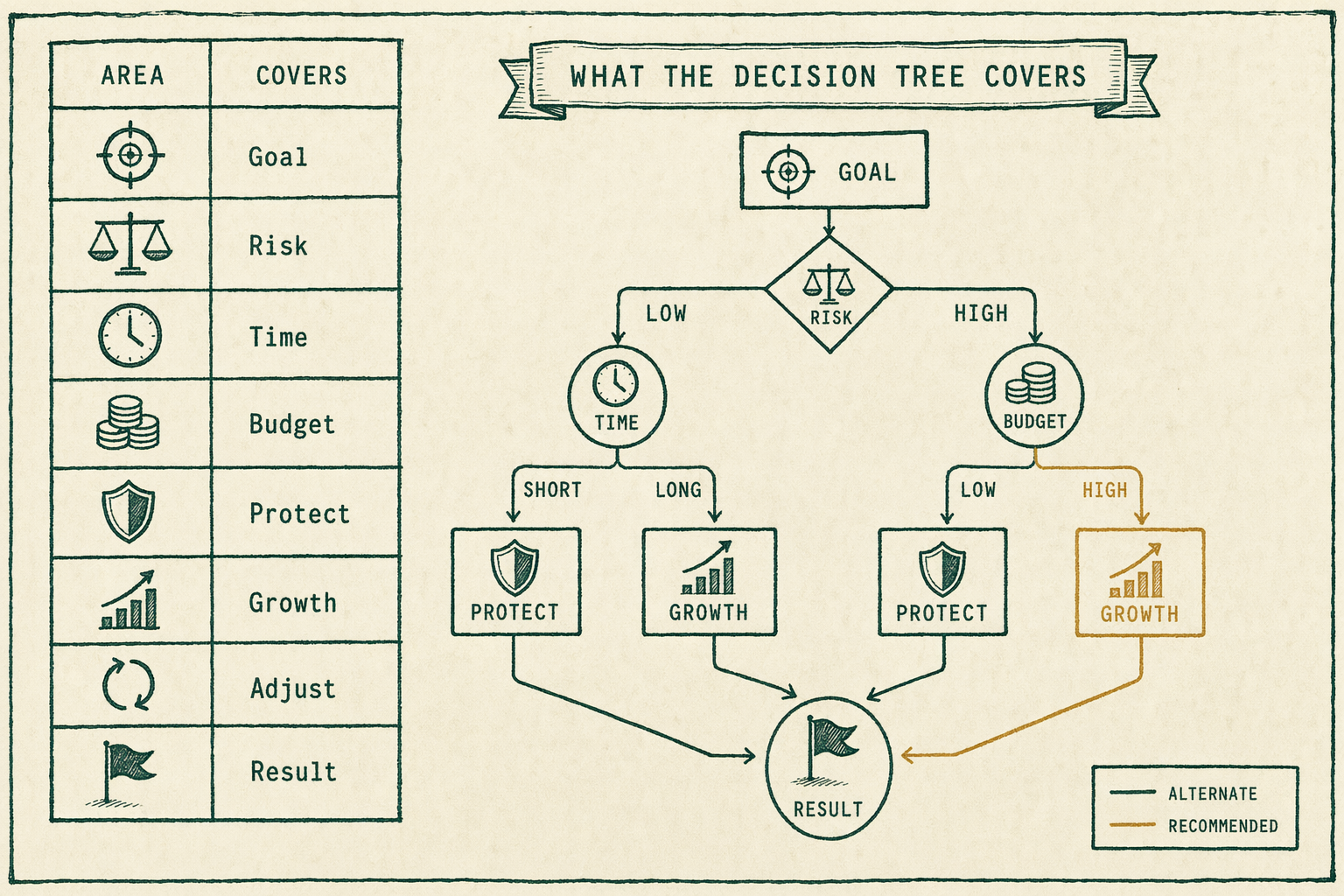
What the decision tree covers
The PDF is a `8`-page structured decision-tree document walking the four canonical branching decisions in Gold IRA tax structuring. The format presents each decision as a visual flow with the IRS-publication citation and the operational implication for each branch.
The four branches: (1) Traditional vs Roth Gold IRA at account open; (2) rollover vs transfer when moving funds in; (3) when to begin Required Minimum Distributions (RMDs) at age 73 and which IRA they apply to; (4) in-kind vs cash distribution at withdrawal time.
Each branch is presented with: the IRS rule that controls the decision (with the specific publication and section citation), the operational implication of each path, the typical scenario where each path makes sense, and the warning-flag conditions that suggest a CPA consultation before proceeding.
The decision tree is structured for use during a CPA conversation — the document surfaces the questions to ask rather than providing the answers. The /editorial-standards/ page documents our editorial-not-advisory positioning; this tool follows that framework.
Traditional vs Roth branching
Branch one is the choice between a Traditional Gold IRA and a Roth Gold IRA at account opening. The fundamental tradeoff is when tax is paid: Traditional defers tax until distribution; Roth pays tax at contribution but allows tax-free qualified distributions.
Branch decision-points in the PDF: • If current marginal income tax rate is materially higher than expected distribution-period marginal rate: Traditional is typically the more tax-efficient choice (defer tax to a lower-rate window). • If current rate is materially lower than expected distribution-period rate: Roth is typically more tax-efficient (pay tax now at a lower rate, capture tax-free distributions later). • If currently subject to Roth contribution income limits (above the IRS-published phaseout thresholds): the choice may be constrained by eligibility rather than preference. • If converting existing Traditional IRA to Roth Gold IRA (a Roth conversion): the conversion itself is a taxable event in the conversion year — covered in the tree's branching with the relevant IRS warning flags.
Required citations: IRS Publication 590-A (for contribution rules and Roth income limits); IRS Publication 590-B (for distribution rules); IRC Section 408A (the Roth IRA statute). All three are cited inline in the PDF.
Critical warning flag: 'tax-free Gold IRA' is the wrong language for Traditional Gold IRA accounts (which are tax-deferred not tax-free). The Editorial Standards page documents our editorial policy on this distinction; the decision tree maintains the distinction explicitly.
Rollover vs transfer branching
Branch two is the choice of how to move existing retirement funds into the Gold IRA wrapper. The covered paths: direct rollover from a 401(k), indirect rollover (with 60-day deadline), and trustee-to-trustee transfer from an existing IRA.
Branch decision-points in the PDF: • If source is an active 401(k) at a current employer: rollover may not be available without an in-service withdrawal provision in the plan's Summary Plan Description. Check the SPD before initiating. • If source is a 401(k) at a former employer (or current employer with eligible distributable event): direct rollover is the default safe path; the 401(k) administrator sends funds to the new Gold IRA custodian without funds landing in your personal name. • If source is an existing IRA: trustee-to-trustee transfer is the cleanest operational path; the IRS does not classify it as a rollover and does not apply the one-rollover-per-twelve-months limit. • If indirect rollover is the only option (rare): mark the 60-day deadline immediately and account for the 20% mandatory withholding if the source is a 401(k).
Required citations: IRS Publication 590-B (distribution rules); IRS Revenue Procedure 2016-47 (the hardship-waiver framework for missed 60-day deadlines); Bobrow v. Commissioner T.C. Memo. 2014-21 (the one-rollover-per-twelve-months interpretation); IRC Section 3405(c) (the 20% mandatory withholding rule).
The /guides/gold-ira-rollover/ topic-hub guide covers this branch in more detail. The decision tree provides the structured version suitable for a CPA conversation.
RMD branch (age 73+)
Branch three concerns Required Minimum Distributions, which begin at age 73 for Traditional IRA holders. (The SECURE Act 2.0 of 2022 increased the RMD age from 72 to 73 effective for individuals turning 72 after December 31, 2022; an additional increase to age 75 is scheduled for years after 2032.)
Branch decision-points in the PDF: • Whether RMDs are calculated separately per Traditional Gold IRA or aggregated with other Traditional IRA balances (answer: aggregated for calculation, but the distribution can be drawn from any single Traditional IRA — the holder elects which account to draw from). • Whether to take the RMD as cash (custodian sells metal at market) or as in-kind metal distribution (the holder takes physical possession of the bullion equivalent to the RMD amount). • Whether to combine RMD timing with the broader tax-planning context including pension income, Social Security, and other distribution decisions. • Whether to use Qualified Charitable Distributions (QCDs) from the IRA to satisfy the RMD with charitable intent — a specific tax-efficient option under IRC Section 408(d)(8).
Roth IRAs (including Roth Gold IRAs) are not subject to RMD requirements during the original owner's lifetime. The SECURE Act 2.0 also eliminated the prior in-plan-Roth-account-conversion RMD requirements. Inherited Roth IRAs have separate distribution rules covered in the PDF.
Required citations: IRS Publication 590-B (RMD rules); SECURE Act 2.0 of 2022 (the relevant statutory provisions); IRS Publication 559 for QCDs.
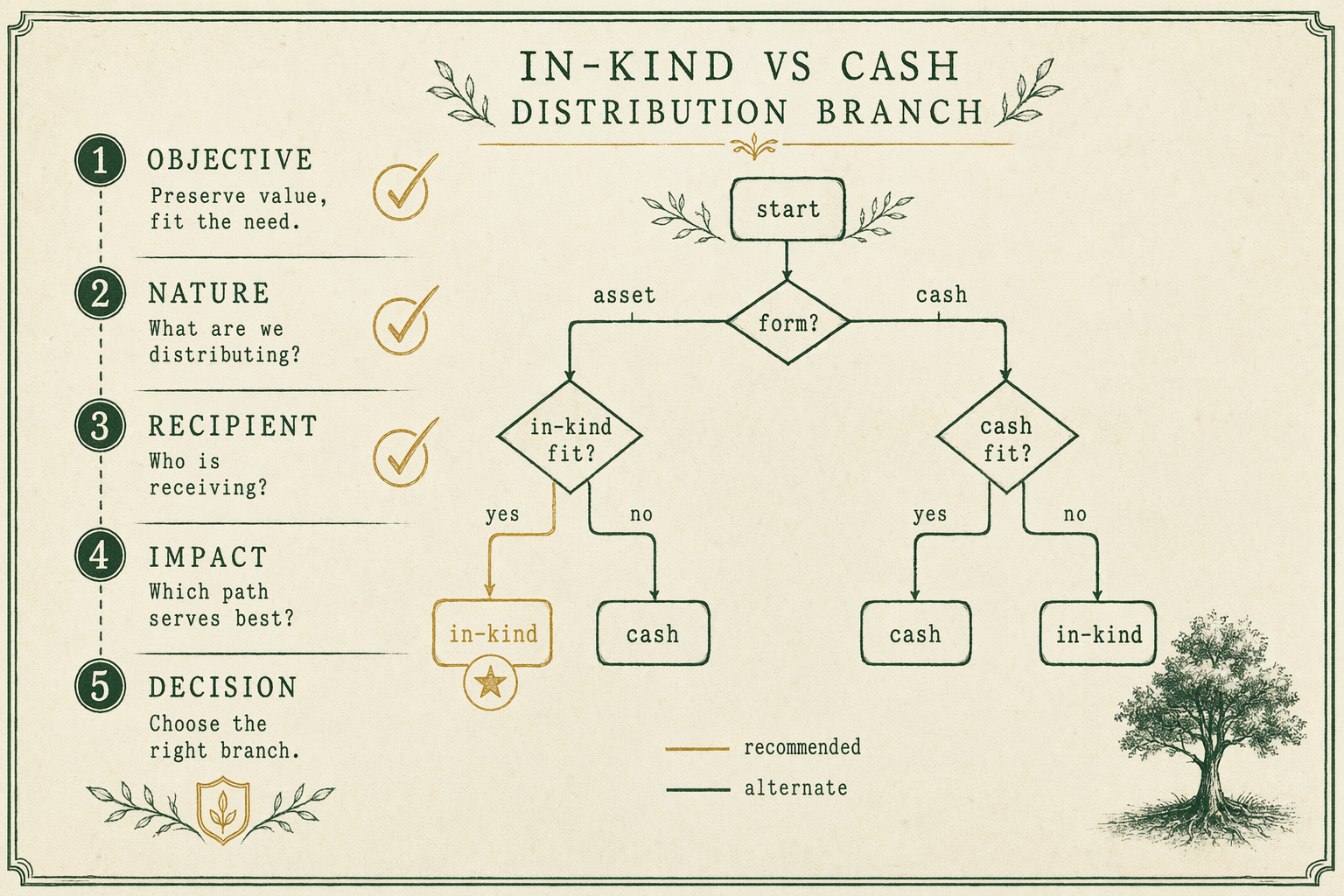
In-kind vs cash distribution branch
Branch four concerns the form of the distribution — whether you receive cash or physical metal when you take a distribution from the Gold IRA.
Branch decision-points in the PDF: • In-kind distribution: the depository ships the specific bullion (allocated, with serial numbers) to the holder's address via secure shipment. The holder pays the depository's shipment fee (typically `$50` to `$150`) and takes possession of the metal. The IRS treats the distribution as taxable at the fair-market value at the distribution date. • Cash distribution: the custodian directs the depository to deliver metal to a designated bullion dealer for sale at market prices; the dealer's proceeds (net of any buyback spread) are remitted to the custodian and onward to the holder. The IRS treats this distribution as taxable at the cash amount received (which approximates fair-market value minus dealer spread). • Operational consideration: in-kind distribution preserves the metal position but requires home or private-vault storage on receipt (with the insurance implications covered in /guides/storage-options/). Cash distribution converts to cash for use, with the buyback spread as the operational cost. • Tax consideration: both distribution types are taxed as ordinary income (Traditional) or as qualified Roth distributions (Roth) at the same tax rates. The choice between in-kind and cash does not change the tax treatment; it changes what the holder receives in hand.
Required citations: IRS Publication 590-B (Section on in-kind distributions); IRS Notice 2014-54 on basis allocation in mixed distributions; IRC Section 408(d) (distributions from individual retirement accounts).
Gold IRA tax decision tree
Frequently asked questions
-
Is this tax advice?
No. This is an educational decision-tree based on published IRS rules. Apply it with a CPA who knows your situation. BullionLens is not a tax adviser. -
How often is it updated?
Whenever the underlying IRS rules change materially. The PDF carries a 'last reviewed' date. -
How do I use this tool?
Open the downloaded file, fill in the fields specific to your situation, and use the result as input to a conversation with a custodian or adviser. The tool surfaces the right questions; it does not generate personalized advice. -
Can I share the download?
Yes, with attribution to bullionlens.com. The methodology and citations inside the document are what give it weight; remove either and downstream readers lose the source-of-truth trail.
In plain English Drop your email and the brief lands in your inbox. We never sell your address.