Allocated vs unallocated storage — cost comparison
Side-by-side cost comparison of allocated and unallocated bullion storage across major depositories, with counterparty implications.
Methodology and disclosure
**Editorial disclosure.** BullionLens earns a commission when a reader opens a Gold IRA account through links on this page; storage providers themselves are typically not direct affiliate partners. Editorial selection is independent — see [our editorial standards](/editorial-standards/). Reviewed `2026-Q2`.
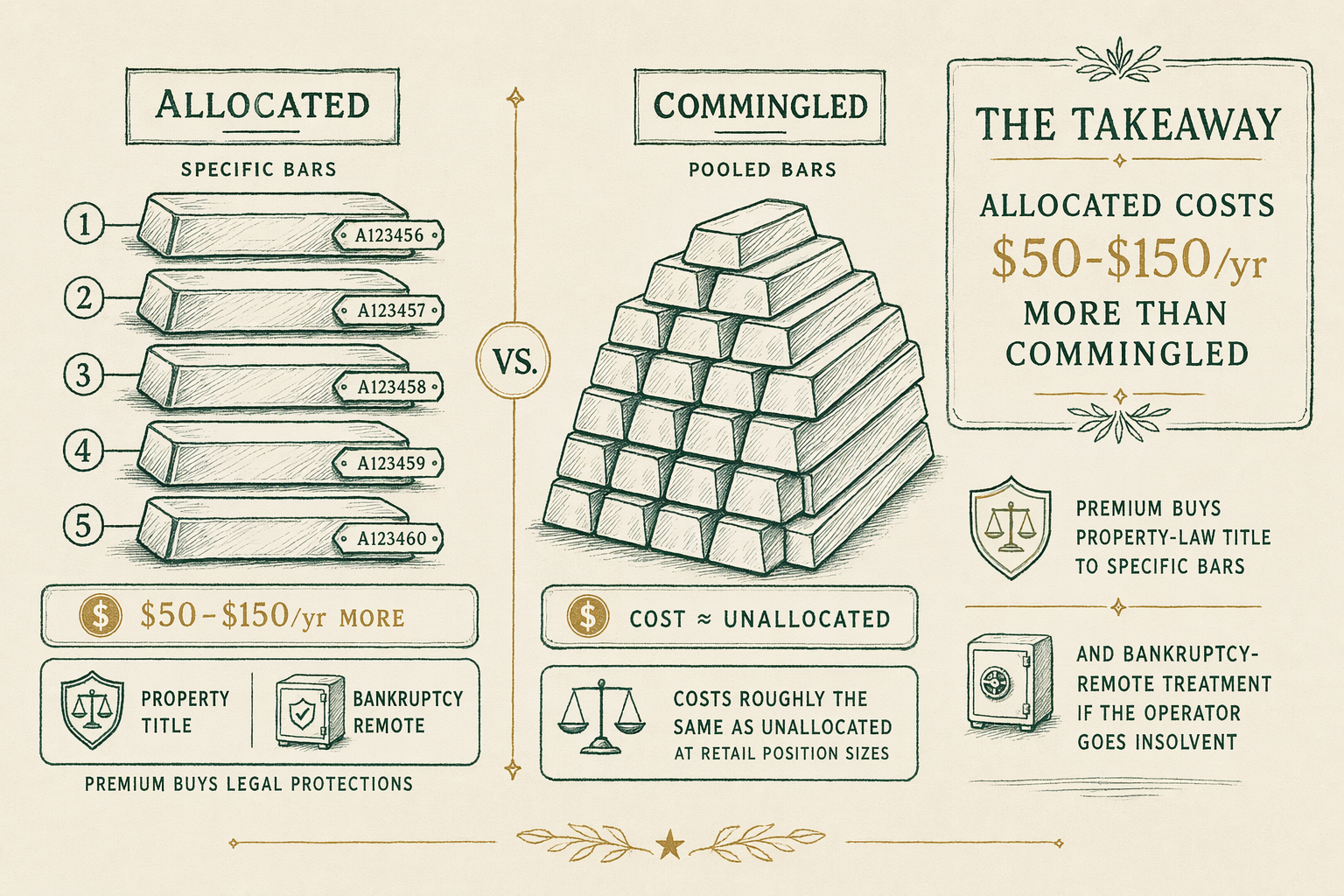
Allocated and unallocated are the two structurally different ways a depository can hold precious metals on a customer's behalf. The distinction matters in three ways: cost (allocated is more expensive), legal claim (allocated produces a property-law claim on specific identified metal; unallocated produces a contract-law claim against the operator), and bankruptcy treatment (the two claims behave very differently if the operator becomes insolvent). This page compares the two arrangements head-to-head on cost, with the counterparty math worked through explicitly.
The cost comparison uses snapshot fee schedules from major US depositories (Delaware Depository, Brink's, IDS) and from major bullion-bank unallocated programs (institutional context). Figures are paraphrased from public materials current as of `2026-Q2`. The retail audience for unallocated storage is small relative to the institutional market — most retail buyers of physical gold either choose allocated storage at a depository or take physical delivery; unallocated is more often encountered in the bullion-bank and ETF-creation-unit context. We cover both contexts.
The three storage arrangements
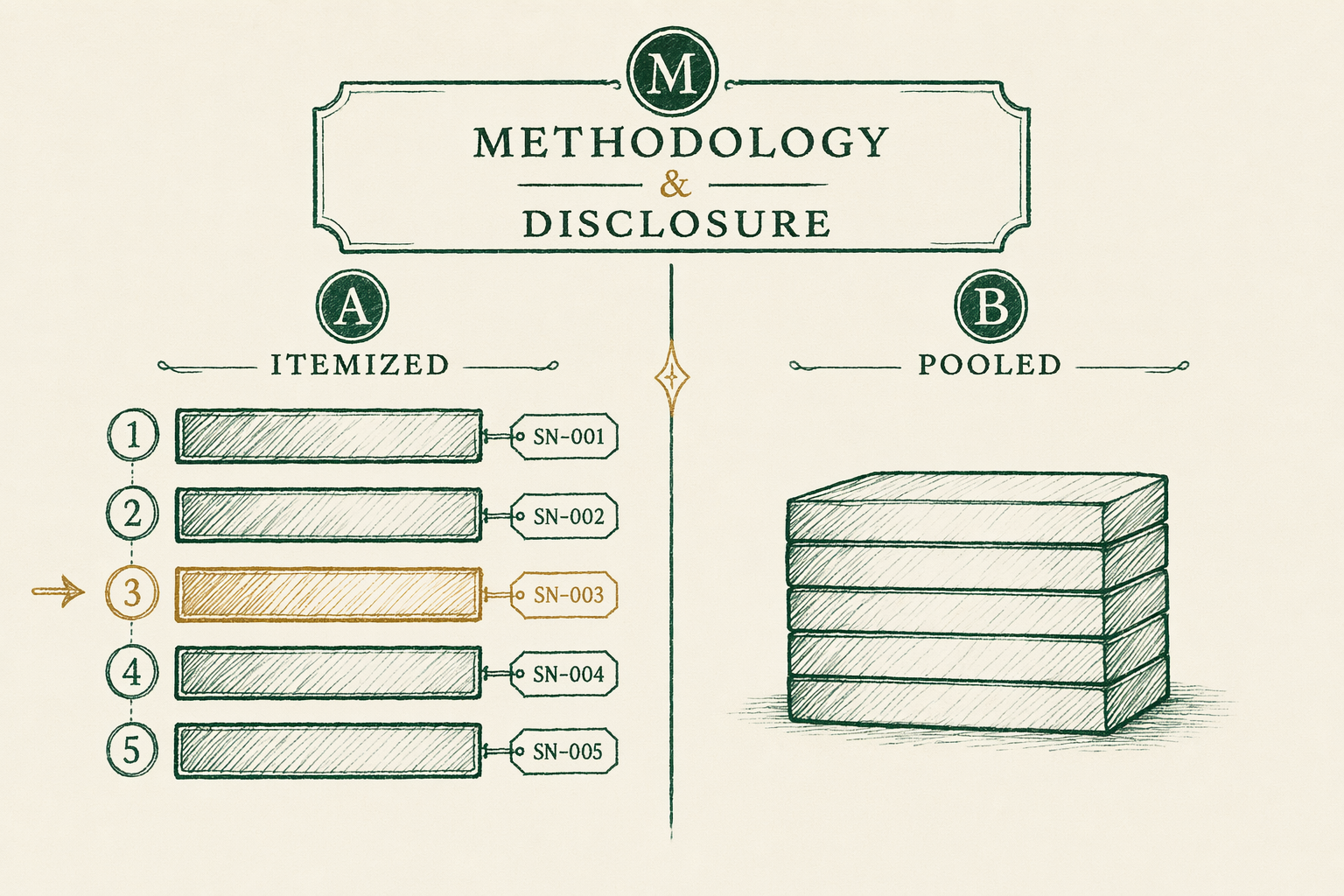
**Segregated allocated.** Specific bars and coins, identified by serial number and weight, are physically separated in the depository (often in dedicated drawers, shelves, or vault sections labeled with the customer's name). The customer holds a property-law claim on specific identified metal. If the depository operator becomes insolvent, the customer's bars are legally outside the operator's bankruptcy estate.
**Commingled allocated.** Specific bars and coins are identified in the depository's records as belonging to the customer (serial numbers and weights are recorded), but the physical arrangement intermixes the customer's bars with other allocated customers' bars of the same type. The customer still holds a property-law claim on specific identified metal. The physical separation is missing, but the legal title is identical to segregated.
**Unallocated.** The customer holds a contract-law claim against the operator for delivery of a stated weight of metal of stated fineness. No specific bars are identified as the customer's; the operator owns the metal in the pool and owes the customer a delivery obligation. If the operator becomes insolvent, the customer is a general unsecured creditor against the bankruptcy estate.
All three arrangements appear in the global precious-metals storage business. Allocated (both segregated and commingled) is the standard for retail customers at US depositories; unallocated is more common in bullion-bank programs (HSBC, JPMorgan, Standard Chartered, Scotia) where institutional customers hold large positions and the cost-saving from the pool structure compounds across the position size.
The cost gap
Snapshot as of `2026-Q2` across major US depositories and bullion-bank programs. Figures are paraphrased from publicly available materials.
**Segregated allocated** at major US depositories runs approximately `$150`-`$300/yr` for retail customer-facing pricing on positions in the `$20,000`-`$200,000` range, with the specific figure depending on the depository, the Gold IRA marketing company's markup, and the holdings value.
**Commingled allocated** at the same depositories runs approximately `$100`-`$200/yr` for the same position range. The savings versus segregated is typically `$50`-`$150/yr`, which is `~50%` cheaper at the lower end and `~33%` cheaper at the higher end.
**Unallocated** at bullion-bank programs typically runs approximately `0.10%`-`0.25%` per year of holdings value, which at a `$100,000` position works out to `$100`-`$250/yr`. The retail context for unallocated is limited; most US retail depositories do not market unallocated storage for IRA holdings because the unallocated structure can produce IRS issues with the 'allocated to the IRA owner' identification requirement.
Net read: commingled allocated and unallocated are roughly equivalent on dollar cost at retail position sizes. The cost savings of unallocated over commingled allocated is small at retail scale. The cost-savings argument for unallocated really only compounds at institutional position sizes (`$10 million`-plus), where the percentage-of-holdings fee structure of unallocated wins decisively against the flat-fee structure of allocated.
Where unallocated typically appears
Unallocated storage appears primarily in three contexts in the precious-metals market. **First**, bullion-bank programs (HSBC, JPMorgan, Standard Chartered, Scotia, UBS) market unallocated accounts to institutional customers who want gold-price exposure with operational simplicity. The percentage-of-holdings fee structure works in the institution's favor at large position sizes.
**Second**, gold-ETF creation-unit mechanics. The London bullion market settles ETF creations and redemptions on an unallocated basis at the working level, even when the ETF ultimately holds allocated gold at the vault. The unallocated layer is operational infrastructure for the bullion-banking system; retail customers do not interact with it directly.
**Third**, certain online 'gold account' services that market a buy-and-store product without specifying allocated treatment. These services occasionally advertise lower storage fees than physical-delivery alternatives; the lower fee reflects the unallocated structure, not an operational efficiency. Read the storage agreement carefully — if the metal is unallocated, the cost savings come with the bankruptcy-treatment consequence above.
Net read: for a retail Gold IRA buyer or a retail physical-bullion buyer at a major US depository, the practical choice is segregated vs commingled allocated, not allocated vs unallocated. Unallocated is rare in the retail US-depository context.
Counterparty risk math
The counterparty-risk math depends on the probability of operator insolvency and on the recovery rate in insolvency. Both are low for major US depositories — Delaware Depository, Brink's, IDS have operated continuously without insolvency events, and the historical record of US-depository insolvencies is short. But the math compounds over a long holding period.
If the annual probability of operator insolvency is `0.1%` (a low estimate for any single year at a major depository) and the recovery rate on an unallocated claim in insolvency is `30%`, the expected annual loss on a `$100,000` unallocated position is `0.1% × $70,000 = $70/yr`. Over a `20`-year holding period the cumulative expected loss is approximately `$1,400`. The cost savings from unallocated vs commingled allocated over the same `20` years is approximately `$1,000`-`$3,000` depending on position size. Within an order of magnitude, the cost savings and the expected loss net out.
The math sharpens at larger position sizes. A `$1 million` position has roughly `10×` the annual expected-loss exposure (`$700/yr` cumulative `$14,000`) but only roughly `2×`-`3×` the cost savings (the percentage fee on unallocated grows linearly with position value; the flat fee on allocated grows much more slowly). At institutional scale, the cost savings dominate and unallocated becomes the rational choice. At retail scale, the cost savings are smaller relative to the counterparty-risk exposure, and allocated (commingled or segregated) is the editorial default.
_(The probability estimates above are illustrative. We are not making forward-looking statements about any specific depository's insolvency probability.)_
Tax and legal implications
**IRA holdings.** The IRS Section 408(m) custody requirement effectively requires allocated storage for Gold IRA holdings. Unallocated storage produces uncertainty about which specific metal is 'allocated to the IRA owner' and can fail the IRS reading of the custody requirement. All major US Gold IRA marketing companies route IRA holdings to allocated (segregated or commingled) storage at IRS-approved depositories. Unallocated is operationally out of scope for Gold IRA placements.
**After-tax (taxable) holdings.** Unallocated storage is legally permitted for after-tax bullion holdings, but the bankruptcy-treatment difference applies. The cost savings versus commingled allocated are small at retail position sizes; the editorial default for after-tax holdings remains allocated at a major US depository unless the buyer specifically wants the bullion-bank unallocated structure for reasons unrelated to cost (institutional context, gold-price-only exposure preference).
**Insurance.** Both allocated and unallocated arrangements carry institutional insurance at major depositories. The insurance covers theft and physical loss; it does not cover operator bankruptcy. A customer who wants protection against operator insolvency needs allocated storage, not insurance — these are different risk categories addressed by different mechanisms.
When each makes sense
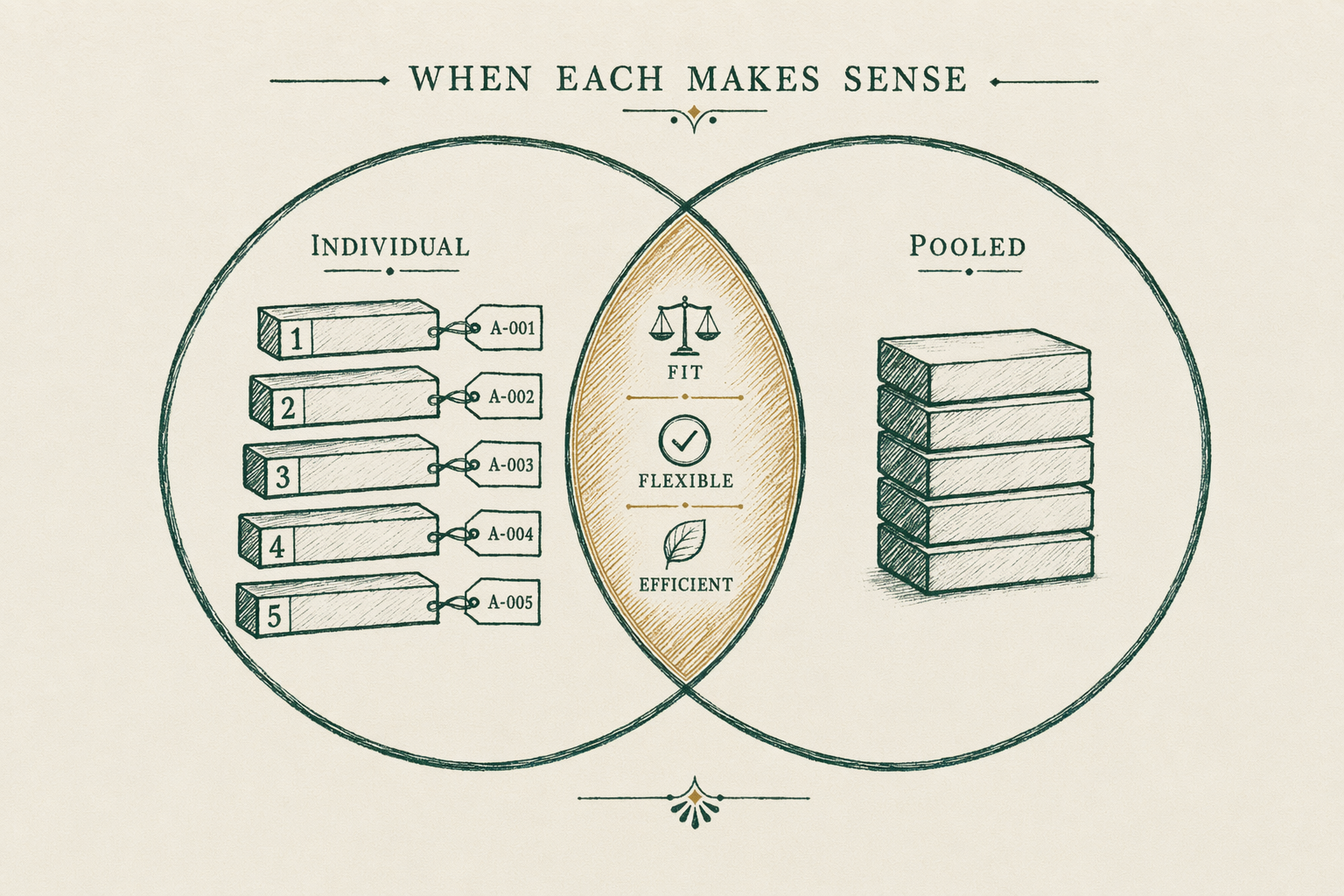
We do not name a universal best. The choice resolves on holding context, position size, and counterparty-risk tolerance.
**Lean toward segregated allocated if:** you specifically want physical separation of your holdings from other customers' bars, you have a high-value position (above `$500,000`) where the segregated premium is small relative to the holding, or you specifically want the option of in-person audit verification of your bars in their dedicated location.
**Lean toward commingled allocated if:** you want the legal-title and bankruptcy-remote benefits of allocated storage at the lower cost point, your position is in the retail `$10,000`-`$500,000` range where the segregated premium is a meaningful fraction of total storage cost, or you are storing IRA holdings (where the IRS effectively requires allocated treatment). Commingled allocated is the editorial default for most retail Gold IRA holdings.
**Lean toward unallocated if:** you are operating at institutional scale where the percentage-of-holdings fee structure produces a meaningful annual saving, you specifically want bullion-bank exposure (HSBC, JPMorgan, Scotia, Standard Chartered) rather than physical-depository exposure, or you are dealing with operational infrastructure at the gold-ETF or trading-house level where unallocated is the working settlement standard. Unallocated is rarely the right answer for a retail US buyer.
_Educational content, not personalized investment advice. BullionLens is not a registered investment adviser. Consult a licensed adviser before making decisions about asset allocation or retirement assets._
Want to talk this through? Book a 30-min research call →
Frequently asked questions
-
How much more does allocated cost?
Across the major depositories, segregated allocated storage runs roughly 50-150% more than commingled or unallocated storage of the same metal weight. The exact gap varies by depository and account size. -
When is unallocated reasonable?
For after-tax holdings at low metal weights where the counterparty risk and the cost saving are both modest. For larger positions and IRA wrappers, allocated is the editorial default. -
Is the comparison data current?
We snapshot fees and arrangements quarterly minimum and stamp each comparison with a 'Last reviewed' date. Companies change fees, custodians, and storage partners — verify with the company directly before opening an account. -
What if my situation doesn't match either company's profile?
The comparison is a starting point, not personalized advice. If neither company fits, see /reviews/gold-ira-companies/ for the full list of companies we cover and /editorial-standards/ for our selection criteria.
In plain English We're an editorial desk. Educational only — talk to a licensed adviser before doing anything with retirement assets.