American Gold Eagle vs American Gold Buffalo
Side-by-side: 22-karat Gold Eagle vs 24-karat Gold Buffalo. Fineness, premium, durability, IRA eligibility, and resale considerations.
Methodology and disclosure
**Editorial disclosure.** BullionLens earns a commission when a reader places an order through links on this page. The dealers we link to typically carry both coins. This does not change the price quoted to you. Editorial selection is independent — see [our editorial standards](/editorial-standards/). Reviewed `2026-Q2`.
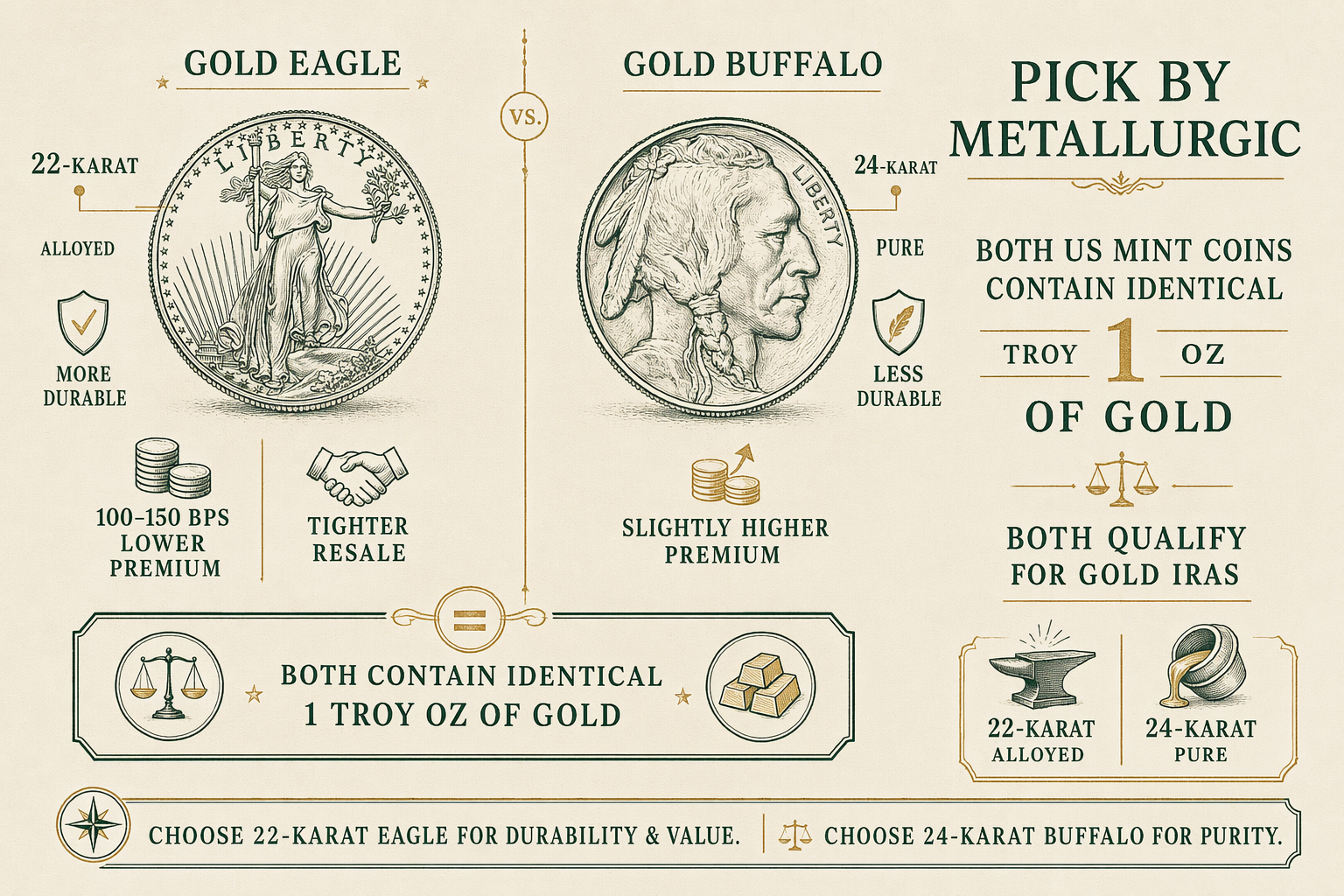
The American Gold Eagle and the American Gold Buffalo are the two flagship US Mint gold bullion coins. Both are produced by the United States Mint, both contain exactly `1 troy oz` of gold, and both are IRS-eligible for Gold IRA holdings. The structural difference is metallurgical: the Gold Eagle is `22-karat` (`91.67%` gold alloyed with copper and silver), while the Gold Buffalo is `24-karat` (`99.99%` pure gold). The metallurgical difference flows through to physical durability, premium over spot, and resale-market characteristics in ways that matter to a long-hold bullion buyer.
This page compares seven objective criteria: fineness and composition, weight and dimensions, premium snapshot on `1 oz`, physical durability, IRA eligibility, resale spread, and editorial considerations. Figures are paraphrased from US Mint specifications and from a snapshot of dealer pricing as of `2026-Q2`. Coin premiums move with market conditions; the snapshot is illustrative.
Fineness and composition
**American Gold Eagle.** `22-karat` (`0.9167` fine), composed of `91.67%` gold, `5.33%` copper, and `3.00%` silver. The `1 oz` coin contains exactly `31.1035 grams` (`1 troy oz`) of actual gold. The alloy adds weight: the total coin weighs approximately `33.93 grams`, and the diameter is `32.7 mm`. The alloy composition follows the historical American gold-coinage tradition that traces back to the pre-`1933` US gold coins, which were also `22-karat` for circulation use.
**American Gold Buffalo.** `24-karat` (`0.9999` fine), composed of `99.99%` gold. The `1 oz` coin contains exactly `31.1035 grams` (`1 troy oz`) of gold and weighs effectively the same `31.1035 grams` (the additional `0.01%` non-gold trace is negligible). The diameter is `32.7 mm` — the same as the Eagle. The Buffalo was first minted in `2006` as the US Mint's response to growing demand for `24-karat` US-Mint bullion to compete with the Canadian Maple Leaf, Austrian Philharmonic, and other `24-karat` sovereign bullion coins.
Net read: both contain identical `1 troy oz` of gold. The difference is whether the gold is alloyed (`22-karat` Eagle) or essentially pure (`24-karat` Buffalo). The actual gold content is the same; the total coin weight differs because of the alloy.

Durability
The metallurgical difference produces real physical-durability consequences. `24-karat` pure gold is a soft metal — Mohs hardness approximately `2.5`-`3.0` — and shows handling marks readily. Pure-gold coins are more prone to fingerprints, scratches, and edge wear from rough handling than their alloyed counterparts.
**The Gold Eagle's `22-karat` alloy** is meaningfully harder than `24-karat` pure gold because the copper-silver alloying adds metallurgical strength. Eagles tolerate handling, storage in non-padded environments, and casual examination better than Buffalos do. Eagles can be stacked, tubed, and shipped without the special handling considerations pure-gold coins require.
**The Gold Buffalo's `24-karat` purity** trades durability for purity. Buffalos require careful handling — typically in capsules or padded tubes — to maintain physical condition. The trade-off matters less for coins stored in an IRS-approved depository (where handling is institutional) than for coins held at home or in a safe-deposit box for direct access.
Net read: for a buyer who plans to take physical possession and handle the coins, the Eagle's durability is a meaningful advantage. For a buyer who plans to leave the coins in a depository for the duration of the holding period, the durability difference is operationally invisible.
IRA eligibility
Both coins are IRS-eligible for Gold IRA holdings under IRC § 408(m)(3), but they qualify under different routes.
**The American Gold Eagle** qualifies under the **named statutory exception** in IRC § 408(m)(3)(A). Congress wrote the Eagle into the statute by name when it created the Gold IRA exception in `1986` (under the American Eagle Bullion Coin Act). The Eagle is permitted in a Gold IRA regardless of fineness — the `22-karat` Eagle does not need to meet the general `99.5%` minimum fineness rule that applies to other gold products because Congress named it specifically.
**The American Gold Buffalo** qualifies under the **general fineness rule** in IRC § 408(m)(3)(B): any gold bullion of `99.5%` fineness or higher, produced by a recognized refiner or sovereign mint, is eligible for an IRA. The Buffalo's `99.99%` fineness clears this requirement easily.
Net read: both coins are equally eligible for a Gold IRA. The eligibility route is different (statutory exception for the Eagle, fineness rule for the Buffalo), but the practical effect is the same — both coins are routinely held inside Gold IRA accounts at all major depositories. The Eagle, the Buffalo, the Canadian Maple Leaf, the Austrian Philharmonic, and the Australian Kangaroo are the five most-cited gold coins in IRA placements.
Resale spread
The resale spread (the buy-side discount from spot at sell-back) follows the same secondary-market depth that drives the ask-side premium.
**Eagles** typically sell back at approximately `0.5%`-`2.0%` under spot at major dealers as of `2026-Q2`. The deep secondary market — the Eagle is the most-traded gold coin in the US — keeps the dealer's resale risk low and the bid-side spread tight.
**Buffalos** typically sell back at approximately `1.0%`-`2.5%` under spot. The thinner secondary market translates into a slightly wider buy-side discount. Over a holding period, the buy-back spread compounds with the higher acquisition premium to make Eagles the cheaper round-trip on a per-coin basis.
For a buy-and-hold investor who never sells, the resale-spread difference is irrelevant. For an investor who may rebalance or exit, the Eagle's tighter round-trip is a small but real cost advantage over the holding period.
Editorial considerations
Two editorial observations. **First**, the `22-karat` vs `24-karat` choice is a true preference question with no universally correct answer. Some buyers specifically want `24-karat` pure-gold coins because the purity carries a tradition of its own (most sovereign-mint gold coins outside the US are `24-karat` — Maple Leaf, Philharmonic, Kangaroo, Britannia post-`2013`). Other buyers specifically want the `22-karat` historical-US-coin tradition that the Eagle represents.
**Second**, the Eagle's lower premium and tighter resale spread make it the financially efficient choice on a per-coin basis. If a buyer is indifferent to the metallurgical question, the Eagle costs less to buy and recovers more on sale. The `1 oz` of gold content is the same; the wrapper around it costs less for the Eagle.
Beyond these two considerations, the choice is largely about preference. Both coins are issued by the US Mint, both carry full sovereign backing, and both are accepted at all major US dealers and at every IRS-approved Gold IRA depository.

Where each may fit
We do not name a universal best. The choice is metallurgical-preference and operational, not financial-by-itself.
**Lean toward the American Gold Eagle if:** you want the lower per-coin premium (approximately `100`-`150 bps` cheaper than the Buffalo on the snapshot reviewed), you plan to take physical possession and want the more durable `22-karat` alloy, or you prefer the historical-US-coin metallurgical tradition.
**Lean toward the American Gold Buffalo if:** you specifically want `24-karat` purity, your other gold holdings are `24-karat` (Maple Leaf, Philharmonic, refiner bars) and you want consistency, or you plan to leave the coins in a Gold IRA depository where the durability question is operationally invisible and the only remaining variable is purity preference.
Both are US Mint issues. Both are IRA-eligible. Both are accepted at all major dealers and depositories. The `1 oz` of gold content is identical; the wrapper around it (the alloy choice) is the question.
_Educational content, not personalized investment advice. BullionLens is not a registered investment adviser. Consult a licensed adviser before making decisions about asset allocation or retirement assets._
Want to talk this through? Book a 30-min research call →
Frequently asked questions
-
Which has higher gold content?
The American Gold Buffalo is 99.99% pure gold. The American Gold Eagle is 91.67% but contains the same 1 oz of actual gold (the Eagle has more total weight due to the alloy). -
Are both IRA-eligible?
Yes. The Buffalo is IRA-eligible under the fineness rule. The Eagle is IRA-eligible under the named statutory exception. -
Is the comparison data current?
We snapshot fees and arrangements quarterly minimum and stamp each comparison with a 'Last reviewed' date. Companies change fees, custodians, and storage partners — verify with the company directly before opening an account. -
What if my situation doesn't match either company's profile?
The comparison is a starting point, not personalized advice. If neither company fits, see /reviews/gold-ira-companies/ for the full list of companies we cover and /editorial-standards/ for our selection criteria.
In plain English We're an editorial desk. Educational only — talk to a licensed adviser before doing anything with retirement assets.