What is the World Gold Council?
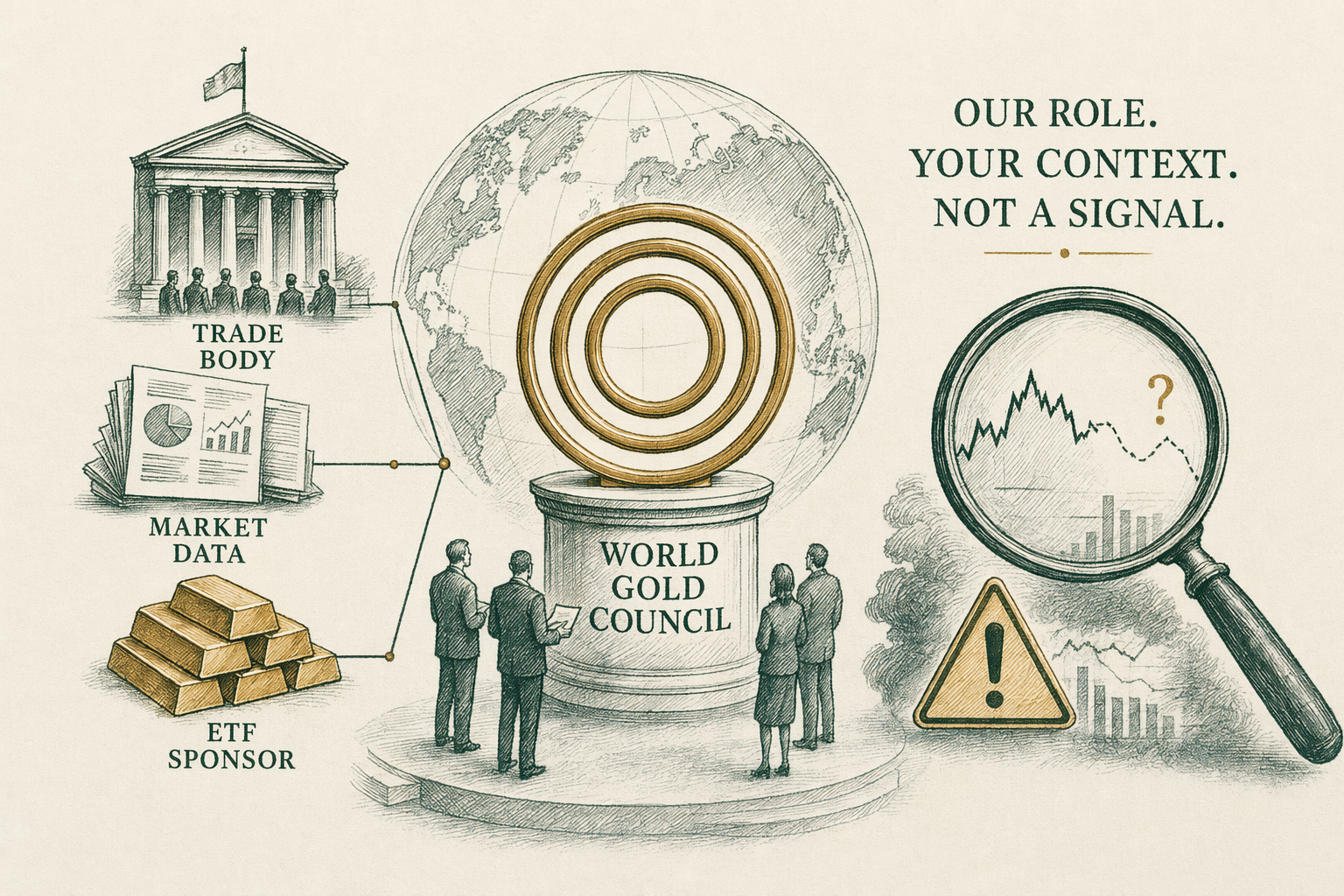
World Gold Council role: industry trade body, market data publisher, ETF sponsor, and the limits of WGC data as a market signal.
Founding and membership
The World Gold Council was founded in 1987 as an industry trade body for the gold mining sector. The organization is headquartered in London with operations in major gold-consuming markets. Membership consists of the major gold mining companies — Newmont, Barrick Gold, AngloGold Ashanti, Gold Fields, Kinross, Newcrest, and similar peers. Membership dues fund the WGC's research, public-relations work, and ETF-sponsorship activities.
The structural role: the WGC promotes gold as an investment, jewelry, technology, and reserve asset. It is not a regulator. It is not a price-fixing body. It has no statutory authority over the gold market. It is, in IRS-classification terms, a trade association funded by an industry seeking to grow demand for that industry's product. Snapshot as of `2026-Q2`.
Annual gold demand reports
The WGC's most-cited publication is its quarterly *Gold Demand Trends* report, supplemented by an annual full-year compilation. The reports aggregate data from Metals Focus (an independent precious-metals research consultancy that supplies the underlying demand-and-supply numbers), the WGC's own internal analysis, and reported central-bank, ETF, and mining-production figures.
Coverage breakdown: jewelry demand (the largest single category historically), bar-and-coin investment demand, ETF flows (inflows and outflows), central-bank net buying or selling, and technology/industrial demand. Supply-side coverage: mine production, recycled gold, and net producer hedging. The reports also include geographic breakdowns — China, India, the United States, Europe, the Middle East, and other major markets each get separate coverage.
The data is useful precisely because it aggregates the demand picture across geographies in a single source. A researcher trying to compile equivalent data independently would need to source from PBOC reserves data, World Federation of Exchanges ETF data, individual central-bank disclosures, Indian jewelry-trade publications, and several others. The WGC does that aggregation work and publishes it on a quarterly schedule.
Central bank reserve survey
The WGC publishes an annual central-bank survey that interviews reserve managers from approximately `60-70` central banks each year, asking about their gold holdings, their plans for accumulation or selling, and their views on gold's role in reserve management. The survey is the standard reference for understanding central-bank sentiment toward gold.
Key findings have been consistent in recent years: a meaningful majority of surveyed central banks plan to increase gold holdings; the most-cited rationales are historical store of value, hedge against systemic risk, no default risk, and effective diversifier. The survey's methodology, sample size, and response rate are documented in each year's publication.
Limitations of the survey: respondents are self-selected and the responses reflect what reserve managers choose to disclose, not a comprehensive view of their actual decision-making. The survey is most useful as a sentiment indicator over time — what is the directional trend in central-bank gold positioning intentions — rather than as a forecast of specific purchase volumes.
Industry-body framing and limits
The WGC is funded by the gold mining industry. Its research is the most comprehensive aggregated data on the global gold market. Both facts are true simultaneously. A careful reader treats WGC data as authoritative on its specific scope (demand aggregation, central-bank survey, ETF flows) while recognizing that the framing of any commentary or forecast reflects the WGC's industry-promotion role.
Practical distinctions: (1) WGC quarterly demand data — cite as authoritative reference, attributing to "per the World Gold Council" rather than as a regulatory figure. (2) WGC central-bank survey — cite as the standard reference on reserve-manager sentiment, attributing to the survey methodology. (3) WGC market commentary and outlook pieces — read with the framing that the WGC's organizational role is gold promotion; the analysis is informed but not neutral.
This is the same caveat that applies to any industry-trade-body publication — the American Petroleum Institute on oil markets, the Aluminum Association on aluminum markets, the International Diamond Manufacturers Association on diamond markets. The data work is valuable; the framing reflects the funder's interests.
Want to talk this through? Book a 30-min research call →
Frequently asked questions
-
Is the World Gold Council a regulator?
No. The WGC is an industry trade body funded by gold mining companies. It publishes market data and research, sponsors SPDR Gold Shares (GLD), and represents the gold industry. -
Is WGC data reliable?
WGC publishes useful aggregated demand and supply data assembled from multiple sources. Like any industry-body data, it should be cited as 'per the World Gold Council' rather than as a regulatory authority. -
Where does BullionLens get its data on this topic?
Primary sources cited in the article. For market data we lean on the LBMA daily fixings, COMEX volume reports, IRS publications, SEC filings, and the World Gold Council's annual reports. We do not cite secondary aggregators as authority. -
When was this page last reviewed?
See the 'Last reviewed' date at the bottom of the page. We commit to a quarterly minimum review cycle; fee schedules, IRS rules, and company arrangements can change between reviews — confirm with primary sources before transacting.
In plain English We're an editorial desk. Educational only — talk to a licensed adviser before doing anything with retirement assets.